

Ahmed Kamel – Egypt Daily News
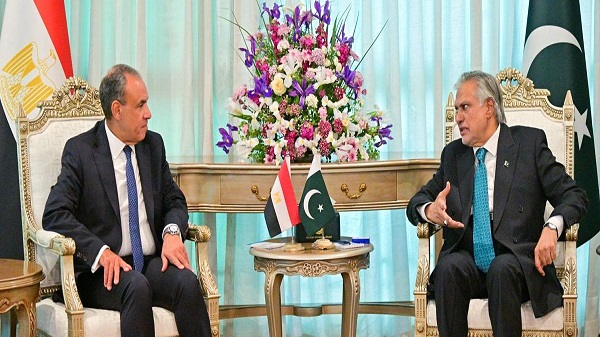
Egyptian Foreign Minister Badr Abdelatty met with Mohammad Ishaq Dar, Pakistan’s deputy prime minister and foreign minister, on Sunday, March 29, 2026, in Islamabad, during Abdelatty’s participation in the quadrilateral ministerial meeting on regional developments and de-escalation efforts.
Tamim Khalaf said that Abdelatty expressed appreciation for the long-standing historic ties between Egypt and Pakistan, highlighting the notable progress in bilateral relations across multiple sectors. He emphasized the importance of maintaining regular institutional mechanisms between the two countries, particularly the joint committee co-chaired by the foreign ministers, and urged its next session to be held promptly to advance mutual interests.
The ministers stressed the importance of enhancing economic and investment cooperation, aiming to expand trade volumes in line with the countries’ potential, especially amid global economic shifts, supply chain disruptions, and fluctuations in energy and commodity markets. Abdelatty underlined the need for developing more integrated approaches to strengthen economic resilience in developing countries.
Abdelatty also highlighted the strategic potential of both nations’ geographic locations as key logistical hubs for global trade. He called for deepening economic and trade connectivity between Egypt’s Suez Canal Economic Zone and Pakistan’s Gwadar Port, exploring opportunities to localize high-value industries within the Suez region, thereby supporting regional supply chains and strategic industry development.
The ministers reviewed Egypt’s recent economic reforms and emphasized activating the joint business council to promote economic engagement and encourage the private sector to play a greater role in bilateral cooperation.
Regional developments in the Middle East were also discussed, focusing on efforts to de-escalate tensions. The ministers highlighted ongoing initiatives within the quadrilateral framework to reduce conflict intensity and support a direct negotiation track between the United States and Iran, aiming to prevent regional instability and mitigate its potential economic fallout.
Abdelatty stressed the need for coordinated regional and international efforts, affirming that diplomatic engagement and de-escalation remain the only viable solutions to the current crisis. Both ministers expressed hope that joint initiatives would lead to a gradual reduction in tensions and a clear path toward ending the conflict.
The meeting concluded with an agreement to continue intensive coordination and consultation to support regional security and stability and to prevent the expansion of conflict in the region.
