

Ahmed Kamel – Egypt Daily News
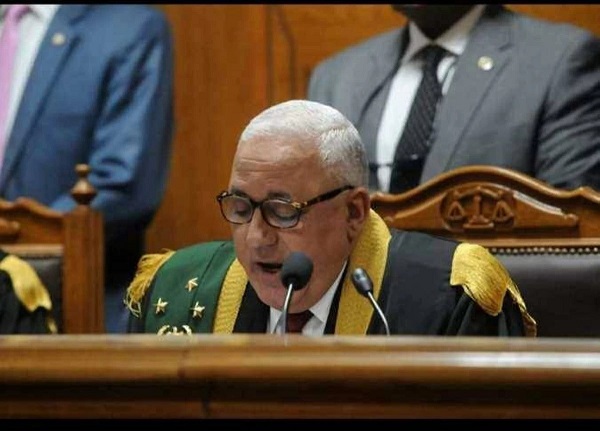
The First Terrorism Chamber of Egypt’s State Security Criminal Court, headed by Judge Mohamed El-Saeed El-Sherebini, has sentenced Mahmoud Ezzat, a senior leader of the Muslim Brotherhood, and 36 others to life imprisonment. In addition, 27 individuals received 15-year sentences, six received 10-year sentences, and three received five-year sentences. One individual was sentenced to one year in prison, with execution of the sentence suspended for three years and a one-year period of police monitoring. Another defendant was sentenced to three years in prison with a corresponding period of monitoring, and one defendant was acquitted.
The court ordered Mahmoud Ezzat and 28 other defendants to pay 7.054 billion Egyptian pounds to the National Telecommunications Regulatory Authority as compensation, in accordance with Article 72 of Law No. 10 of 2003 regulating telecommunications.
Following completion of their sentences, the court placed Ezzat and 44 others under a five-year period of police supervision. It also barred Ibrahim Ali Azzam, the ninth defendant referred for trial, from residing in any border governorates for five years after serving his sentence. Criminal proceedings against Ibrahim Monir and Mahmoud Mohamed were closed due to their deaths, while cases involving Mohamed Badie and Mohamed Khairat El-Shater were not considered further due to previous rulings.
The court further ordered that Mahmoud Ezzat and 73 other members of the Muslim Brotherhood, the so-called “parallel Egyptian parliament,” the Egyptian Revolutionary Council, the Support for Legitimacy Coalition, and the Egyptian Solidarity Association (Rabaa), as well as associated media outlets including Mekameleen, Al-Thawra, Al-Sharq, and Watani TV, be designated as terrorist entities. The court also ordered the dissolution of the organization, the closure of its offices and media channels in Egypt and abroad, and the inclusion of the convicted individuals and entities on Egypt’s official lists of terrorists.
The charges centered on allegations of espionage for foreign states, collaboration with terrorist organizations outside Egypt, funding elements of the Brotherhood, and sharing information deemed harmful to national security.
