

Ahmed Kamel – Egypt Daily News
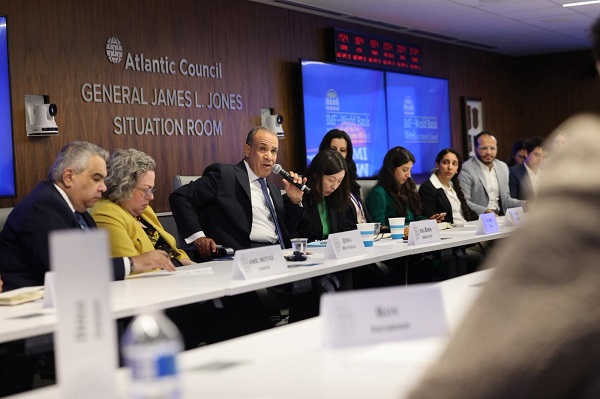
Egypt’s Foreign Minister Badr Abdelatty on Wednesday outlined Cairo’s efforts to promote stability across a turbulent Middle East during a high-level discussion at the Atlantic Council, emphasizing Egypt’s active role in addressing regional crises.
Speaking at a session titled “Egypt in a Turbulent Middle East,” Abdelatty said Egypt continues to pursue de-escalation and political solutions amid what he described as “exceptional regional circumstances,” marked by overlapping conflicts and rising tensions.
Egypt Positions Itself as a Key Regional Stabilizer
Abdelatty highlighted Egypt’s “active and constructive” diplomacy aimed at containing conflicts and restoring calm, stressing that Cairo remains committed to supporting security and stability across the region.
The discussion focused on a range of pressing issues, including the Palestinian cause, ongoing developments in Sudan and Lebanon, and instability in the Horn of Africa. Abdelatty reiterated Egypt’s long-standing positions on these crises, underlining the country’s support for political solutions and respect for state sovereignty.
Focus on Gaza and Regional Flashpoints
Participants engaged in an interactive dialogue with the Egyptian foreign minister, with particular attention given to the war in Gaza and its broader regional implications. Abdelatty reaffirmed Egypt’s stance on the Palestinian issue, presenting it as central to achieving lasting peace in the Middle East.
He also addressed the worsening situations in Sudan and Lebanon, warning of the risks posed by prolonged instability and calling for coordinated international efforts to prevent further escalation.
Strong Emphasis on Egypt–US Strategic Ties
Abdelatty praised ongoing efforts to strengthen the strategic partnership between Egypt and the United States, pointing to growing cooperation in economic, trade, and investment sectors.
He noted a shared interest in expanding US investments in Egypt, alongside deeper collaboration across multiple fields, reflecting what he described as a “mutual commitment” to advancing bilateral relations.
Why It Matters:
Egypt is increasingly positioning itself as a central diplomatic actor in the Middle East, leveraging its ties with global powers and regional stakeholders to manage crises. Cairo’s messaging at influential platforms like the Atlantic Council signals its intent to reinforce both its geopolitical relevance and its role as a mediator in regional conflicts.
