

Ahmed Kamel – Egypt Daily News
President Abdel-Fattah El-Sisi laid out Egypt’s core foreign policy positions during a high-level Arab-European consultative meeting in Cyprus, warning of escalating regional risks and calling for urgent political solutions to ongoing crises across the Middle East.
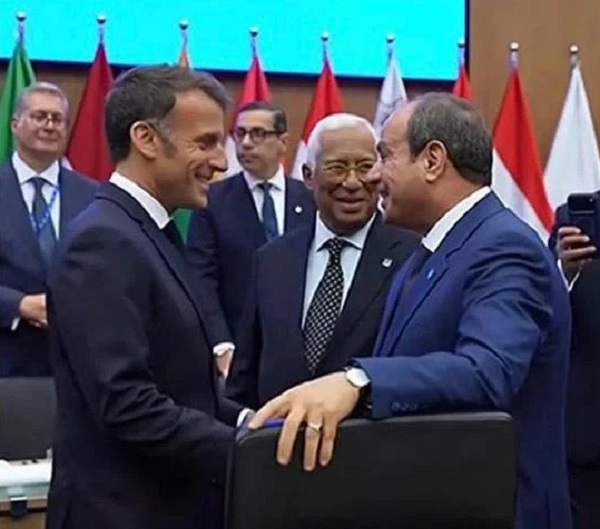
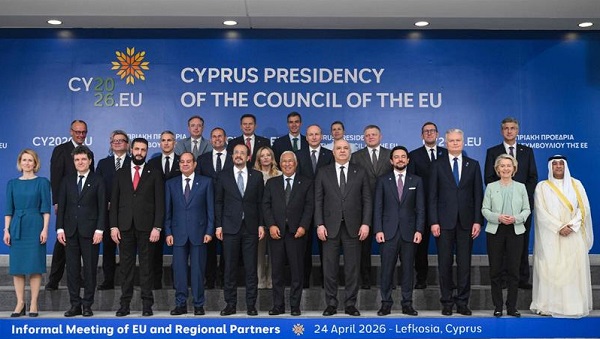
The meeting, held in the Cypriot capital, brought together Arab leaders, European Union officials, and top EU leadership including António Costa, President of the European Council, Ursula von der Leyen, President of the European Commission, and Cypriot President Nikos Christodoulides.
Rising tensions and shared risks
In his address, President El-Sisi emphasized that the Middle East is facing “waves of crises and conflicts” whose consequences extend far beyond the region.
“The crises in our region do not stop at its borders,” he said, warning that instability is directly impacting Europe, particularly in energy markets, food security, and global supply chains.
He pointed specifically to the Iranian crisis, describing it as a major destabilizing force with the potential to disrupt maritime navigation and even pose environmental and nuclear risks.
Firm stance on Iran and regional security
President El-Sisi strongly condemned recent Iranian attacks targeting Gulf states, Jordan, and Iraq, calling them “unacceptable under any circumstances.”
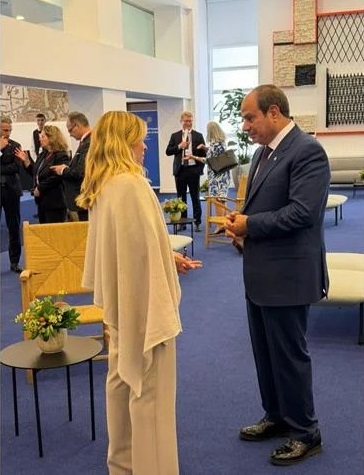
He reaffirmed that Egypt considers the security of Arab nations an integral part of its own national security, signaling Cairo’s continued alignment with regional allies amid escalating tensions.
Political solutions ‘not optional’
A central theme of President El-Sisi’s speech was the rejection of military escalation in favor of diplomacy.
He stressed that:
- Political solutions are the only viable path to long-term stability
- Freedom of navigation must be protected under international law
- A Middle East free of weapons of mass destruction remains a critical goal
“Resolving conflicts through peaceful means has become a necessity, not an option,” he said.
Palestinian cause remains ‘central issue’
President El-Sisi reaffirmed Egypt’s longstanding position that the Palestinian cause remains the core issue in the region.
He warned against any actions that could undermine the two-state solution and outlined key priorities:
- Preventing displacement of Palestinians from their land
- Halting settlement expansion
- Supporting governance in Gaza through a Palestinian national committee
- Deploying an international force to monitor ceasefire efforts
- Accelerating reconstruction in Gaza
He also urged the European Union to maintain its support for the establishment of an independent Palestinian state based on 1967 borders, with East Jerusalem as its capital.
Lebanon and Sudan also in focus
Beyond Gaza, President El-Sisi highlighted other regional flashpoints:
- Lebanon: Called for preserving the ceasefire and strengthening state institutions
- Sudan: Reaffirmed support for national sovereignty and rejected parallel political entities
He stressed the importance of international backing for both countries to prevent further instability.
Egypt-EU partnership expands
Turning to relations with Europe, President El-Sisi underscored the growing strategic partnership between Egypt and the EU, which was elevated in 2024 and reinforced by a summit in 2025.
He outlined key areas of cooperation:
- Economic integration into global supply chains
- Industrial development to position Egypt as a manufacturing hub
- Migration management, including tackling root causes and expanding legal pathways
- Human development, with a focus on education and technology
President El-Sisi noted that Egypt currently hosts around 10 million migrants, highlighting the country’s role as a major regional stabilizer despite limited international support.
Call for deeper cooperation
In closing, President El-Sisi warned against isolationist approaches, urging stronger cooperation between Arab and European partners.
“It has become clear that isolation is not the path to stability,” he said. “The correct path is dialogue, shared responsibility, and joint visions for the future.”
