

Ahmed Kamel – Egypt Daily News
A fragile pause in fighting between Israel and Lebanon has been extended for another 45 days after high-level negotiations in Washington, offering a temporary diplomatic breakthrough as violence continues to rage along the border.
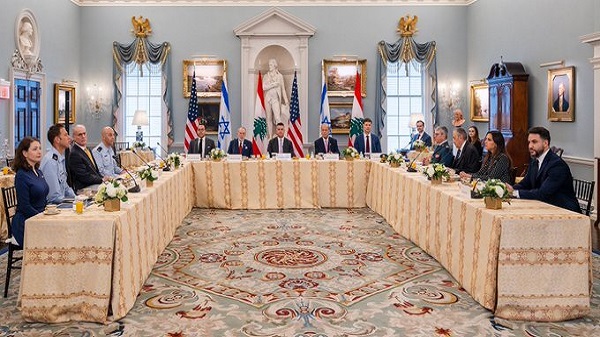
The agreement, confirmed by the United States Department of State, follows two days of talks aimed at preventing the confrontation between Israel and Hezbollah from exploding into an even wider regional conflict.
American officials described the extension as an attempt to create space for broader negotiations focused on long-term border security and political stability between the two neighboring states.
State Department spokesman Tommy Pigott said Washington hoped the renewed truce could eventually lead to “lasting peace” and stronger guarantees respecting the sovereignty of both countries.
The ceasefire was initially brokered in April by Donald Trump, but the deal has struggled to hold. Despite the agreement, Israeli air strikes and Hezbollah rocket attacks have continued almost daily across southern Lebanon and northern Israel.
Only hours before the extension was announced, Lebanon’s health ministry accused Israel of carrying out deadly strikes in the south that killed 22 people, including children. Lebanese officials said residential areas and emergency responders had come under attack, while Israel insisted its operations were targeting Hezbollah infrastructure and fighters.
The Israeli military has intensified operations in southern Lebanon in recent days, arguing that it needs to establish a security buffer zone to prevent future cross-border attacks.
Entire communities near the border have been heavily damaged or reduced to rubble after months of bombardment, deepening fears that the conflict is beginning to resemble the widespread destruction seen in Gaza.
Human rights organizations have accused Israel of using excessive force in some attacks, allegations Israeli officials strongly reject.
At the same time, Hezbollah has maintained pressure on Israeli forces through repeated rocket launches and drone strikes targeting military positions and towns in northern Israel.
The fighting has devastated large parts of southern Lebanon, considered the political and military heartland of Hezbollah and home to much of Lebanon’s Shia population.
According to Lebanese authorities, more than one million people have fled their homes since the conflict erupted earlier this year, creating one of the country’s worst displacement crises in decades.
The war began in March after tensions across the Middle East dramatically escalated following a joint U.S.-Israeli military operation against Iran. Hezbollah quickly entered the confrontation by launching rockets toward Israeli territory, prompting Israel to respond with extensive air raids and a ground offensive inside Lebanon.
Since then, Lebanon says nearly 2,900 people have been killed, while Israeli authorities report the deaths of 18 soldiers and four civilians.
Diplomatic efforts are now expected to continue on parallel political and military tracks.
Washington announced that political negotiations between Israel and Lebanon would resume in June, while military representatives from both countries are scheduled to hold separate security discussions at the Pentagon later this month.
Israeli Ambassador Yechiel Leiter described the Washington meetings as productive, while Lebanese Prime Minister Nawaf Salam said Beirut would work to secure broader Arab and international backing ahead of future negotiations.
Despite the diplomatic movement, the continued exchange of fire highlights how unstable the ceasefire remains. With tensions still high and both sides continuing military operations, fears persist that the border conflict could rapidly spiral back into full-scale war.
