

Ahmed Kamel – Egypt Daily News
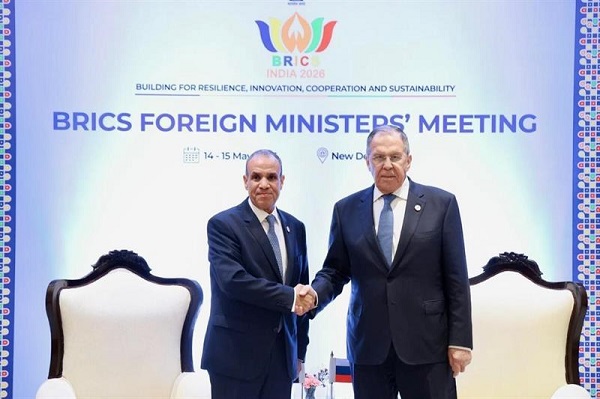
Badr Abdelatty and Sergey Lavrov held high-level talks in New Delhi on Thursday, reaffirming the growing strategic partnership between Egypt and Russia while discussing regional crises stretching from Gaza and Sudan to Iran and Libya.
The meeting took place on the sidelines of the BRICS foreign ministers summit held in the Indian capital, where both sides emphasized closer coordination inside the expanding economic bloc amid mounting geopolitical tensions and global economic uncertainty.
According to Egypt’s foreign ministry, Abdelatty stressed the urgent need for reforms to the international financial system, calling for a stronger role for the BRICS-backed New Development Bank in supporting developing economies struggling under global financial pressures.
The talks quickly expanded beyond economics into some of the Middle East’s most volatile crises.
On Iran, Abdelatty outlined Cairo’s efforts to reduce regional tensions and prevent further escalation, emphasizing the importance of maintaining diplomatic engagement between Washington and Tehran despite rising instability across the region.
Both Cairo and Moscow stressed the need for a peaceful political settlement that safeguards the interests of countries throughout the Middle East while avoiding a broader regional confrontation.
The Gaza war also featured prominently during the discussions.
The Egyptian foreign minister reiterated the importance of moving forward with the second phase of U.S. President Donald Trump’s proposed framework related to Gaza, while stressing the urgent need for unrestricted humanitarian, medical and relief aid to enter the devastated enclave.
Abdelatty also highlighted the importance of beginning reconstruction and early recovery operations in Gaza, describing them as essential steps toward restoring governance structures and advancing a comprehensive political solution to the Palestinian issue.
Sudan’s ongoing conflict was another major topic during the meeting, with Egypt reaffirming its firm support for Sudan’s unity and territorial integrity.
Abdelatty rejected the formation of parallel political entities inside Sudan and emphasized the need for an inclusive Sudanese-led political process capable of preserving the country’s national institutions and preventing deeper fragmentation.
On neighboring Libya, Cairo once again voiced support for national unity and political stability, urging the unification of Libyan institutions and the organization of simultaneous presidential and parliamentary elections aimed at ending years of division.
The two ministers also discussed developments in the Horn of Africa, where Egypt reiterated its support for Somalia’s stability and emphasized that Red Sea security should remain the responsibility of the region’s coastal states.
Beyond regional politics, the meeting underscored the expanding economic relationship between Cairo and Moscow.
Abdelatty praised ongoing cooperation on several major joint projects, including the Russian Industrial Zone inside the Suez Canal Economic Zone and the strategically important El-Dabaa Nuclear Power Plant project.
The Egyptian foreign minister called for faster implementation of these initiatives while encouraging additional Russian investment in key sectors of the Egyptian economy.
He also pointed to Egypt’s broader efforts to improve its investment environment through legislative and institutional reforms designed to strengthen private sector participation.
Food security cooperation emerged as another central issue during the talks.
Abdelatty praised the strong partnership with Russia in grain imports and revealed that Egypt is studying plans to establish a grain logistics hub in cooperation with Moscow, a move that could further strengthen Egypt’s role as a regional trade and distribution center.
For his part, Lavrov expressed Moscow’s appreciation for the growing level of cooperation with Cairo and stressed the importance of maintaining close consultation on regional and international issues of mutual concern.
The meeting highlighted how Egypt and Russia continue to deepen coordination not only within BRICS, but also across a rapidly changing geopolitical landscape where economic alliances and regional security have become increasingly intertwined.
