

Ahmed Kamel – Egypt Daily News
Egypt and the United Arab Emirates have renewed a bilateral currency swap agreement valued at AED 5 billion, equivalent to approximately EGP 69 billion, for a further five years, reinforcing financial cooperation between the two Arab economies.
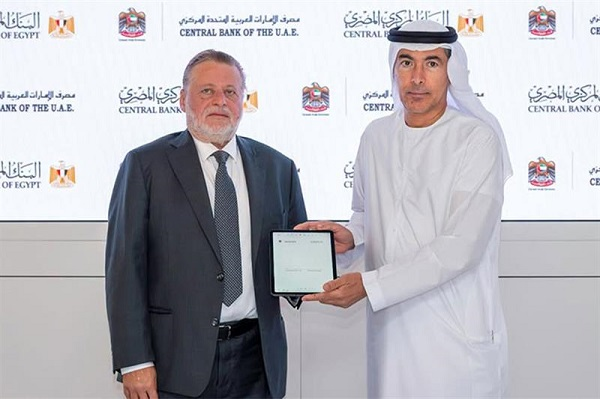
The agreement was signed at the headquarters of the Central Bank of the UAE by its governor, Khaled Mohamed Balama, and Central Bank of Egypt Governor Hassan Abdalla. The arrangement is intended to support trade and investment, strengthen financial stability and encourage the use of the Egyptian pound and UAE dirham in bilateral transactions.
The renewal extends a framework first established in September 2023, when the two central banks agreed to exchange up to AED 5 billion and EGP 42 billion. At the time, the facility was valued at roughly $1.4 billion and was presented as a mechanism for improving financial cooperation and supporting liquidity between the two countries.
Under a currency swap arrangement, central banks exchange their currencies for a specified period and under agreed terms. Such facilities can give financial institutions access to foreign currency liquidity, reduce pressure on foreign-exchange markets and make it easier for companies to settle cross-border transactions without relying exclusively on the US dollar.
The renewed agreement comes as Egypt continues to pursue measures aimed at improving foreign-currency liquidity and strengthening confidence in its financial system. The country has faced sustained pressure from high external financing requirements, rising import costs and disruptions to important sources of foreign exchange. The International Monetary Fund has repeatedly emphasized the importance of a flexible exchange-rate system for Egypt, arguing that a heavily managed pound had contributed to foreign-currency shortages, market imbalances and abrupt devaluations.
In a statement, the Central Bank of the UAE said the renewal reflected the depth of strategic ties between the two countries and their shared commitment to expanding financial and banking cooperation. Balama said the agreement would support financial stability and facilitate trade and investment, while also contributing to efforts to increase the use of national currencies in bilateral settlements.
Abdalla said the renewal demonstrated the continuation of close cooperation between Egypt and the UAE. He described the swap line as an instrument that could promote local-currency transactions for commercial and financial settlements and strengthen the resilience of financial markets in both countries.
The arrangement could be particularly significant for Egypt because the UAE is one of its most important Arab economic partners. Emirati capital has played a major role in Egypt through investments in real estate, infrastructure, financial services, energy, logistics and other sectors. The two countries also maintain extensive trade relations under the framework of the Greater Arab Free Trade Area.
The swap agreement is separate from direct investment and does not itself represent a grant or a new investment commitment. Instead, it provides a financial channel through which the two central banks can exchange currencies under predetermined conditions. Its practical effect will depend on how the facility is activated, the terms of individual transactions and demand from banks and companies engaged in bilateral trade.
For Egyptian importers, the availability of dirham liquidity could help facilitate payments for goods and services sourced from the UAE. It could also reduce the need for some transactions to be converted through the dollar, potentially lowering settlement costs and limiting exposure to fluctuations in global dollar markets.
For the UAE, the arrangement supports the broader objective of deepening economic ties with Egypt and expanding the role of national currencies in regional trade. Local-currency settlement mechanisms have gained greater attention across emerging markets as governments seek to reduce transaction costs, diversify payment channels and limit vulnerability to external currency shortages.
The original swap agreement was announced during a difficult period for Egypt’s economy. In 2023, the country was dealing with a severe shortage of foreign currency, multiple devaluations of the Egyptian pound and elevated inflation. External pressures had intensified after the economic consequences of the Russia-Ukraine war increased the cost of food, fuel and other imports. At the time, analysts described the UAE-Egypt facility as part of a wider effort to provide Egypt with additional foreign-exchange options. Business Insider1
The two countries also expanded their economic cooperation through the development of Ras El-Hekma on Egypt’s Mediterranean coast. The project, announced in 2024, involved a major UAE-backed investment and was widely viewed as a source of foreign currency that could ease Egypt’s external financing pressures. The agreement helped underline the UAE’s role as one of Egypt’s most important strategic investment partners.
The renewed currency swap is therefore part of a broader relationship that combines central-bank cooperation, investment projects, trade agreements and financial-sector partnerships. It also reflects the two governments’ efforts to build mechanisms capable of supporting economic activity during periods of market volatility.
However, the swap line is not a substitute for broader economic reforms. Egypt’s long-term financial stability will continue to depend on its ability to improve exports, attract sustainable investment, manage public debt, strengthen domestic production and maintain access to foreign currency. The IMF has also stressed the importance of fiscal reforms, exchange-rate flexibility and policies that protect vulnerable households while restoring macroeconomic stability.
The central banks said they would continue working to expand financial and banking cooperation. They also reaffirmed their commitment to supporting economic growth, strengthening market resilience and encouraging greater use of local currencies in trade and investment between Egypt and the UAE.
With the agreement now renewed for five years, the facility is expected to remain an important component of bilateral financial cooperation. Its significance will ultimately be measured not only by the amount available for exchange, but also by whether it helps increase trade, improve payment efficiency and create additional room for businesses and financial institutions to operate across the two markets.
