

Ahmed Kamel – Egypt Daily News
Israeli Prime Minister Benjamin Netanyahu said Thursday that he has ordered the Israeli military to expand its control over Gaza to 70% of the territory, signaling a major escalation that threatens to further undermine the already fragile ceasefire with Hamas.
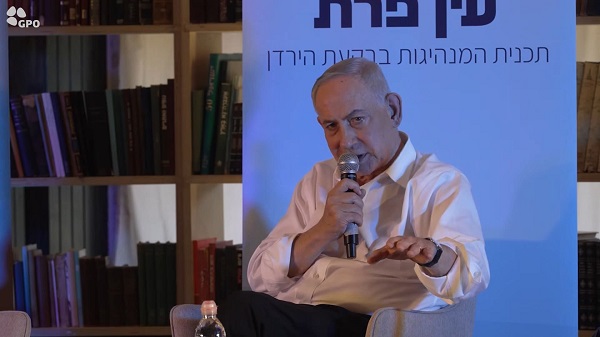
Speaking during a conference in the occupied West Bank, Netanyahu said Israeli forces are steadily increasing their presence across the besieged enclave as part of what he described as a campaign to tighten pressure on Hamas.
“We are now in 60% of the territory of the Gaza Strip. We were at 50%. We moved to 60%,” Netanyahu said. “My directive is to move to take it step by step first of all 70. Let’s start with that.” Audience members at the event responded by urging the Israeli leader to seize all of Gaza, reflecting growing pressure from Israel’s far-right factions for a permanent military occupation of the enclave.
The remarks come as concerns intensify that the US-brokered ceasefire agreement between Israel and Hamas is steadily collapsing on the ground despite remaining officially in effect. Under the ceasefire deal reached in October 2025, Israeli forces had withdrawn to a demarcation boundary known as the “yellow line,” leaving Israel in control of roughly 53% of Gaza’s territory.
But Israeli military maps circulated to international aid organizations in late April reportedly showed Israeli forces already controlling around 64% of the enclave, suggesting the military footprint has continued expanding despite ongoing negotiations.
Any further territorial seizure would compress Gaza’s roughly two million Palestinians into an even smaller section of the devastated coastal strip, worsening an already catastrophic humanitarian crisis marked by mass displacement, destroyed infrastructure and severe shortages of food, water and medical supplies.
Earlier this week, Hamas accused Israel of effectively redrawing the ceasefire boundary by force.
The Palestinian movement said Israel’s actions amount to “an explicit and ongoing undermining of the ceasefire agreement” and accused Tel Aviv of attempting to impose “new facts on the ground” aimed at entrenching long-term military control over Gaza.
International mediators have increasingly warned that the ceasefire framework is at risk of disintegrating entirely.
Nickolay Mladenov, the Bulgarian diplomat overseeing implementation of the agreement, warned earlier this month that the temporary separation line inside Gaza could become permanent if negotiations continue to stall.
“The yellow line could turn into a fence or wall,” Mladenov warned, describing the possibility of a lasting partition of Gaza. He also acknowledged that despite the ceasefire, civilians in Gaza continue to face deadly violence and constant fear from ongoing Israeli military operations.
Israel has repeatedly launched airstrikes and special operations inside Gaza since the truce took effect, accusing Hamas of rebuilding military infrastructure and rearming during the pause in major fighting.
According to the Palestinian Ministry of Public Health, more than 850 people have been killed in Gaza since the ceasefire officially began. Earlier this month, Israel announced the assassination of Izz al-Din al-Haddad, the head of Hamas’ military wing. Israeli forces later carried out another strike targeting his successor less than two weeks afterward.
Israeli Defense Minister Israel Katz vowed Thursday that Israel would continue hunting Hamas leaders wherever they are located. “We vowed to eliminate everyone who led the October 7 massacre, and that is what will be done,” Katz said. “They are all condemned to death everywhere.”
A central obstacle in negotiations remains Hamas’ refusal to fully disarm, a key condition demanded by Israel and backed by the United States under the ceasefire framework.
The agreement envisions a gradual Israeli withdrawal from Gaza once Hamas dismantles its military infrastructure and an international security force deploys across parts of the enclave. Although several countries have expressed willingness to contribute troops to such a force, no deployment timetable has been finalized, leaving a dangerous vacuum as Israel steadily expands territorial control.
With diplomacy stalled and military operations continuing, fears are growing that temporary wartime divisions inside Gaza may evolve into a long-term occupation and permanent fragmentation of the Palestinian territory.
