

Ahmed Kamel – Egypt Daily News
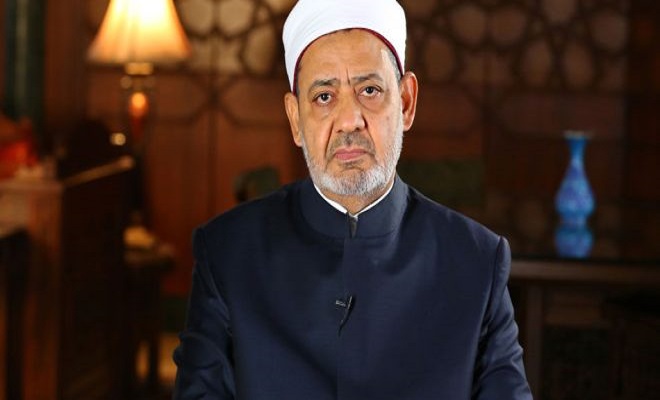
At the “World Meeting for Peace” organized by the Sant’Egidio Community in Rome, Grand Imam of Al-Azhar and Chairman of the Muslim Council of Elders, Dr. Ahmed Al-Tayeb, delivered a powerful call for justice, peace, and moral responsibility amid growing global crises. The international gathering attended by Italy’s President Sergio Mattarella, Belgium’s Queen Mathilde, and leading religious figures and thinkers from around the world, focused on the theme “Finding the Courage to Achieve Peace.”
In his keynote address, Sheikh Al-Tayeb stressed that peace in the Middle East is impossible without justice for the Palestinian people and the establishment of an independent Palestinian state with Jerusalem as its capital. “The international community today is united in recognizing that the two-state solution is the only viable path to peace in the region and the world,” he said. “There can be no peace in the Middle East without the establishment of a Palestinian state.”
He expressed his deep appreciation for the countries that recently recognized the State of Palestine at the United Nations, describing their move as “a manifestation of human conscience awakening to the truth.” “I salute these nations for their courage,” he said, “and I hope this recognition will be a practical step toward enabling the Palestinian people to obtain their legitimate rights.”
A Moral Call for Justice and Conscience
The Grand Imam devoted much of his speech to reflecting on the erosion of moral and humanitarian values in the modern world. He argued that the absence of true justice has plunged humanity into wars, poverty, and inequality. “Absolute justice is the golden rule upon which the heavens and the earth were established,” he said, adding that when contemporary civilization neglects this principle, “it creates senseless wars imposed on defenseless nations and spreads famine, unemployment, and environmental destruction.”
He condemned what he called “the hypocrisy of modern power structures,” where aggression and domination are often justified under the guise of international order. “We live in a world where oppression is dressed as law, and the arrogance of power dictates the fate of the weak in the name of global systems,” Al-Tayeb said. “Such a world cannot know peace or dignity.”
He paid tribute to “the free voices of the world men, women, and children whose consciences were shaken by the massacres in Gaza that have bled the heart of humanity and darkened the pages of modern history.”
“No Peace Without Justice, No Justice Under the Rule of Arms”
Al-Tayeb criticized what he described as the “moral collapse” of the international order, saying that global peace has become hostage to military might and the interests of the arms industry. “What we witness today is not peace built on justice, but a world order sustained by force and greed,” he warned. “When peace becomes dependent on weapons and wars, humanity loses its moral compass.”
He argued that the double standards of global politics applying “a hundred different measures” depending on power and influence, have eroded trust in international law and institutions. “This sickness that has infected global justice cannot be understood except as a symptom of racism, arrogance, and the abandonment of conscience,” he said, invoking philosophical traditions from Plato and Aristotle to Al-Farabi, Ibn Rushd, and modern European thinkers who upheld moral duty as a universal human law.
Faith, Ethics, and Artificial Intelligence
Turning to contemporary challenges, the Grand Imam addressed the moral implications of emerging technologies, particularly artificial intelligence. He revealed that Al-Azhar, the Muslim Council of Elders, and the Vatican are jointly working on a Global Charter for the Ethics of Artificial Intelligence, a project he began with the late Pope Francis before the pontiff’s illness and passing delayed its completion.
“Artificial intelligence is now one of the most powerful forces shaping our societies,” Al-Tayeb said. “We must ensure it serves humanity and justice, not domination and exploitation. Protecting our spiritual and moral values in this new technological era is not optional it is an ethical and human duty.”
The Grand Imam emphasized that religion and ethics must work hand in hand to guide human progress. “The world is in desperate need of justice to restore its peace, and of a living conscience that realizes every injustice inflicted upon a single person is a wound in the body of all humanity,” he said. “Civilization collapses not when systems fail, but when morals and compassion vanish.”
A Final Appeal for Global Conscience
Concluding his address, Sheikh Al-Tayeb warned that the separation of morality from faith has led to today’s global corruption and moral decay. “When faith no longer guides ethics, morality becomes fragile an instrument of conflict, greed, and the crushing of the poor and the weak,” he said.
Reiterating his central message, the Grand Imam declared, “When justice disappears, oppression takes its place; values vanish, and humanity itself is lost beneath the weight of material greed and false power. The sun of truth has set, and the world is falling into a moral void that threatens the collapse of its systems before the collapse of its values.”
At a time of deep global division, Sheikh Al-Tayeb’s address stood as both a spiritual rebuke of modern injustice and a renewed call for moral courage urging world leaders to rebuild peace on the foundation of justice, equality, and the unshakable dignity of every human being.
