

Ahmed Kamel – Egypt Daily News
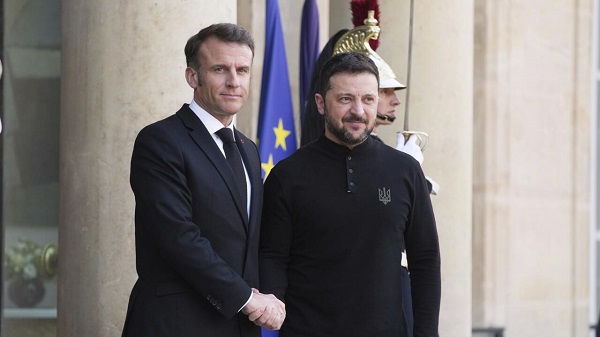
Ukrainian President Volodymyr Zelenskyy expressed cautious optimism on Monday regarding ongoing revisions to the U.S.-led peace proposal aimed at ending Russia’s nearly four-year war in Ukraine, saying the plan “looks better” but remains a work in progress. His comments came after talks in Paris with French President Emmanuel Macron, the latest stop in a rapid series of diplomatic consultations among Kyiv, Western allies, and Washington.
Zelenskyy said that negotiations are still in flux, stressing that Ukraine’s sovereignty over its territory remains “the most complicated” aspect of the discussions. “It’s a process, it’s not over yet,” he noted, signaling that Kyiv continues to press for terms that safeguard its territorial integrity and long-term security.
Macron echoed that assessment, describing the discussions as being in a “preliminary phase” but noting that the current momentum could represent “a turning point” for peace in Europe. The French leader emphasized that any final agreement must be shaped collectively with European partners at the table, not negotiated solely between Washington and Moscow.
The renewed diplomatic activity comes as the Trump administration revises its original 28-point framework, which drew criticism for proposals that would have restricted Ukraine’s military development, blocked NATO membership, and required territorial concessions to Russia. Trump has since downplayed the document, calling it a “concept” that is still being refined.
The meeting in Paris followed weekend talks between Ukrainian and U.S. officials. Secretary of State Marco Rubio described those discussions as productive, acknowledging that several provisions had been reworked to address Ukrainian and European objections.
Meanwhile, in Moscow, Kremlin spokesperson Dmitry Peskov confirmed that President Vladimir Putin will meet on Tuesday with U.S. special envoy Steve Witkoff, whose role drew scrutiny last week after reports that he advised Putin’s foreign policy team on how to present the plan to Trump. Macron’s office later said that both he and Zelenskyy held calls with Witkoff as part of the ongoing diplomatic coordination.
European apprehension remains high. EU foreign policy chief Kaja Kallas warned that the bilateral U.S.-Russia talks risk placing undue pressure on Ukraine to yield territory. “I’m afraid that all the pressure will be put on the victim,” she said in Brussels after a meeting of EU foreign and defense ministers.
Macron has urged Western allies to prepare “rock-solid” security guarantees for Ukraine should a ceasefire or peace agreement emerge. He has backed the idea of deploying a multinational “reassurance force” on land, at sea, and in the air to bolster Ukraine’s defenses. According to the Élysée, Macron and Zelenskyy also held discussions with leaders from Germany, Britain, Poland, Italy, the Netherlands, Norway, Denmark, Finland, as well as EU and NATO officials.
Escalation on the Battlefield
Even as diplomatic channels intensified, the conflict on the ground saw significant escalation. Russia accused Ukraine of launching strikes over the weekend against critical energy infrastructure, including an attack on a major oil terminal operated by the Caspian Pipeline Consortium near Novorossiysk. The strike, carried out by Ukrainian naval drones, damaged one of the terminal’s three mooring points and temporarily halted operations. A day earlier, similar drone attacks targeted two oil tankers in Turkish waters that Russia allegedly uses to circumvent sanctions.
Peskov condemned the strikes as “outrageous,” stressing that the CPC terminal constitutes “an international facility.” Russia’s Ministry of Defense reported that it intercepted 32 Ukrainian drones overnight across 11 regions and over the Sea of Azov.
In the Russian republic of Dagestan, officials said a Ukrainian strike damaged an apartment building in the coastal city of Kaspiysk more than 1,000 kilometers from the front line, illustrating Kyiv’s growing ability to hit deep inside Russian territory.
Ukraine, meanwhile, faced another deadly attack on Monday. A Russian missile strike on the city of Dnipro killed four people and wounded 40 others, including 11 in critical condition, according to regional authorities. The midday strike damaged residential towers, a local educational institution, and the warehouse of a humanitarian organization. Search and rescue efforts were ongoing late into the day.
Ukraine’s Air Force said Russia had launched 89 drones overnight prior to the Dnipro strike, of which 63 were shot down or electronically jammed. According to its monthly report, Russia fired 100 missiles and nearly 9,600 reconnaissance and strike drones at Ukraine throughout November, highlighting the relentless pace of the air campaign even as diplomatic talks intensify.
