

Ahmed Kamel – Egypt Daily News
A behind-the-scenes consolidation is underway inside the Republican Party, with Vice President JD Vance increasingly emerging as the favored heir apparent to Donald Trump, even as public polling suggests the 2028 presidential field remains far from settled.
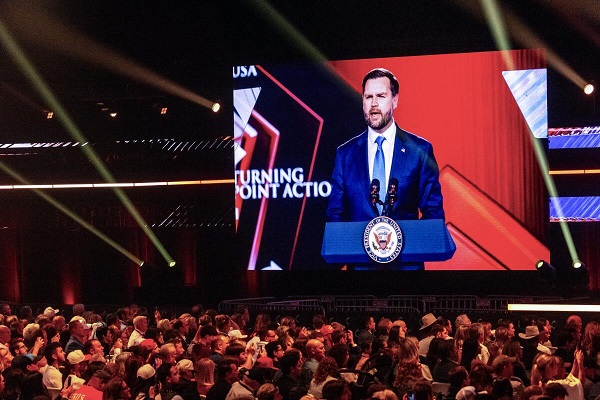
Key conservative organizations and influential figures in Trump’s orbit are beginning to coalesce around Vance, signaling an effort to avoid a bruising and divisive Republican primary once Trump leaves office. Among the most notable developments is the growing role of Turning Point USA, the powerful conservative youth organization founded by the late Charlie Kirk, which is now mobilizing to lay early groundwork for a Vance presidential run.
Turning Point USA plans to deploy representatives across all 99 counties in Iowa in the coming months, according to insiders familiar with the strategy. The aim is to build an organizational and grassroots infrastructure that could give Vance an early and decisive advantage in the first-in-the-nation caucus state, potentially deterring other serious contenders from entering the race.
The move reflects a broader effort among Trump allies to quietly clear the field. Earlier this month, Secretary of State Marco Rubio, once viewed as a possible 2028 contender and occasionally floated by Trump himself, effectively ruled out a run. “If Vance runs for president, he’s going to be our nominee, and I’ll be one of the first people to support him,” Rubio told Vanity Fair.
At Turning Point USA’s annual conference in Arizona last week, Kirk’s widow, Erika Kirk, endorsed Vance from the stage. A straw poll of conference attendees found that 84% said they would back the vice president in the Republican primaries, underscoring his strong support among the party’s activist base.
Polling, however, paints a more nuanced picture. A CNN survey conducted in early December showed Vance leading potential Republican contenders with 22% support, while figures such as Rubio and Florida Governor Ron DeSantis lagged in the single digits. Yet a striking 64% of respondents said they had no specific candidate in mind, suggesting that the race remains wide open and that name recognition and institutional backing have not yet translated into broad voter commitment.
Vance’s standing also varies sharply depending on the audience. A recent Gallup poll found that 91% of Republicans approve of his performance as vice president, a strong foundation for a primary campaign. But only 39% of Americans overall view him favorably, highlighting the challenge he could face in a general election should he secure the nomination.
Calls for Unity and Controversy
Closing the Turning Point USA conference, Vance urged party unity amid growing infighting among right-wing influencers over racism, antisemitism, and the boundaries of acceptable rhetoric within Republican politics.
“President Trump did not build the greatest coalition in politics by running his supporters through endless, self-defeating purity tests,” Vance said. “Every American is invited.”
He invoked Charlie Kirk’s legacy, saying Kirk trusted supporters to make their own judgments and warning that internal “canceling” distracts from more pressing political goals. The remarks drew criticism from some on the right, who argued that Vance appeared to downplay or tolerate bigotry within the movement.
The issue is personal for the vice president. He and his family have been the targets of racist attacks from Nick Fuentes, a far-right podcaster who has praised Adolf Hitler and repeatedly directed abuse at Vance’s wife and children over their Indian heritage. In a recent interview, Vance responded bluntly, saying anyone who attacks his wife “can eat s,” adding that this was his “official policy as vice president.”
In the same interview, Vance described Tucker Carlson who has defended Fuentes on free speech grounds as a friend, noting Carlson’s early support for Vance as Trump’s vice-presidential pick in 2024.
Trump, Succession, and the Third-Term Debate
Trump himself has repeatedly praised Vance as a potential successor without formally endorsing him. He has called the vice president “very capable” and suggested he would be “probably favored” in a future GOP race.
Despite this, some of Trump’s most ardent supporters continue to push the idea of a third presidential term in 2028, even though the 22nd Amendment to the Constitution bars it. Trump has publicly acknowledged that the constitutional language appears clear, and those closest to him say he understands the limits.
“He knows he can’t run again,” White House Chief of Staff Susie Wiles told Vanity Fair, describing the matter as “pretty unequivocal.” Trump, who would be 82 when he leaves office, has acknowledged this reality multiple times in private conversations, she said.
Not everyone in Trump’s circle agrees. Steve Bannon, a key architect of Trump’s 2016 campaign, continues to argue that a path to a third term could exist, while reportedly dismissing Vance as “not tough enough” to carry the movement forward.
Even prominent constitutional lawyer Alan Dershowitz, who recently presented Trump with a theoretical roadmap for a third term during an Oval Office meeting and plans to publish it in an upcoming book, said he does not believe Trump will pursue another run. “That is my conclusion based on what he has said in public,” Dershowitz told The Times, adding that Trump himself has suggested the idea is “too cute.”
An Open Field, for Now
With the 2026 midterm elections looming, potential candidates in both parties are expected to quietly assess their prospects over the next year before making any formal moves. While JD Vance appears to be consolidating institutional and activist support early, the large share of undecided Republican voters suggests the party’s post-Trump future is not yet fully written.
For now, the Republican establishment and much of Trump’s inner circle seem inclined toward an orderly succession. Whether that early alignment translates into inevitability or sparks resistance from rival factions, will likely define the next chapter of GOP politics.
