

Ahmed Kamel – Egypt Daily News
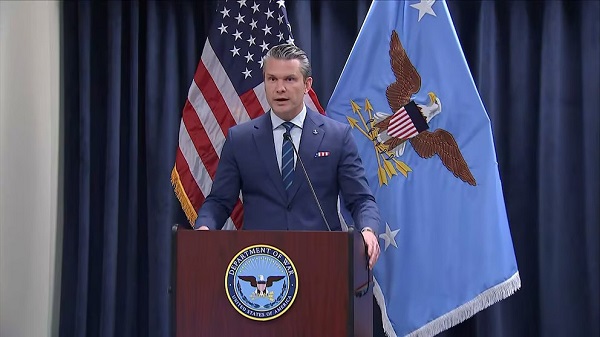
United States Secretary of War Pete Hegseth said Thursday that the U.S. military has enough weapons and ammunition to continue its ongoing military campaign against Iran for as long as necessary, seeking to ease concerns about the strain on American military stockpiles as the conflict enters its sixth consecutive day.
Speaking to reporters, Hegseth dismissed suggestions that the United States could face shortages of missiles or other munitions amid sustained operations.
“We’ve got no shortage of munitions,” he said. “Our stockpiles of defensive and offensive weapons allow us to sustain this campaign as long as we need to.”
The comments come as U.S. forces continue a series of strikes targeting Iranian military infrastructure. According to Brad Cooper, the senior U.S. military commander overseeing American forces in the Middle East, the campaign has significantly reduced the scale of Iranian retaliatory attacks.
Cooper told reporters that Iranian missile launches have dropped by approximately 90 percent since the first day of the conflict, while drone attacks have decreased by 83 percent. Despite the decline, hostilities have continued, including a drone strike attributed to Iran that killed six American troops stationed in Kuwait earlier in the week.
“Iran is hoping that we cannot sustain this, which is a really bad miscalculation,” Hegseth said, suggesting Washington is prepared for a prolonged confrontation.
U.S. military officials say the campaign has involved extensive aerial operations. Over the past three days alone, American aircraft have struck nearly 200 targets across Iran, including sites near the capital, Tehran. The targets reportedly include missile launch facilities, command centers, and underground infrastructure linked to Iran’s ballistic missile program.
Among the weapons deployed were heavy bunker-busting bombs delivered by Northrop Grumman B-2 Spirit stealth bombers. According to Cooper, the aircraft dropped dozens of 2,000-pound penetrating munitions designed to destroy fortified underground facilities, the type of hardened installations Iran has spent years constructing to protect critical missile systems.
While U.S. officials have emphasized the operational success of the strikes, the financial cost of the campaign is expected to be substantial. The Center for Strategic and International Studies estimates that the military operations are costing approximately $891 million per day. At that rate, the first four days of the conflict alone would total roughly $3.7 billion.
The United States Department of War has not publicly disclosed the total cost of the war so far, nor has it outlined a specific endpoint or defined what conditions would constitute victory.
The United States has invested heavily in expanding its munitions production capacity in recent years, partly in response to concerns about sustaining large-scale conflicts. In 2025, the U.S. Congress approved a reconciliation bill allocating $25 billion for munitions procurement. Around the same time, defense contractor Lockheed Martin announced a new agreement with the Pentagon aimed at accelerating missile production and development.
As military operations continue, analysts warn that prolonged high-intensity conflict could still place pressure on weapons inventories, even for a military with the vast resources of the United States. For now, however, American officials insist the country retains the capacity to maintain the campaign for the foreseeable future.
