

Ahmed Kamel – Egypt Daily News
The United Arab Emirates has detonated a political and economic bombshell in global energy markets, announcing it will exit OPEC effective May 1, a move that signals deep fractures inside the oil cartel at the worst possible moment.
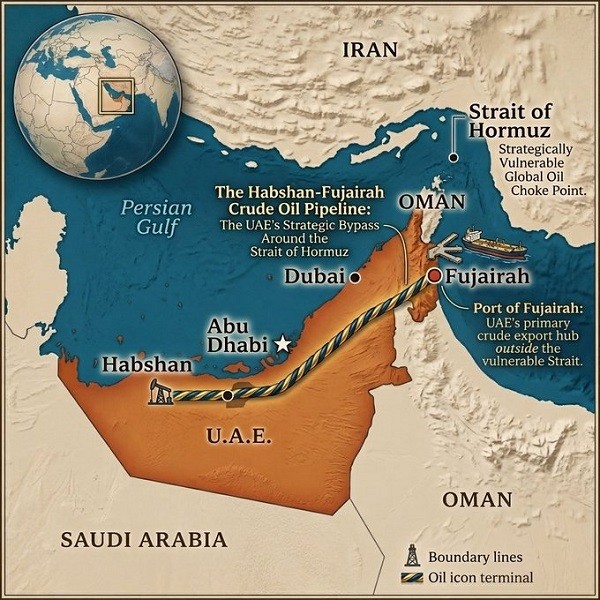
With oil prices already surging and the Strait of Hormuz effectively choked by war, Abu Dhabi’s decision strips OPEC of one of its most powerful producers and exposes a growing rift with Saudi Arabia that could reshape control over global energy flows.
The timing is anything but accidental.
As U.S.-Iran negotiations stall and tensions escalate across the Gulf, the UAE is positioning itself for a post-conflict oil surge, one where it is no longer bound by production limits dictated by a weakening alliance.
A Strategic Break, Not a Sudden One
The UAE’s departure has been building for years.
Frustrated by OPEC quotas that capped its output despite billions invested in expanding capacity, Abu Dhabi has increasingly signaled it wants freedom to pump—and sell—more oil.
Now it has it.
With current production around 3.4 million barrels per day and capacity nearing 5 million, the UAE is one of the few countries capable of rapidly increasing supply once regional bottlenecks ease.
That matters.
Because global markets are tight, and getting tighter.
Oil Markets on Edge
Brent crude has already surged above $111 per barrel, more than 50 percent higher than prewar levels, driven largely by the effective closure of the Strait of Hormuz, through which roughly 20 percent of the world’s oil supply flows.
In the short term, the UAE’s exit changes little. Oil is still physically constrained by conflict.
But the long game is clear: once the war pressure eases, Abu Dhabi intends to flood the market with additional supply, potentially dragging prices down and weakening OPEC’s grip.
OPEC’s Power Is Cracking
The cartel, which controls roughly 40 percent of global oil output, has been losing influence for years.
U.S. production now exceeds 13 million barrels per day, outpacing even Saudi Arabia, while internal divisions among OPEC members have become harder to contain. The UAE’s exit is not just symbolic it removes one of the group’s few members with significant spare capacity.
That weakens OPEC’s core function: controlling supply to stabilize prices. And it sends a message. The era of unquestioned Saudi dominance inside OPEC is fading.
Saudi-UAE Tensions Spill Into Energy Policy
Behind the scenes, this is as much about politics as it is about oil. Relations between Riyadh and Abu Dhabi have cooled significantly, with competition intensifying over regional influence, trade routes, and economic leadership.
Disputes in Yemen, friction in the Red Sea, and diverging economic strategies have all contributed to the strain.
Even optics are shifting.
At a Gulf summit in Jeddah this week, the UAE downgraded its representation sending its foreign minister instead of its ruler, understated but telling signal.
Publicly, officials insist there is no conflict.
Privately, the split is becoming harder to ignore.
A Calculated Exit from a Declining Alliance
The UAE also confirmed it will leave the broader OPEC+ framework, further distancing itself from the Russia-led effort to stabilize oil markets. The message is blunt: flexibility now matters more than coordination.
Abu Dhabi wants direct leverage with major energy buyers especially China, without the constraints of collective decision-making. It is a pivot toward independence at a time when alliances are under stress.
What Comes Next
For now, markets remain hostage to war.
But once the Strait of Hormuz reopens and supply chains normalize, the UAE could emerge as a major swing producer outside OPEC’s control. That scenario would fundamentally alter how oil prices are set.
And it would leave OPEC weaker, more fragmented, and increasingly reactive rather than dominant. At a moment when global energy stability is already under pressure, the UAE has made one thing clear:
The old oil order is breaking and it may not come back.
