

Ahmed Kamel – Egypt Daily News
Israel launched a broad wave of airstrikes on targets in both Tehran and Beirut early Friday, dramatically escalating the conflict in the Middle East as the war entered its seventh day and raised fears of a widening regional confrontation involving multiple countries and armed groups.
The Israeli military said it targeted key infrastructure linked to Iran’s military and security apparatus in the Iranian capital while simultaneously striking positions associated with the Lebanese group Hezbollah in Beirut’s southern suburbs.
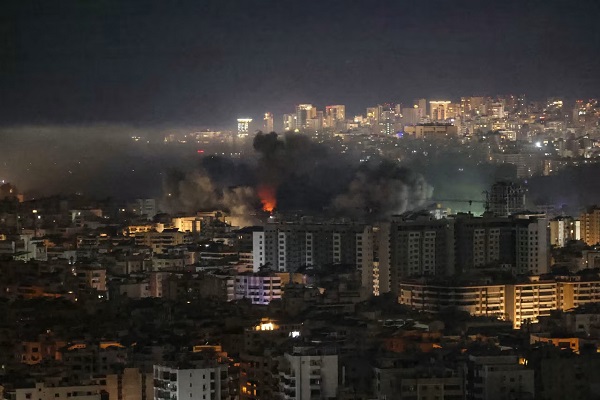
In Lebanon, the escalation triggered scenes of panic after the Israeli military issued an unprecedented evacuation order covering nearly all of southern Beirut, an area believed to house more than half a million residents and widely considered a Hezbollah stronghold. The warning sent tens of thousands of civilians rushing to leave the area late Thursday evening, with roads quickly becoming gridlocked as families attempted to flee before the expected strikes.
Residents described chaotic scenes as people abandoned homes and businesses in fear of imminent bombardment. A local flower shop owner, identified as Hussein, said he saw people running barefoot through the streets in an attempt to escape. Many families struggled to evacuate elderly relatives or those unable to move quickly as traffic jams spread across the southern suburbs of the Lebanese capital.
Explosions began rocking southern Beirut shortly after nightfall and continued into the early hours of Friday morning. The districts targeted by Israel, commonly referred to as Dahieh, still bear visible scars from a devastating 66-day conflict in 2024 between Israel and Hezbollah, which caused widespread destruction in the area.
The scale of the latest evacuation order has intensified fears among residents and analysts alike. Previous Israeli warnings ahead of airstrikes typically focused on a single building or small cluster of structures. Ordering the evacuation of entire neighborhoods marked a significant escalation.
Adding to tensions, Israeli Finance Minister Bezalel Smotrich warned that Beirut’s southern suburbs could face destruction comparable to the city of Khan Younis in the Gaza Strip, which was heavily damaged during Israel’s war with Hamas.
Meanwhile in Iran, Israeli aircraft launched what the military described as a “broad-scale wave of strikes” on regime infrastructure in Tehran. Iranian media reported hearing multiple explosions across different parts of the capital as well as the sound of fighter jets overhead. The semi-official Mehr news agency said blasts were heard in central, eastern and western areas of the city.
The intensifying air campaign comes as Iran continues its own military response. Satellite imagery from across the Arabian Peninsula suggests Iranian forces have attempted to degrade regional air-defense systems by targeting U.S.-made radar installations capable of detecting incoming missiles and drones.
Regional countries have reportedly been working to intercept incoming projectiles as Iran launches missile and drone strikes in response to Israeli and U.S. operations.
The United States has signaled that it is prepared for a prolonged conflict. President Donald Trump said there were “no time limits” on how long the war might continue, while U.S. Defense Secretary Pete Hegseth said the campaign had “only just begun.”
Amid the escalating hostilities, hundreds of American citizens were evacuated from the region. The first chartered evacuation flight carrying U.S. nationals departed from Abu Dhabi and arrived safely in the United States after many Americans sought to leave the region as the fighting intensified.
The conflict has also deepened tensions inside Lebanon. Hezbollah resumed rocket fire toward Israel earlier in the week after its leader Naim Qassem vowed to confront what he described as Israeli aggression following a joint U.S.–Israeli operation that reportedly killed Iran’s Supreme Leader Ali Khamenei.
Hezbollah warned Israeli residents early Friday to evacuate towns within five kilometers of the Lebanese border, stating that Israel’s attacks on Lebanese territory would “not pass without a response.”
The growing confrontation has triggered political fallout inside Lebanon. In an unprecedented move, the Lebanese president announced a ban on Hezbollah’s military and security operations, although the Lebanese Armed Forces have so far been unable to prevent the group from launching rockets toward northern Israel.
According to Lebanon’s Ministry of Public Health, at least 123 people have been killed and 683 injured in Israeli strikes across the country so far, figures reported Thursday evening by the state-run National News Agency of Lebanon.
Despite a ceasefire agreement reached between Israel and Lebanon in 2024, Israeli airstrikes have continued almost daily in southern Lebanon and the Bekaa Valley, targeting what Israel says are Hezbollah positions.
With Israeli strikes now hitting both Iran and Lebanon while Tehran continues retaliatory attacks, analysts warn that the rapidly widening conflict risks drawing in additional regional actors and further destabilizing the Middle East.
