

Ahmed Kamel – Egypt Daily News
U.S. President Donald Trump signaled that the United States could significantly intensify its military campaign against Iran, warning that new targets, including areas and groups not previously considered, may soon come under attack as the conflict enters its second week.
In a message posted on the social media platform Truth Social, Trump said Iran would face heavy strikes and suggested that Washington was considering a broader military escalation following days of fighting between U.S. and Israeli forces and Iranian military units.
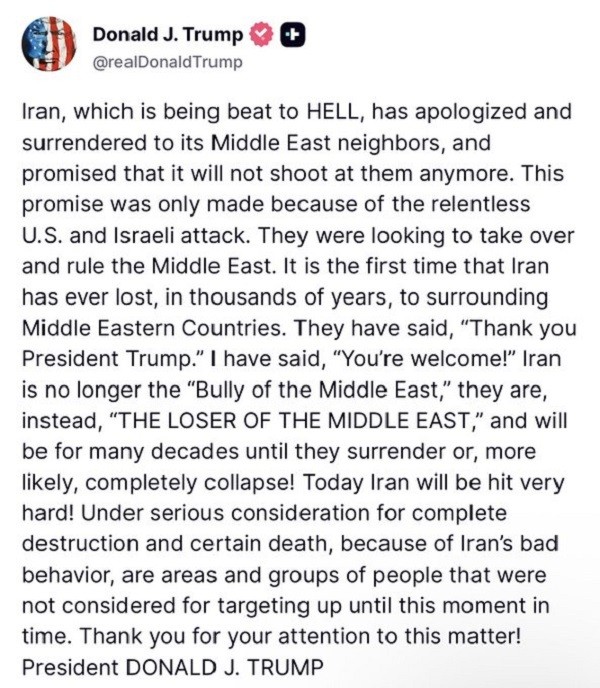
“Today Iran will be hit very hard,” Trump wrote, adding that U.S. planners were weighing the “complete destruction” of additional targets due to what he described as Tehran’s continued hostile behavior.
Trump’s comments came one week after the United States launched a major military operation against Iranian forces and strategic facilities, marking one of the most direct confrontations between Washington and Tehran in decades. The campaign followed a series of escalating attacks across the Middle East and the killing of several senior Iranian leaders during joint U.S.-Israeli strikes.
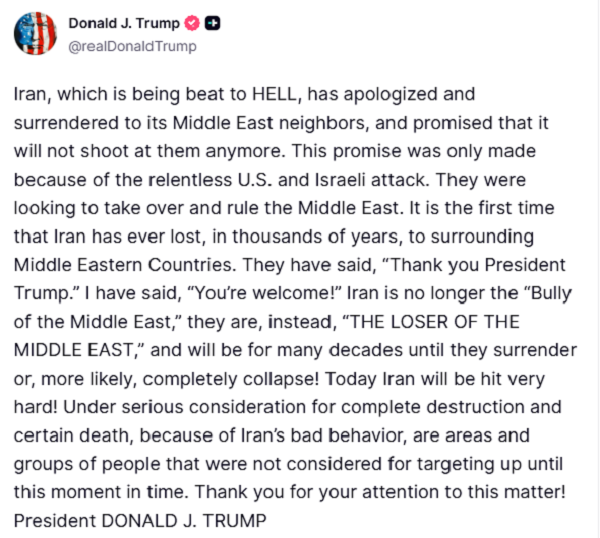
In his post, Trump also mocked statements made earlier by Iranian President Masoud Pezeshkian, claiming the Iranian leader had effectively “surrendered” to neighboring states by promising to halt attacks on Gulf countries.
According to Trump, Tehran’s apparent willingness to step back from targeting its regional neighbors came only after “relentless U.S. and Israeli attacks.”
“Iran is no longer the bully of the Middle East,” Trump wrote. “They are instead the loser of the Middle East and will be for many decades until they surrender or collapse.”
Mixed signals from Tehran
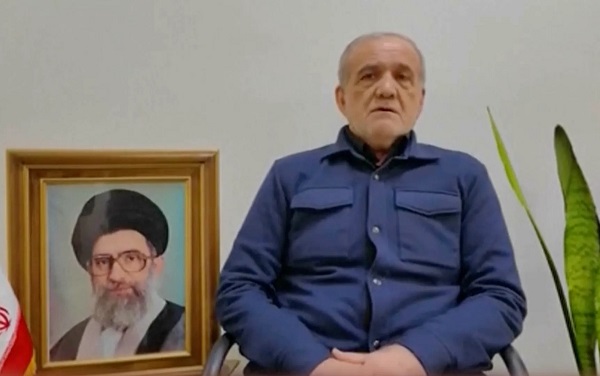
Trump’s threat of further escalation came just hours after Pezeshkian delivered one of the strongest signals yet that Iran may be seeking to reduce tensions with its Gulf neighbors.
In an address believed to have been prerecorded, Pezeshkian apologized to countries across the Persian Gulf for recent missile and drone strikes that had triggered widespread panic in areas previously considered outside the main battlefield.
The Iranian president said Tehran would halt attacks on neighboring states, particularly those in the Gulf, though he attached a key condition: that their territories not be used to launch military operations against Iran.
Several Gulf states host major American military facilities, making them strategically significant in the ongoing conflict.
Pezeshkian suggested that some Iranian strikes may have been carried out independently by military units responding to the war rather than by direct political orders.
He said Iranian forces had “acted on their own authority and did what was necessary to defend our homeland with dignity and strength,” reflecting a narrative often used by Iranian officials to justify the targeting of regional locations believed to support U.S. operations.
However, the statement left open significant questions about whether Iran’s various military institutions are unified in their strategy. Analysts note that the Iranian government’s formal leadership structures do not always exercise direct control over the powerful Islamic Revolutionary Guard Corps, which maintains its own command networks and regional proxy alliances.
Power vacuum after leadership strikes
The uncertainty surrounding Iran’s military posture has intensified following the killing of the country’s supreme leader, Ali Khamenei, in earlier U.S. and Israeli strikes — an event that dramatically reshaped Iran’s leadership structure and triggered the formation of a temporary governing council that now includes Pezeshkian.
The strikes that killed Khamenei and several other senior figures marked one of the most consequential moments of the conflict, sending shockwaves across the region and raising fears of a prolonged war.
Despite Pezeshkian’s conciliatory tone toward Gulf neighbors, missile launches continued shortly after his speech, with several projectiles reportedly detected across the region in what officials described as some of the largest barrages since the war began.
Those launches coincided with the one-week anniversary of Khamenei’s death, underscoring the volatile and fragmented nature of the conflict.
Regional uncertainty
Across the Gulf, Pezeshkian’s remarks were initially met with cautious relief. Governments in the region have been increasingly concerned about the possibility that the war could expand into a broader regional confrontation involving energy infrastructure, shipping routes, and major population centers.
But the continued missile launches that followed his statement suggested that Tehran’s pledge to halt attacks may not yet translate into a complete operational pause.
Security analysts say the coming days could prove decisive. If Washington follows through on Trump’s threat of expanded strikes, the conflict could enter a new and potentially more dangerous phase, particularly if Iranian military factions or allied armed groups respond independently.
For now, the region remains on edge as both sides signal contradictory intentions — the United States preparing for broader military action while Iranian leadership sends tentative messages of de-escalation that are undercut by ongoing attacks.
