

Ahmed Kamel – Egypt Daily News
US President Donald Trump has abruptly canceled a planned diplomatic mission to Pakistan aimed at reviving talks with Iran, signaling a sharper shift toward pressure over negotiation as a fragile ceasefire holds across the region.
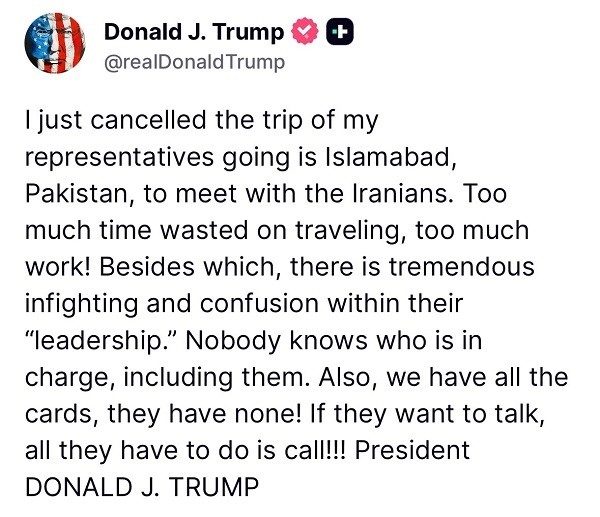
The decision halted travel plans for senior envoys Steve Witkoff and Jared Kushner, who had been expected to engage Iranian officials in Islamabad through Pakistani mediation. Speaking to Fox News, Trump dismissed the need for further outreach, arguing Washington holds decisive leverage.
“We have all the cards,” he said, adding that Tehran could initiate contact if it was serious about negotiations. “They can call us anytime.”
Diplomacy Collapses Before It Begins
The talks effectively unraveled before they started. Iran’s Foreign Minister Abbas Araghchi left Islamabad without meeting any US officials, reinforcing Tehran’s refusal to enter direct negotiations under current conditions.
Iran has insisted that any dialogue must be indirect, facilitated by third parties, while accusing Washington of undermining earlier diplomatic efforts with military escalation. Officials in Tehran have also rejected core US demands including relinquishing enriched uranium, calling them unrealistic and one-sided.
The result: a diplomatic process that collapsed before envoys even boarded their flight.
Pakistan’s Mediation Effort Tested
Pakistan, which has positioned itself as a key intermediary, now faces a setback in its attempt to broker talks. Araghchi held meetings with Prime Minister Shehbaz Sharif and Army Chief Asim Munir, outlining what Tehran described as non-negotiable “red lines.”
Islamabad had pushed for renewed engagement following Trump’s decision to extend the ceasefire, hoping to convert the pause in fighting into a political breakthrough. Instead, the cancellation underscores how far apart the two sides remain.
Ceasefire Holds, Pressure Builds
Although large-scale fighting has paused, the standoff continues to ripple through global markets. Disruptions in shipping through the Strait of Hormuz a vital artery for oil and gas, are fueling economic uncertainty, even as military tensions simmer.
Trump has paired his diplomatic pullback with a more confrontational posture, reiterating demands tied to Iran’s nuclear program and maritime security. His administration has also authorized tougher military rules of engagement in the Gulf, raising the risk of renewed escalation.
A Strategic Pause or a Dead End?
The cancellation of the Islamabad mission highlights a deeper breakdown in trust. Previous rounds of talks, including rare direct engagement earlier this year, failed to yield results and were followed by open conflict further hardening positions on both sides.
For Washington, the message is clear: negotiations will happen on its terms. For Tehran, the priority remains resisting pressure while keeping talks at arm’s length. With neither side willing to compromise publicly, the diplomatic track appears frozen, leaving the region in a tense holding pattern where a ceasefire exists, but a path to peace does not.
