

Ahmed Kamel – Egypt Daily News
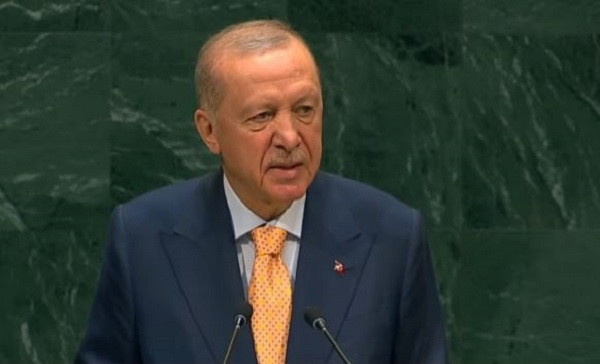
Turkish President Recep Tayyip Erdoğan turned his address to the United Nations General Assembly into a forceful denunciation of Israel’s conduct in Gaza and the West Bank, accusing the international community of failing to respond to what he described as a deepening humanitarian catastrophe.
Speaking in New York on Tuesday, Erdoğan called on countries that have not recognized Palestine to reconsider their positions. He presented Palestinian statehood as the central political solution to the conflict and said attempts to prevent its establishment would ultimately fail.
His speech was among the most outspoken interventions at this year’s General Assembly, with the Turkish leader describing Gaza as a symbol of the international system’s inability to protect civilians. The Israeli delegation reportedly left the chamber during his remarks, reflecting the sharp deterioration in relations between Ankara and Jerusalem since the war in Gaza began.
Erdoğan began by drawing attention to the absence of Palestinian President Mahmoud Abbas, who was unable to attend the UN gathering for a second consecutive year. He said Abbas’s absence represented an injustice to the Palestinian people and pledged that Türkiye would continue to speak on behalf of what he called a free and sovereign Palestinian state.
“Those countries that have not recognized Palestine should reconsider their decisions,” Erdoğan said, renewing a demand that Türkiye has repeatedly made in international forums.
He outlined his preferred political outcome as an independent Palestinian state based on the borders that existed before the 1967 Arab-Israeli war, with East Jerusalem as its capital. Erdoğan said the creation of such a state was not merely a diplomatic objective but a necessary condition for a durable peace in the region.
The Turkish president devoted much of his speech to Gaza’s humanitarian conditions. He said tens of thousands of Palestinians had been killed during the conflict, most of them women and children, and accused Israel of carrying out what he described as acts of state terrorism.
Erdoğan used some of his strongest language when describing the impact of the war on children. He said Gaza had become the world’s largest cemetery for children and claimed it also had the highest rate of child amputations. He referred to children attempting to return to school with makeshift prosthetic limbs and said fuel shortages had left much of the territory’s hospital infrastructure unable to function.
He also accused Israel of continuing military operations despite a cease-fire arrangement and claimed that more than 1,300 Palestinians had been killed after the truce took effect. In another account of his speech, the number was reported as more than 1,500. The differing figures reflect the difficulty of verifying casualty totals during an active and politically contested conflict.
Erdoğan argued that the humanitarian emergency could not be separated from the question of Gaza’s political future. He called for reconstruction to begin immediately and urged governments to increase pressure on Israel to permit and support the process. He said Türkiye remained committed to an agreement reached in Sharm el-Sheikh and would continue to monitor its implementation.
The president also criticized the administration of Israeli Prime Minister Benjamin Netanyahu for allegedly refusing to advance the next phase of a cease-fire framework. He said Palestinian factions had accepted moving forward with the plan but claimed Israel had not taken comparable steps to end its military presence and occupation.
The West Bank featured prominently in Erdoğan’s remarks as well. He accused Israeli settlers of carrying out increasingly serious violence against Palestinians and said the territory was experiencing its worst period of settler attacks. He further alleged that Muslims and Christians were being denied access to holy sites in Jerusalem.
The Turkish leader described the situation as evidence of a wider effort to change the political and demographic reality of the occupied Palestinian territories. He warned that efforts to suppress Palestinian national aspirations would not succeed, regardless of how long they continued.
Erdoğan also broadened his criticism to include the United Nations itself. He said the organization had failed to fulfill the mission for which it was established: preventing war and protecting international peace. He pointed to conflicts in Palestine, Lebanon and Sudan as examples of crises in which civilians had placed their hopes in the UN but received inadequate protection.
He backed calls to reform the Security Council, repeating his longstanding argument that global decisions should not be controlled by five permanent members. Erdoğan has frequently summarized that position with the slogan that “the world is bigger than five.”
Despite the confrontational tone, he framed his remarks as a humanitarian appeal rather than a personal dispute with Israel. Erdoğan said the suffering in Gaza should concern anyone with a sense of morality and compassion.
His address reflected Türkiye’s broader regional policy: support for Palestinian statehood, opposition to Israeli military operations in Gaza and demands for a political settlement based on the two-state formula. It also underscored the widening diplomatic divide between Ankara and Jerusalem, as well as the growing frustration among Arab and Muslim governments over the international community’s inability to halt the violence.
