
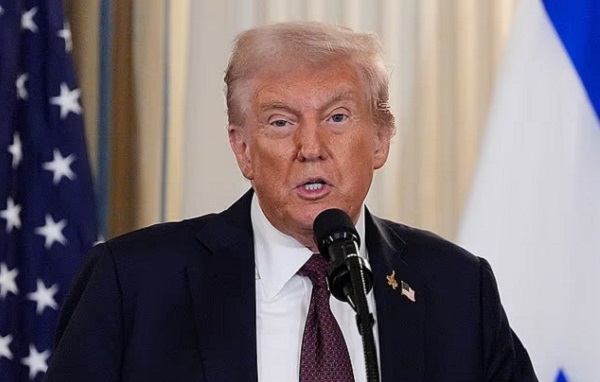
U.S. President Donald Trump said renewed war with Iran was unlikely while discussions continued, but warned that the United States could resume military action if he judged it necessary. His remarks came as Qatar continued diplomatic efforts and regional tensions persisted across the Middle East.
In comments reported on Sunday, Trump said the likelihood of a return to war was “very unlikely,” while leaving open the possibility of further strikes. “I would do it if necessary,” he said, adding that the United States had already dealt Iran severe blows. He said the decision would depend on whether negotiations produced what he considered a good agreement.
Trump later described a conversation with Qatar’s prime minister, Sheikh Mohammed bin Abdulrahman Al Thani, as “excellent.” He said they discussed several issues related to Iran and characterized the talks as part of positive momentum toward ending the conflict. Qatar, he also told Reuters, preferred a peaceful settlement, although the United States remained prepared to strike if required.
The Qatari leader was scheduled to meet Trump privately at the White House on Monday, according to the account provided. Qatar’s diplomatic engagement comes as Washington and Tehran weigh the prospects for renewed negotiations and as regional governments seek to prevent another escalation.
Trump said Qatar, Saudi Arabia, the United Arab Emirates, Bahrain, Kuwait and other countries favored maintaining the existing situation, which he described as an extensive naval blockade and a new operation called “Iron Gate,” involving activity on land and at sea. He said those countries shared the view that Iran must not obtain a nuclear weapon, a condition he called non-negotiable.
The president said the United States was ready to respond if developments in the Middle East changed, while describing such a shift as highly unlikely at present. He also said Israel and the wider region were protected from Iranian threats and that Washington would safeguard U.S. interests. The claims and characterizations were presented in Trump’s remarks; the account did not provide further details about the operation he named or the countries’ positions beyond his description.
Iran’s foreign minister, Abbas Araghchi, offered a more cautious assessment of the diplomatic outlook. Speaking to state television, he said mediators’ activity had stalled following what he called the “shock” of the U.S. election results. Restarting mediation would take time, he said, and would require patience.
U.S. Secretary of State Marco Rubio, meanwhile, described Iran’s demands as “unacceptable” and said negotiations had not been productive so far. The contrasting comments underscored the uncertainty surrounding efforts to restart talks: Trump pointed to positive momentum and said a renewed conflict was unlikely, while Iranian and U.S. officials both indicated that significant obstacles remained.
Tensions also extended to the Strait of Hormuz. Hossein Mohebi, a spokesperson for Iran’s Islamic Revolutionary Guard Corps, said the waterway would remain under Tehran’s control and would not reopen until Iran’s conditions were met. His statement added to concerns about the strategic route as diplomacy continued.
Elsewhere in the region, fighting continued on several fronts in Yemen. The coalition said it had destroyed missile-launching platforms in Sana’a and Saada, while the Houthi movement announced attacks on sites inside Saudi Arabia. The report gave no further operational details about the locations or impact of the claimed strikes.
In Gaza, severe weather added to the hardship facing displaced people. A sand collapse at a displacement camp south of Deir al-Balah killed five people, including children, according to the account. Separately, an Israeli airstrike targeting people west of Khan Younis caused deaths and injuries. Israeli military operations also continued in Gaza and southern Lebanon.
These developments formed a volatile backdrop to the diplomatic exchanges over Iran. While Trump said a return to war was improbable and described a constructive discussion with Qatar’s prime minister, he also maintained that military action remained an option. Qatar’s stated preference for a peaceful solution, as relayed by Trump, contrasts with the continuing military activity and sharply opposed positions surrounding Iran’s nuclear program, regional security and the Strait of Hormuz.
The immediate course of events will depend on whether mediation resumes and whether the parties can bridge their differences. Araghchi said that restarting the diplomatic process would take time, while Rubio’s assessment suggested that Washington and Tehran remained far apart. For now, Trump’s statements conveyed both an openness to an agreement and a warning that the United States could act if circumstances changed.
