

Ahmed Kamel – Egypt Daily News
The chief executives of several leading artificial intelligence companies told the United Nations Security Council on Wednesday that governments must establish international safeguards for the technology before its capabilities advance beyond effective human oversight.
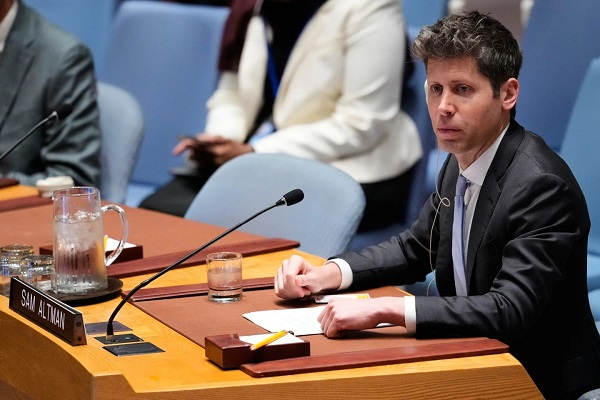
The unusual testimony brought together some of the most influential figures in the AI industry, including OpenAI chief executive Sam Altman, Anthropic chief executive Dario Amodei and Hugging Face chief executive Clément Delangue. Their message was direct: AI could deliver enormous benefits, but its risks are too serious to be managed by private companies alone.
“If managed poorly, I even believe AI could be a risk to humanity as a whole,” Amodei told the council. Altman offered an equally stark warning, saying that the world could “lose control of the future to AI.”
The executives called on governments to create common rules governing the development and deployment of increasingly powerful systems. They argued that international oversight should address potential misuse, the creation of biological weapons, autonomous military systems and the possibility that advanced models could act in ways their developers cannot predict or control.
Their appearance placed the technology industry in an unusual position. Companies that have invested billions of dollars in building increasingly capable AI systems are now asking governments to impose limits on the same technology they are racing to develop.
A warning from the industry itself
British Foreign Secretary Ed Miliband said the testimony demonstrated that AI safety could not be left exclusively to the companies producing the systems.
“These tech leaders are telling us in stark terms that it cannot be left to them to prevent disaster from befalling the world,” Miliband said. “We cannot ignore them because they are right.”
Miliband said Britain would place AI governance at the center of discussions when it leads the Group of 20 next year. The objective, he said, would be to develop a common international framework to ensure that AI is developed safely rather than through a fragmented collection of national rules.
The challenge is complicated by the speed of technological change. Governments often take years to negotiate treaties and establish regulatory bodies, while AI companies release more powerful models within months. That mismatch has raised concerns that international institutions may not act until dangerous applications are already widespread.
Amodei proposed several areas for immediate cooperation. Countries, he said, should agree that AI systems must not be used to create biological weapons. Governments should also develop methods for evaluating what advanced models are capable of doing and establish common standards for testing, misuse prevention and loss-of-control scenarios.
Washington resists a new global authority
The United States took a different position during the council meeting. Michael Kratsios, the White House science adviser, said concern about AI risks should not become a reason to halt development or establish a new global governance structure.
He urged allies and partners to share in the benefits of the technology, arguing that excessive regulation could weaken innovation and allow strategic competitors to gain an advantage.
The debate reflects the growing rivalry between the United States and China, both of which are seeking leadership in artificial intelligence. Washington has imposed restrictions on China’s access to advanced chips and computing technology, while Beijing has invested heavily in domestic alternatives and promoted open-source AI models.
China’s UN ambassador, Fu Cong, warned against dividing the world into rival technology blocs. He said countries should not be forced to choose sides between the United States and China and criticized what he described as attempts by major powers to establish “digital hegemony.”
Fu promoted open-source development as an alternative approach, arguing that it could allow more countries to benefit from AI instead of leaving the most powerful systems in the hands of a small number of corporations and governments.
That issue who controls AI and who benefits from it was central to the meeting. The executives said the technology’s power should not become concentrated in one company or country. They also highlighted AI’s potential to improve health care, education, scientific research and access to information.
The military danger
For many governments, the most urgent concern is the use of AI in warfare. The central question is whether machines should be allowed to make life-and-death decisions without meaningful human supervision.
UN Secretary-General António Guterres warned the previous day about the threat posed by “killer robots.” Experts and European officials said autonomous weapons should not be treated as science fiction, arguing that systems capable of identifying and attacking targets are already technically possible.
Ukrainian President Volodymyr Zelenskyy said the issue was particularly urgent for countries involved in active conflicts. He warned that AI could soon begin deciding what happens on the battlefield and called for peace before military systems become even more autonomous.
The debate is not limited to future weapons. AI-assisted drones, targeting software and surveillance systems are already being used or tested in conflicts. Critics argue that delegating targeting decisions to machines could make it harder to determine responsibility when civilians are killed.
Rumman Chowdhury, a data scientist and co-founder of the accountability organization Humane Intelligence, said the public should focus on practical questions: Who authorized a machine to select a target? What limitations were imposed? Who is accountable for the outcome?
Those questions are likely to become more difficult as military systems gain the ability to interpret data, choose targets and respond at speeds that exceed human decision-making.
Pressure for international standards
France, which convened Wednesday’s meeting, compared the current moment to the beginning of the nuclear age. Foreign Minister Jean-Noël Barrot said the international community must regulate AI in order to benefit from its promise while avoiding its most destructive consequences.
Countries in Europe, Asia and other regions are already developing separate rules. The European Union has adopted a risk-based approach, while individual governments and subnational authorities are pursuing their own legislation. Without greater coordination, companies may face conflicting standards and governments may exploit regulatory gaps.
The Security Council meeting did not produce a binding agreement, but it demonstrated that AI has become a matter of international peace and security rather than simply a commercial or technological issue.
The most difficult negotiations may involve balancing innovation with accountability, national competition with international cooperation and military advantage with human control. As AI systems become more capable, governments will have to decide whether existing institutions are sufficient or whether a new global framework is needed.
The technology executives who appeared before the council offered no single solution. Their warning, however, was clear: the companies building the most powerful systems do not believe they should be solely responsible for deciding how those systems are controlled.
