

Ahmed Kamel – Egypt Daily News
Egypt and Belarus are moving to deepen economic ties through a new push for industrial cooperation and long-term investment partnerships, as Cairo intensifies efforts to position itself as a regional manufacturing and export hub connecting Africa, the Middle East, and global markets.
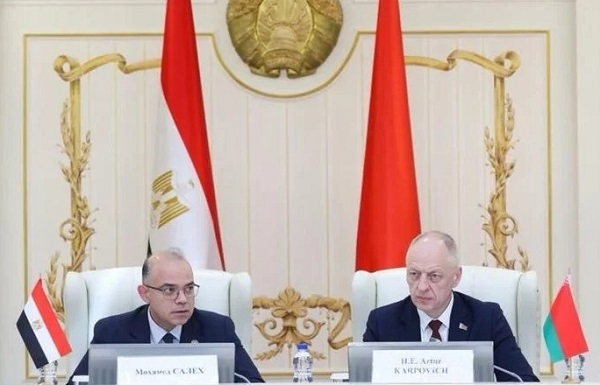
The latest discussions took place during high-level meetings in the Belarusian capital Minsk, where Egypt’s Minister of Investment and Foreign Trade, Mohamed Farid Saleh, held bilateral talks with Belarusian Minister of Trade and Antimonopoly Regulation Artur Karpovich as part of the ongoing Egyptian-Belarusian Joint Committee sessions.
Behind the diplomatic language and official meetings lies a broader strategic ambition from both governments: transforming political relations into tangible industrial projects capable of generating production, technology transfer, and cross-border trade.
Egyptian officials are increasingly focusing on attracting manufacturing partnerships rather than short-term capital flows, particularly in sectors viewed as strategically important to the country’s industrial future.
During the talks, Minister Mohamed Farid stressed that the Egyptian government sees the private sector as the central engine of economic growth, emphasizing the importance of building direct and effective communication channels between Egyptian and Belarusian companies.
He said Cairo is seeking to accelerate cooperation by moving beyond formal agreements toward practical investment projects capable of delivering long-term economic returns.
According to the minister, Egypt aims to organize regular joint business forums in both countries to create direct platforms linking investors, manufacturers, exporters, and financial institutions.
The strategy reflects Egypt’s broader economic direction under ongoing reform efforts, where authorities are attempting to increase private-sector participation while reducing pressure on state resources amid challenging global economic conditions.
One of the key sectors highlighted during the discussions was heavy equipment manufacturing, including the production and assembly of tractors, trucks, and buses.
Egyptian officials believe the country possesses several competitive advantages that could support large-scale industrial expansion, including upgraded infrastructure networks, expanding industrial zones, strategic geographic positioning, and investment incentives designed to attract foreign manufacturers.
The emphasis on vehicle and machinery assembly also aligns with Cairo’s ambitions to localize industrial production and reduce dependence on imports, particularly as currency pressures and global supply disruptions continue to affect Egypt’s economy.
Minister Mohamed Farid said Egypt remains open to exploring various mechanisms that could ensure the economic feasibility of joint projects while maintaining governance standards and transparency.
He stressed that market principles and profitability remain essential foundations for ensuring the sustainability of future investments, signaling Cairo’s desire to attract commercially viable partnerships rather than politically symbolic agreements.
On the Belarusian side, Minister Artur Karpovich described Egypt as a strategic partner and a critical gateway to African and Middle Eastern markets.
Belarus has increasingly shown interest in expanding its commercial footprint beyond traditional markets, especially as geopolitical tensions and sanctions reshape global trade routes and economic alliances. Karpovich emphasized the importance of strengthening direct ties between companies in both countries and expanding cooperation mechanisms between business communities.
He also highlighted Belarus’s interest in activating institutional cooperation frameworks, including joint business councils and economic forums aimed at removing obstacles facing investors and accelerating industrial collaboration.
According to Belarusian officials, particular attention is being directed toward partnerships focused on technology transfer, industrial expertise exchange, and production cooperation in priority sectors.
The meetings in Minsk come as Egypt continues an aggressive campaign to attract foreign investment across manufacturing, logistics, energy, and export-oriented industries, positioning itself as one of the region’s largest industrial and consumer markets.
For Cairo, the growing partnership with Belarus is not simply about trade figures or diplomatic protocol. It is part of a larger economic calculation centered on industrial expansion, local manufacturing, and the creation of strategic alliances capable of supporting Egypt’s ambitions to become a major regional production center in an increasingly fragmented global economy.
