

Ahmed Kamel – Egypt Daily News
A New Demographic Milestone Reached in Real Time
Egypt has officially crossed a new population threshold, with the number of residents inside the country reaching 109 million, according to the live population clock linked to the database of births and deaths maintained by the Ministry of Health and Population in coordination with the Central Agency for Public Mobilization and Statistics.
The milestone marks an increase from 108 million recorded on 16 August 2025 — meaning one million additional people were added in just 267 days, a pace that underscores how rapidly the country continues to expand despite ongoing demographic shifts.
A Million People in Less Than Nine Months
Behind the headline figure lies a striking statistical rhythm. Egypt added this latest million at a faster rate than the previous cycle, which took 287 days, and slightly faster than the one before it at 268 days.
The data shows that the country is now experiencing a daily natural increase driven by an average of 5,439 births per day, compared to 5,165 during the previous million milestone period. At the same time, daily deaths edged slightly higher to around 1,694 per day, compared with 1,681 previously, a marginal rise that has not offset the overall upward trajectory.
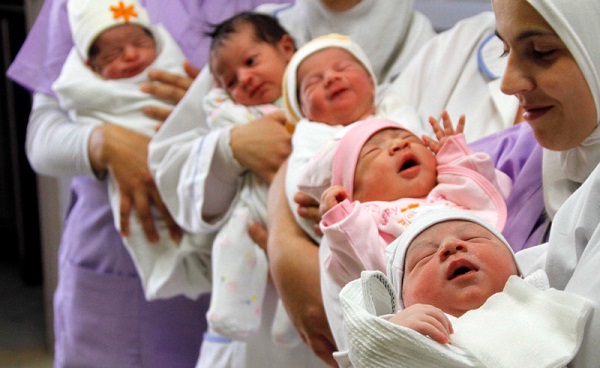
In practical terms, Egypt is now adding approximately 227 newborns every hour, nearly 4 births every minute, or one new child roughly every 15.9 seconds.
A Nation Growing, But Not Uniformly
While the national curve continues upward, the internal structure of population growth reveals deep regional contrasts. Birth rates remain significantly higher in Upper Egypt governorates, where traditional demographic patterns persist.
According to the latest figures, Assiut leads the country with 22.8 births per 1,000 people, followed closely by Sohag (22.6), Qena (22.3), Minya (22.0), and Beni Suef (20.6).
At the opposite end of the spectrum, more urbanized or coastal governorates show far lower rates. Port Said records just 11.4 births per 1,000, while Dakahlia, Damietta, Gharbia, and Suez all remain under 15 births per 1,000 residents.
Fertility Rates Slowly Declining, but Pressure Remains
Despite the headline growth, long-term indicators point to a gradual slowdown in fertility trends, a shift Egyptian authorities have pursued for years through population policy and awareness campaigns.
Data shows the fertility rate has fallen from 3.5 children per woman in 2014 to 2.85 in 2021, and further down to 2.34 in 2025, reflecting a slow but steady demographic transition.
The Central Agency for Public Mobilization and Statistics notes that while the decline is significant, it has not yet translated into reduced population pressure due to the country’s large base population and youthful demographic structure.
A Structural Challenge That Outruns Policy Gains
Even as fertility declines, Egypt’s population continues to expand at a scale that places sustained pressure on infrastructure, housing, education, healthcare, and employment.
The government describes the issue as one of the country’s most persistent development challenges, not because growth is unexpected, but because its speed still outpaces the ability of services and resources to fully absorb it.
In this context, reaching 109 million is not just a statistical update. It is a reminder that Egypt’s demographic engine is still running strong, even as policymakers attempt to gradually slow it down.
