

Ahmed Kamel – Egypt Daily News
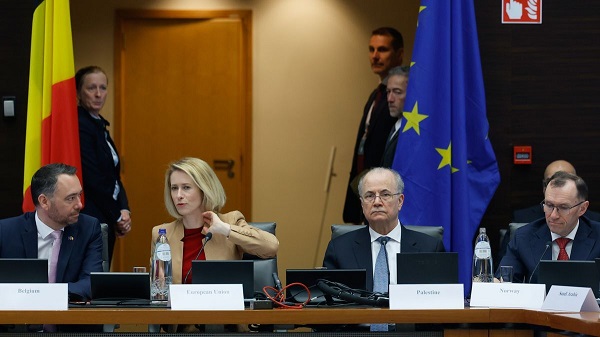
The European Union is attempting to reassert itself in Middle East diplomacy through a high-level meeting in Brussels focused on the future of Palestine and post-conflict governance. With participation from more than 60 countries, the gathering reflects growing European concern that it has been largely absent from key negotiations shaping the region’s most sensitive conflicts.
At the center of the shift is a changing political landscape within Europe itself. The weakening influence of Hungarian Prime Minister Viktor Orbán who had frequently blocked unified EU positions on the Israeli-Palestinian issue, has opened space for more coordinated action. His expected successor, Péter Magyar, is signaling a more pragmatic stance, raising the possibility of reduced internal resistance to common EU policies.
For years, European diplomacy on the conflict has been constrained by internal divisions, even as the bloc remains a major financial supporter of Palestinian institutions and a key economic partner of Israel. Despite this influence, Europe was not directly involved in recent ceasefire arrangements in Gaza, underscoring a gap between economic weight and political leverage.
The Brussels discussions are now exploring ways to convert that economic presence into coordinated diplomatic action. Options under consideration include targeted measures against violent settlers in the West Bank and a reassessment of existing cooperation frameworks with Israel. While major treaty changes remain politically difficult, momentum is building toward more tangible policy steps if consensus improves.
Palestinian representatives used the forum to push for a unified governance model in Gaza and stronger international involvement in post-war arrangements. Mohammad Mustafa emphasized the need for coordinated security structures and long-term institutional rebuilding to prevent further fragmentation on the ground.
Across Europe, there is a growing recognition that the two-state framework still represents the most widely supported political horizon, even as conditions on the ground continue to complicate its implementation. Several member states are now urging the EU to move beyond statements of principle toward more operational engagement.
The Brussels meeting therefore marks less of a breakthrough than a recalibration. Europe is not entering the center of the peace process overnight, but it is signaling a clear intention to stop remaining on the margins.
