

Ahmed Kamel – Egypt Daily News
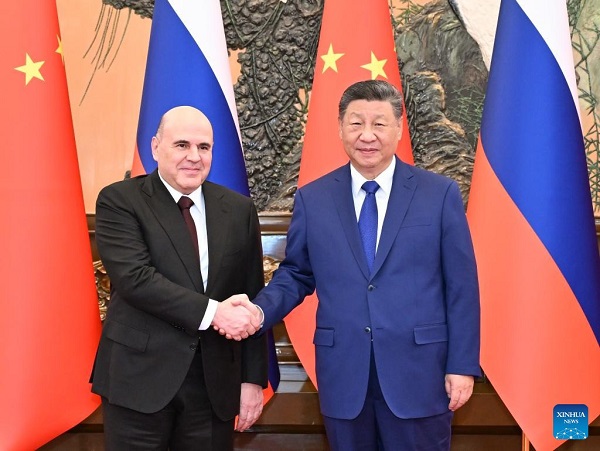
Chinese President Xi Jinping on Tuesday called for stronger cooperation and closer alignment between China and Russia’s long-term development strategies, underscoring the growing partnership between the two countries amid global geopolitical tensions.
Meeting in Beijing with Russian Prime Minister Mikhail Mishustin, Xi said that despite a turbulent international environment, Beijing and Moscow have “steadfastly navigated challenges with great composure,” and remain committed to pursuing “higher-level and higher-quality development goals.”
Xi described the deepening China–Russia relationship as a “strategic choice” for both nations, emphasizing that maintaining and advancing bilateral ties serves their “fundamental interests” and contributes to global peace and stability.
The talks come as both countries seek to strengthen economic and technological cooperation while counterbalancing Western influence. Xi noted that his earlier meetings this year with Russian President Vladimir Putin had produced “new blueprints” for cooperation and reiterated that both sides should “fully implement” the agreements reached by their leaders.
Expanding Economic and Technological Cooperation
Xi urged the two governments to expand mutual investment and enhance collaboration in traditional sectors such as energy, infrastructure, agriculture, and aerospace, while exploring new opportunities in artificial intelligence, the digital economy, and green technology. These areas, he said, would help create “new growth drivers” and bring tangible benefits to both nations.
The Chinese leader also called for closer people-to-people exchanges to strengthen cultural and educational ties and mutual understanding between Chinese and Russian citizens.
Xi noted that China’s new 15th Five-Year Plan, adopted at the recent Fourth Plenary Session of the 20th Communist Party of China Central Committee, outlines the nation’s top-level design for economic and social development over the next five years. He said China would continue to promote “high-quality growth” and “high-level opening up” as part of its modernization strategy.
“China is willing to work with Russia to better synergize its 15th Five-Year Plan with Russia’s own development strategies,” Xi said, pledging to ensure that the cooperation “continuously benefits both peoples.”
Moscow Echoes Call for Partnership
Delivering greetings from President Putin, Prime Minister Mishustin said the two meetings between the Russian and Chinese heads of state this year had “strategically planned for the development of bilateral relations” and “consolidated the comprehensive strategic partnership of coordination” between Moscow and Beijing.
He reaffirmed Russia’s readiness to work with China to implement the consensus reached by the two leaders and deepen cooperation in trade, science and technology, energy, agriculture, and the digital economy. Mishustin also highlighted the importance of strengthening multilateral coordination and expanding cultural and educational exchanges.
“Russia stands ready to work with China to implement the important agreements of our presidents and bring cooperation to a new level,” Mishustin said.
A Growing Strategic Alignment
The meeting underscores the continued warming of China–Russia ties, which have intensified since Moscow’s invasion of Ukraine in 2022 and the subsequent isolation of Russia from Western economies. Both governments have portrayed their partnership as a counterweight to U.S. and European influence, emphasizing economic self-reliance, multipolarity, and resistance to what they call Western “hegemony.”
While Beijing has stopped short of providing direct military support to Moscow, it has expanded trade, energy imports, and technological cooperation with Russia, a relationship that analysts say is increasingly asymmetrical but mutually beneficial.
For Xi, the push for “synergy” between the two nations’ development blueprints aligns with his broader vision of “Chinese modernization” and a reordering of global governance frameworks in which Beijing and Moscow play more central roles.
