

Ahmed Kamel – Egypt Daily News
Egypt has urged the UN Security Council to take tougher measures to end Sudan’s war, warning that the conflict could lead to the fragmentation of the country if armed groups are allowed to establish rival institutions or secure permanent territorial control.
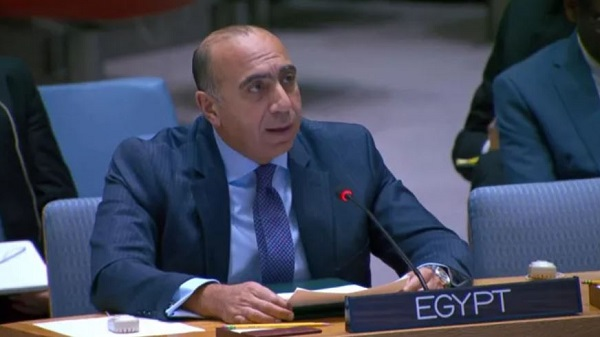
Addressing the council, Egypt’s Permanent Representative to the United Nations, Ambassador Ihab Awad, said Sudanese civilians were bearing the greatest burden of a war that has continued amid what he described as an inadequate international response. He accused the international community of failing to act decisively against attacks attributed to the rebel militia and said the lack of firm action had encouraged further violations.
Awad said civilian protection could not be treated as a selective obligation. International responses, he argued, must apply equally across Sudan and must not vary according to political considerations or the identity of the parties involved.
The Egyptian diplomat said the immediate objective should be to stop the fighting, not simply contain its effects. Diplomatic calls for a ceasefire, he added, would have little impact unless they were accompanied by practical steps to prevent the military, financial and logistical support that allows the conflict to continue.
Egypt’s position is that the war must be brought to an end rather than managed indefinitely. Awad said Sudan’s humanitarian crisis could not be addressed while armed groups continued to receive supplies and recruit fighters.
He also called for the creation of a credible accountability mechanism to investigate atrocities committed against civilians. Evidence of abuses has been reported by journalists, local correspondents, aid workers and others working in areas affected by the fighting.
The Security Council, Awad said, should ensure that those responsible for attacks and other violations are identified and prosecuted. He argued that the absence of accountability would make it more difficult to deter future crimes and could reinforce the belief that armed actors can operate without consequences.
A central element of the Egyptian statement was opposition to any attempt to create a parallel authority in Sudan. Cairo rejects arrangements that could produce separate administrations, competing institutions or alternative centers of power, saying they would entrench the country’s division and undermine its sovereignty.
Awad said Sudan’s unity must remain a fundamental principle of any international initiative. Political arrangements that appear to offer a short-term solution, he warned, could ultimately create a permanent split and make a negotiated settlement more difficult.
Egypt also rejected what it considers an artificial equivalence between Sudan’s official state institutions and the rebel militia. Awad said the country’s national institutions remain essential to preserving the state and preventing further collapse.
He argued that restoring stability would require international support for those institutions rather than efforts that weaken them or place them on the same footing as non-state armed groups. Any future political process, he said, should preserve Sudan’s national framework and provide a realistic path toward ending the conflict.
The Egyptian representative further warned that the war was being prolonged by the movement of weapons and foreign fighters into Sudan. He called for stronger efforts to stop illegal arms transfers to the rebel militia and to prevent mercenaries from entering the country.
According to Awad, foreign fighters have been involved in attacks against civilians in Darfur, Kordofan and the Blue Nile region. Their presence has contributed to the spread of violence and increased the vulnerability of communities already facing displacement, shortages of food and medicine, and the breakdown of essential services.
He said peace efforts would remain ineffective unless they addressed the external networks sustaining the conflict. Ending the flow of arms, money and fighters, he maintained, should be treated as a necessary first step toward reducing violence and creating conditions for negotiations.
Sudan’s war has generated a severe humanitarian emergency, with large numbers of civilians forced to flee their homes and millions requiring urgent assistance. Fighting has damaged homes, hospitals and public infrastructure, while access to humanitarian relief has been restricted in several areas.
The scale of the crisis has placed additional pressure on neighboring countries, including Egypt, which has received large numbers of Sudanese fleeing the conflict. Cairo has consistently called for international efforts that protect civilians, preserve Sudan’s territorial integrity and prevent the war from becoming a regional security crisis.
Awad’s remarks also reflected Egypt’s concern that the establishment of rival authorities could create new tensions across Sudan’s borders. Fragmentation could make it more difficult to deliver aid, secure transport routes and negotiate a nationwide settlement.
Egypt is therefore calling for an approach that combines an immediate cessation of hostilities with measures to protect civilians, enforce accountability and cut off external support for the armed groups. It also wants the international community to recognize the role of Sudan’s official institutions in maintaining the country’s unity.
Awad said the Sudanese crisis could not be resolved through declarations alone. A viable international response, he argued, must produce concrete action against those fueling the conflict and prevent the creation of political or military structures that operate outside the national state.
Egypt’s message to the Security Council was that preserving Sudan as a unified state should guide every diplomatic and humanitarian initiative. Ending the war, according to Cairo, requires more than negotiations between rival forces; it requires stopping the mechanisms that sustain the fighting and ensuring that any eventual settlement protects civilians, supports national institutions and prevents the country’s permanent division.
