

Ahmed Kamel – Egypt Daily News
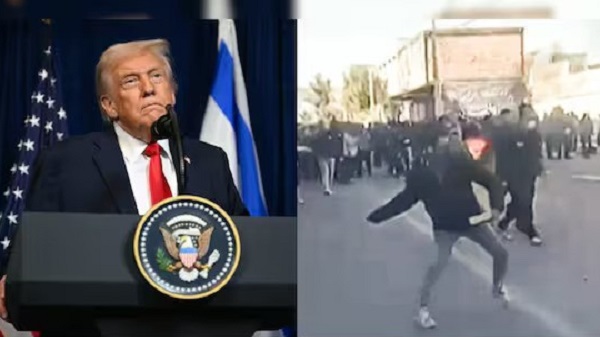
US President Donald Trump has issued a sharp warning to Iran’s leadership amid escalating protests over economic hardship, saying the United States is “locked and loaded and ready to go” if Iranian authorities violently suppress demonstrators. His comments came as unrest spread to multiple cities and reports emerged of civilians being killed in clashes with security forces.
The demonstrations, the largest Iran has seen in three years, began as protests over soaring prices, inflation and economic stagnation. Shopkeepers in Tehran launched strikes over the cost of living, with unrest quickly spreading beyond the capital to provincial cities across the country. As night fell on Thursday, clashes intensified, prompting Iranian authorities to deploy reinforcements and impose heavy security measures.
At least six people have been reported killed since the protests turned violent, according to Iranian media and local officials. The semi-official Fars news agency said two people died in clashes in the city of Lordegan in Chaharmahal and Bakhtiari province, while three others were killed in Azna in neighboring Lorestan province. State television also reported the death of a member of the security forces during overnight unrest in the western city of Kouhdasht.
Human rights groups, however, have challenged some of the official accounts, claiming that at least one of those described by state media as a security officer was in fact a protester killed by government forces. Independent verification has been difficult amid restrictions on reporting and internet disruptions.
Crowds in several cities chanted openly anti-government slogans, including calls for the overthrow of Supreme Leader Ayatollah Ali Khamenei. Videos circulating on social media showed riot police and plainclothes agents confronting demonstrators, with reports of live fire, mass arrests and roadblocks. Dozens of protesters were detained as security forces attempted to regain control of key streets.
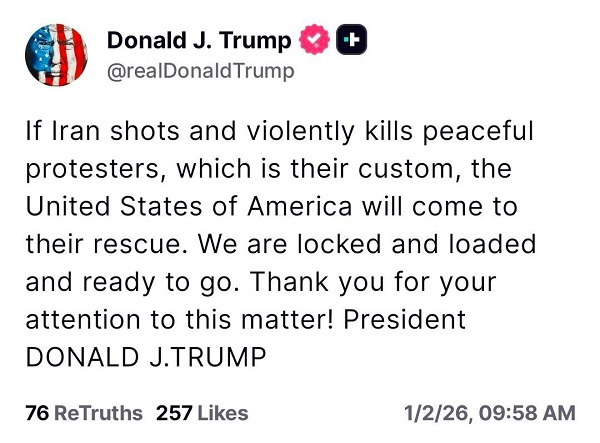
Trump reacted to the unrest with a series of posts on his Truth Social platform, accusing Tehran of routinely killing peaceful protesters and vowing US intervention if the violence continues. “If Iran shoots and violently kills peaceful protesters, which is their custom, the United States of America will come to their rescue,” he wrote, adding that Washington was “locked and loaded and ready to go.”
The comments drew swift condemnation from Iranian officials. Ali Larijani, a senior adviser to the Supreme Leader, warned that US interference would plunge the Middle East into chaos. Another Iranian official said any American intervention would destabilize the entire region, reflecting Tehran’s long-standing position that foreign powers are seeking to exploit internal unrest.
The protests come at a particularly sensitive moment for Iran’s leadership. The country’s economy has been battered by years of Western sanctions, inflation hovering around 40 percent, and a sharp depreciation of the national currency, with the rial falling to around 1.4 million to the US dollar. The pressure has intensified following Israeli and US airstrikes in June that targeted Iran’s nuclear infrastructure and senior military figures.
President Masoud Pezeshkian, a reformist who took office promising economic relief and limited engagement with the West, has attempted to strike a conciliatory tone, signaling a willingness to negotiate with protesters. However, he has publicly acknowledged the limits of his power, particularly in addressing currency collapse and sanctions-driven economic constraints.
State television has also reported a series of arrests linked to the unrest, including seven people it described as monarchists or individuals connected to Europe-based opposition groups. In a separate announcement, authorities claimed to have seized 100 smuggled pistols, though no further details were provided.
One image has come to symbolize the current wave of protests: a photograph of a lone demonstrator sitting in the road in Tehran, blocking armed security forces on motorcycles. Shared widely by Iranian and international media, the image drew comparisons to the iconic “Tank Man” photograph from China’s 1989 Tiananmen Square protests.
While the current demonstrations appear smaller in scale than the nationwide uprising of 2022 sparked by the death of Mahsa Amini in police custody, analysts say the underlying grievances remain unresolved. That earlier movement left several hundred people dead, including dozens of security personnel, and fundamentally altered the relationship between many Iranians and the state.
As protests continue and international rhetoric escalates, Iran’s leadership faces mounting pressure at home and abroad, raising fears that further violence could deepen instability in an already volatile region.
