

Ahmed Kamel – Egypt Daily News
Representative Alexandria Ocasio-Cortez ignited controversy at the Munich Security Conference after alleging that U.S. military aid to Israel had “enabled a genocide in Gaza,” comments that drew immediate criticism from pro-Israel advocates and foreign policy analysts.
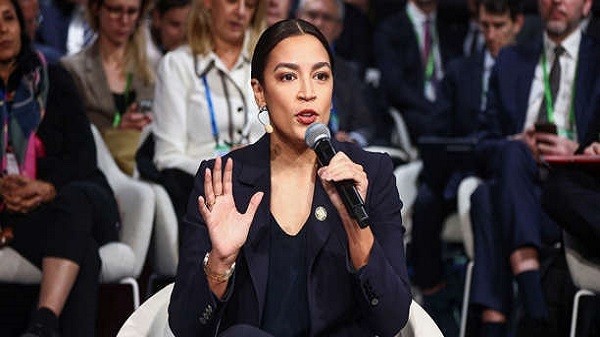
Speaking during a town hall-style event on the sidelines of the annual gathering in Germany, Ocasio-Cortez argued that Washington has a legal and moral obligation to enforce human rights conditions on foreign military assistance.
“To me, this isn’t just about a presidential election,” she said. “I think that the United States has an obligation to uphold its own laws, particularly the Leahy laws. And I think that the idea of completely unconditional aid, no matter what one does, does not make sense. I think it enabled a genocide in Gaza.”
She added that thousands of women and children had died in what she described as an avoidable humanitarian catastrophe, asserting that U.S. law requires conditioning aid when there are credible allegations of gross human rights violations.
The Legal Framework
Ocasio-Cortez specifically cited the Leahy Laws, legislation introduced in 1997 by former Senator Patrick Leahy. The laws prohibit the Departments of State and Defense from providing assistance to foreign security force units when there is credible information that those units have committed gross violations of human rights.
Her remarks reflect a broader debate within the Democratic Party over whether U.S. military support for Israel should be conditioned in light of civilian casualties in Gaza, where Israel has conducted extensive operations against Hamas, which is designated as a terrorist organization by both the United States and the European Union.
Symbolism and Historical Sensitivity
The setting of Ocasio-Cortez’s remarks amplified the controversy. Munich holds historical significance as the birthplace of the Nazi movement; it was the site of Adolf Hitler’s failed Beer Hall Putsch in 1923 and later became closely associated with the rise of National Socialism and the Holocaust.
Critics argued that invoking the term “genocide” against Israel in Germany where the Holocaust was orchestrated, was especially inflammatory.
Tom Gross, an international affairs commentator, sharply criticized the congresswoman’s statements, accusing her of promoting what he described as a “phony genocide allegation” and arguing that such rhetoric fuels antisemitism.
A Broader Political Context
Ocasio-Cortez’s comments come amid intensified scrutiny of U.S.-Israel relations and growing divisions within American politics over the Gaza conflict. While progressive lawmakers have increasingly called for conditioning aid or reevaluating military support, many Republicans and some centrist Democrats continue to defend strong, largely unconditional backing for Israel’s security.
The congresswoman’s remarks also arrive as speculation continues about her future political ambitions. During the Munich conference, she was asked about potential presidential aspirations, though she did not directly address the prospect.
Internationally, European governments have largely balanced support for Israel’s right to defend itself with calls for adherence to international humanitarian law and increased protections for civilians.
Whether Ocasio-Cortez’s language signals a broader shift in Democratic foreign policy positioning or remains a marker of the party’s progressive wing, remains to be seen. What is clear is that the debate over U.S. aid, accountability and the framing of the Gaza war has become one of the most contentious fault lines in transatlantic politics.
