

Ahmed Kamel – Egypt Daily News
A senior Israeli official has warned that Lebanon could face the same level of devastation seen in Gaza if hostilities with Hezbollah continue to intensify, according to reports in Israeli media, as cross-border fighting raises fears of a wider regional war.
“Israel will do in Lebanon what it did in Gaza,” the official was quoted as saying, in reference to the widespread destruction of buildings and infrastructure during Israel’s military campaign in the Gaza Strip. The remarks come as Israeli leaders signal a readiness to significantly expand military operations against Hezbollah following a surge in rocket attacks from southern Lebanon.
The warning follows what Israeli officials described as a coordinated barrage by Hezbollah that saw more than 200 rockets fired toward Israel in less than 24 hours. Israeli sources say the attack appeared to be coordinated with Iran amid the broader regional confrontation that has drawn in several actors across the Middle East.
According to Israeli officials, Israel had until recently been attempting to avoid a major escalation on the Lebanese front in order to concentrate its military campaign on Iran. That approach, they say, changed dramatically after the latest rocket barrage.
“Before this attack we were prepared to pursue a ceasefire in Lebanon,” a senior Israeli official said. “But after what happened, there is no turning back from a large-scale military operation.”
Israeli and American officials have indicated that Israel is preparing to significantly expand its ground operations in Lebanon. The reported objective is to seize territory south of the Litani River and dismantle Hezbollah’s military infrastructure in the area, a long-standing demand by Israel which it argues is necessary to prevent future attacks.
The Litani River has historically been considered a strategic boundary in southern Lebanon under United Nations Security Council Resolution 1701, which ended the 2006 war between Israel and Hezbollah and called for Hezbollah forces to withdraw north of the river. Israel has repeatedly accused the group of violating that resolution by maintaining military positions and launching sites near the border.
At the same time, the administration of U.S. President Donald Trump is said to be backing Israel’s goal of disarming Hezbollah but is urging Israel to limit the damage inflicted on Lebanon’s already fragile infrastructure. American officials have also encouraged direct negotiations between Israel and Lebanon in the hope of eventually reaching a broader security arrangement along the border.
Despite diplomatic efforts, rhetoric from Hezbollah suggests the group is preparing for a prolonged confrontation.
Hezbollah Secretary-General Naim Qassem said on Friday that the organization was ready for a long war with Israel and dismissed Israeli threats to inflict escalating damage on Lebanon.
“We have prepared ourselves for a long confrontation, and God willing they will be surprised on the battlefield,” Qassem said. “The enemy’s threats do not frighten us. This is an existential battle, not a limited or simple one.”
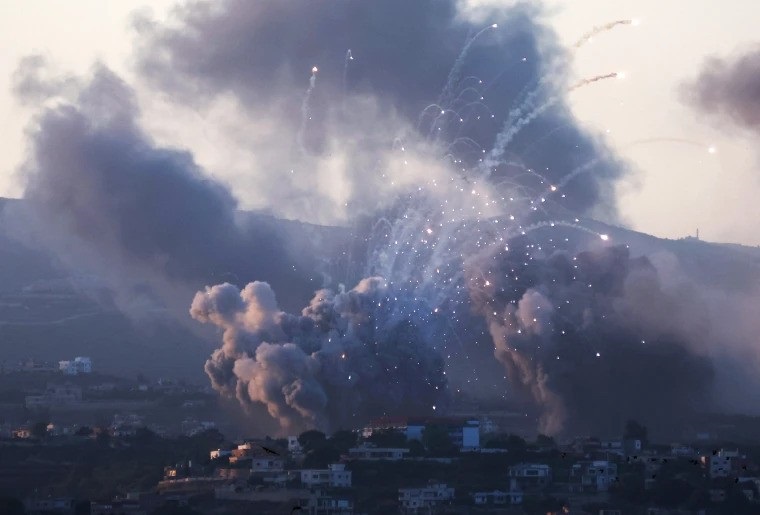
Israeli airstrikes have continued across several areas of Lebanon as tensions mount and expectations grow that a major ground offensive could begin in the near future.
In one of the latest incidents, four people were killed when an Israeli strike hit an apartment in the southern Lebanese city of Sidon, according to Lebanon’s official National News Agency. Lebanese health authorities also reported that an Israeli airstrike in southern Lebanon killed 12 medical workers at a healthcare center, highlighting growing concerns about the humanitarian impact of the fighting.
The escalating confrontation along the Israeli-Lebanese border comes amid a broader regional crisis involving Iran, Israel, and the United States. Analysts warn that a large-scale Israeli ground operation in southern Lebanon could trigger a wider conflict across the Middle East, particularly if Hezbollah widely regarded as one of the most heavily armed non-state actors in the world, mobilizes its full military capabilities.
International diplomatic efforts are continuing to prevent further escalation, but with both sides signaling readiness for a prolonged conflict, the prospect of another major war on Israel’s northern front appears increasingly likely.
