

Ahmed Kamel – Egypt Daily News
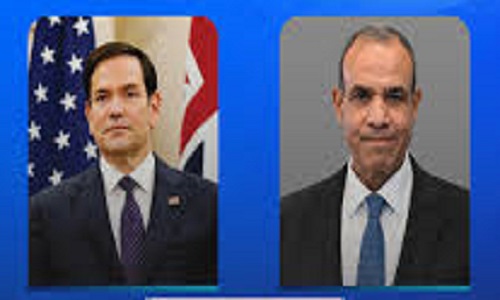
Egypt’s Foreign Minister Badr Abdelatty held a phone call on Thursday with U.S. Secretary of State Marco Rubio to discuss strengthening bilateral relations and addressing rapidly evolving developments across the Middle East.
The talks focused on ways to reinforce the long-standing strategic partnership between Egypt and the United States, which officials described as spanning more than four decades and serving as a cornerstone for regional stability. Both sides expressed their intention to further deepen cooperation across political, economic, and security fields in pursuit of mutual interests.
The conversation also addressed the widening scope of regional conflict and ongoing military escalation. The U.S. side expressed appreciation for Egypt’s leadership and its role in mediation efforts aimed at de-escalation, crisis containment, and the promotion of stability across the region.
Abdelatty highlighted the economic repercussions of the current escalation, noting its impact on global markets and the Egyptian economy in particular. He stressed the importance of international support, including financial assistance and liquidity measures, to help mitigate the effects of rising energy and food prices, as well as declining revenues from tourism and the Suez Canal.
Reaffirming Egypt’s position, the foreign minister emphasized the need to prioritize diplomatic solutions and political negotiations over military confrontation. He pointed to ongoing mediation efforts coordinated with Turkey and Pakistan to reduce tensions and encourage all parties to move toward a ceasefire.
On the Palestinian issue, Abdelatty outlined Egypt’s efforts to advance the next phase of a U.S.-backed framework, including the deployment of an international stabilization force and the activation of a Gaza administrative committee, paving the way for the return of the Palestinian Authority to full governance responsibilities. He stressed the urgency of protecting Palestinian civilians and creating conditions for the resumption of a political process aimed at a comprehensive and just resolution.
The minister also condemned attacks by Israeli settlers against Palestinian civilians and property in the West Bank, describing them as violations of international law that undermine prospects for peace.
Regarding Sudan, both officials discussed efforts to secure a temporary humanitarian truce as a step toward a permanent ceasefire. The U.S. side commended Egypt’s constructive role, while Abdelatty underscored the importance of a Sudanese-led political process free from external interference, alongside the need to preserve the country’s sovereignty and territorial integrity.
On developments in Lebanon, Abdelatty briefed Rubio on the outcome of his recent visit to Beirut, calling for an immediate halt to hostilities and rejecting any violations of Lebanese sovereignty or targeting of civilian infrastructure. He emphasized the importance of fully implementing United Nations Security Council Resolution 1701 and strengthening state institutions to assert authority across all Lebanese territory.
Water security was also a key topic of discussion. Abdelatty reiterated Egypt’s position that the Nile River represents a vital lifeline for the Egyptian people, particularly in the context of severe water scarcity. He reaffirmed Egypt’s commitment to cooperation with Nile Basin countries in line with international law, while rejecting unilateral measures affecting the shared river system and raising concerns over Ethiopia’s continued stance on the issue.
The call concluded with both sides agreeing to maintain close coordination and consultation to further strengthen bilateral relations and contribute to regional security and stability.
