

Ahmed Kamel – Egypt Daily News
Tensions between the United States and Iran are rising again despite a fragile ceasefire, as U.S. President Donald Trump announced that an American delegation will travel to Pakistan on Monday to resume negotiations aimed at ending the conflict.
The move comes as both sides exchange accusations over violations of the truce, casting doubt on the durability of the agreement and the prospects for a diplomatic breakthrough.
Ceasefire Under Strain
Iran and the United States traded blame on Sunday over alleged breaches of the ceasefire.
Tehran accused Washington of maintaining what it described as an “illegal naval blockade” on its ports, signaling that economic and military pressure remains in place despite the truce.
Meanwhile, Trump accused Iran of violating the agreement by closing the strategic Strait of Hormuz, a critical global shipping route through which a significant share of the world’s oil supply passes.
These competing narratives highlight the fragility of the ceasefire, with both sides offering sharply different interpretations of its terms.
Talks to Resume in Pakistan
Amid rising tensions, Trump confirmed that a U.S. delegation will head to Islamabad to restart negotiations with Iranian officials.
The talks are viewed as a key diplomatic channel to prevent further escalation following days of military and economic confrontation.
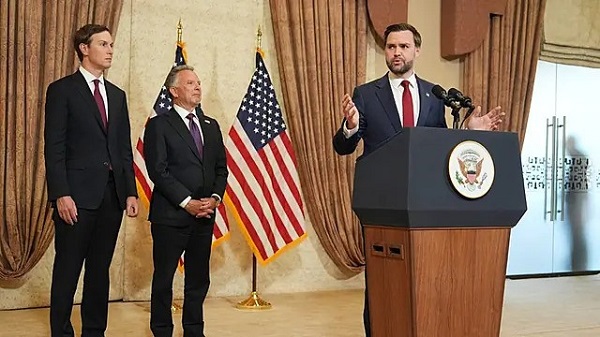
According to a White House official, the delegation will be led by Vice President JD Vance, alongside special envoy Steve Witkoff and senior adviser Jared Kushner.
Their participation mirrors the previous round of talks held over the weekend, suggesting Washington is maintaining continuity in its negotiation approach.
Mixed Signals from Washington
The composition of the delegation underscores inconsistencies in U.S. messaging.
Trump had earlier indicated that Vance would not be part of the mission, only for a White House official to later confirm his involvement. The apparent contradiction raises questions about internal coordination as the administration navigates a complex and fast-moving conflict.
Renewed Threats Alongside Diplomacy
Even as diplomatic efforts resume, Trump has reinforced his warnings to Tehran.
The U.S. president stated that failure to reach an agreement could lead to the destruction of Iran’s infrastructure, signaling that military options remain on the table.
Such rhetoric risks undermining negotiations, as it may deepen Iranian concerns that Washington is pursuing a dual strategy of pressure and diplomacy.
A Critical Diplomatic Test
The upcoming talks in Pakistan could prove decisive in determining whether the ceasefire holds or collapses.
With global markets watching closely particularly energy traders concerned about disruptions in the Strait of Hormuz, the outcome of these negotiations carries implications far beyond the region.
For now, diplomacy continues. But with trust eroding on both sides, the path to a lasting agreement remains uncertain.
