

Ahmed Kamel – Egypt Daily News
Eight years. Two presidents. A pandemic that shut down the world economy almost overnight. Historic inflation that crushed household budgets. And finally, an unprecedented criminal investigation into the head of America’s central bank.
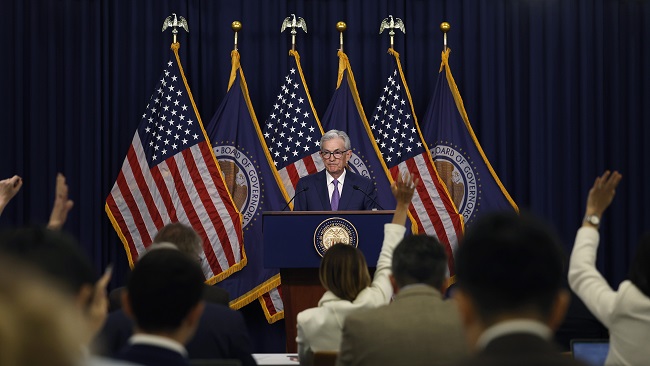
On Friday, Jerome Powell steps down as chair of the Federal Reserve, ending one of the most dramatic and politically charged tenures in the institution’s 113-year history.
Powell leaves behind a deeply divided legacy praised by many economists for steering the United States away from economic collapse during the COVID-19 pandemic, while criticized for underestimating the inflation crisis that later erupted across the country.
His successor, Kevin Warsh, will now inherit an economy that remains resilient in employment but increasingly strained by renewed inflationary pressures tied to geopolitical instability and surging energy prices.
“You don’t choose your challenges, but you do choose how you respond,” economist Claudia Sahm said in comments reflecting on Powell’s years at the Fed. “In the end, Powell’s legacy will be judged by those outcomes.”
Powell first took office in 2018 after being nominated by Donald Trump, who at the time described him as a “consensus builder” capable of sustaining economic growth.
The American economy then appeared strong. Unemployment was near historic lows and inflation hovered close to the Fed’s long-standing 2% target. Powell moved aggressively early in his tenure, raising interest rates four times during his first year in an effort to prevent economic overheating and preserve room for future emergency cuts.
That room became critical only two years later.
By early 2020, the COVID-19 pandemic had frozen large sections of the global economy. Businesses collapsed almost overnight as lockdowns spread across the United States. Tens of millions of Americans suddenly found themselves unemployed.
Facing one of the most severe economic shocks in modern history, Powell convened emergency meetings and slashed interest rates to near zero. The Federal Reserve unleashed extraordinary stimulus measures aimed at stabilizing financial markets and preventing a full-scale depression.
“Families, businesses, schools, organizations, and governments at all levels are taking steps to protect people’s health,” Powell said during the height of the crisis. “These measures will understandably take a toll on economic activity in the near term.”
The economic collapse was staggering. America’s unemployment rate exploded from 4.4% in March 2020 to 14.7% just weeks later.
Yet the recovery came with remarkable speed. Massive federal spending packages approved under both the Trump and Joe Biden administrations, combined with the Fed’s ultra-low rates, fueled a rapid rebound that turned the COVID recession into the shortest recession in modern U.S. history.
But the recovery carried a dangerous side effect.
Supply chain disruptions caused by the pandemic, combined later with geopolitical turmoil including the Russia-Ukraine war and Middle East instability, triggered a wave of inflation not seen in four decades.
Powell initially dismissed the price surge as “transitory,” a statement that would later haunt his tenure.
By June 2022, annual inflation had soared to 9.1%, the highest level in 40 years. Americans faced skyrocketing costs for groceries, fuel, housing and borrowing. Mortgage rates surged while credit card debt became increasingly expensive.
The Fed responded with one of the most aggressive interest-rate hiking campaigns in decades, pushing benchmark rates to levels not seen since 2001. Critics warned the tightening would trigger a devastating recession and mass unemployment.
That recession never arrived.
Inflation eventually fell sharply, dropping to 3% by mid-2023, while the labor market remained surprisingly resilient. Economists later credited Powell with engineering a rare “soft landing”, slowing inflation without causing catastrophic job losses.
Wendy Edelberg of the Brookings Institution said the Fed ultimately managed to reduce inflation “without creating unnecessary pain in the labor market. But Powell’s final years became consumed not only by economic battles, but also by an escalating political war with Trump following the president’s return to the White House in 2025.
Trump repeatedly pressured Powell to cut interest rates and publicly attacked the Fed chair over cost overruns tied to a major renovation project at the Federal Reserve headquarters in Washington. The conflict escalated dramatically when the U.S. Department of Justice opened a criminal investigation into Powell, the first criminal probe ever launched against a sitting Fed chair.
The investigation centered on Powell’s congressional testimony regarding renovation costs.
In a rare and highly unusual public response, Powell accused the administration of attempting to intimidate the Federal Reserve and undermine its independence.
“No one certainly not the chair of the Federal Reserve is above the law,” Powell declared in a video statement. “But this unprecedented action should be seen in the broader context of the administration’s threats and ongoing pressure.”
The Justice Department eventually dropped the criminal probe last month, though oversight of the renovation project remains under review by the Fed’s inspector general.
For many observers, Powell’s willingness to resist political pressure may become one of the defining elements of his legacy. “The attack on the Fed chair was appalling,” said finance professor Rebel Cole, a former Federal Reserve employee. “Powell stood up to it.”
Now, as Warsh prepares to assume leadership of the world’s most influential central bank, new challenges are already mounting.
Inflation has begun climbing again amid soaring gasoline prices linked to the ongoing U.S.-Israeli conflict with Iran. At the same time, the unemployment rate remains historically low at 4.3%, underscoring the unusual resilience of the American economy despite years of global instability.
Economist Alan Blinder summed up Powell’s complicated legacy bluntly: the Fed chair may have reacted too slowly to inflation, but he preserved the independence of the central bank during one of the most politically volatile periods in modern American history.
