

Ahmed Kamel – Egypt Daily News
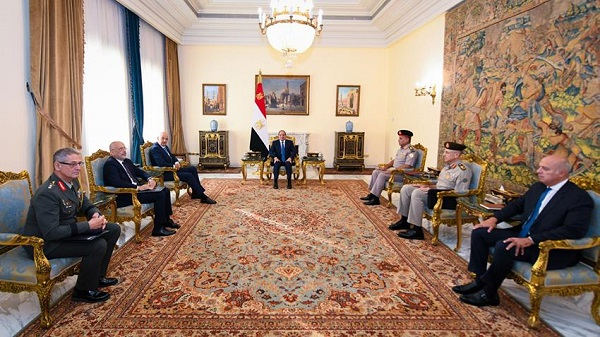
President Abdel Fattah El-Sisi held separate meetings in Cairo on Tuesday with the defence ministers of Greece and Cyprus, focusing on military cooperation, regional security and the future of trilateral coordination in the Eastern Mediterranean.
President El-Sisi met first with Greek Minister of National Defence Nikolaos Dendias before receiving Cypriot Defence Minister Vasilis Palmas. The talks brought together senior military officials and diplomats from the three countries and highlighted the growing importance of their strategic partnership at a time of mounting security and geopolitical pressures across the Mediterranean and the Middle East.
During his meeting with Dendias, President El-Sisi emphasized the need to expand the strategic relationship between Egypt and Greece, particularly in the military and defence fields. He also asked the Greek minister to convey his greetings to Prime Minister Kyriakos Mitsotakis.
Egyptian Presidential Spokesman Mohamed El-Shennawy said the president described relations with Greece as historically important and stressed the need to translate the political partnership into broader cooperation that serves the interests of both countries.
Dendias conveyed greetings from Mitsotakis and expressed Greece’s appreciation for its longstanding relations with Egypt. He said Athens was interested in strengthening coordination with Cairo to address common security challenges, including terrorism and irregular migration.
The Greek minister also praised Egypt’s role in reducing irregular migration toward Europe. Egypt has become an important partner for European countries in efforts to limit dangerous migration routes across the Mediterranean, combat human-smuggling networks and improve regional border security.
The discussions with the Greek minister were followed by a separate meeting between President El-Sisi and Palmas. The Egyptian president welcomed the Cypriot defence minister and underlined the importance of the bilateral partnership between Cairo and Nicosia.
President El-Sisi called for closer cooperation in security and military affairs and urged both sides to widen their partnership across other areas. He also asked Palmas to convey his greetings to Cypriot President Nikos Christodoulides.
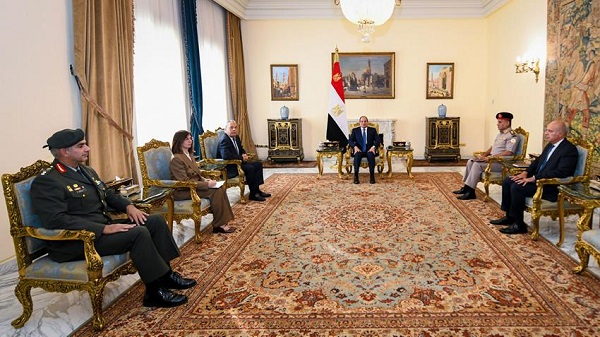
Palmas delivered greetings from Christodoulides and highlighted Cyprus’s interest in maintaining close coordination with Egypt. He praised the progress made in political, economic and military cooperation and said Cyprus valued Egypt’s role in reducing regional tensions and supporting peace and stability.
The Cypriot minister also emphasized the importance of continued cooperation in the Mediterranean, particularly in confronting common security challenges. Like his Greek counterpart, he recognized Egypt’s role in addressing irregular migration and supporting regional stability.
At the center of both meetings was the trilateral cooperation framework linking Egypt, Greece and Cyprus. President El-Sisi described the mechanism as a successful model of regional partnership and said it had become an important platform for promoting security, stability and shared prosperity in the Eastern Mediterranean.
The three countries have developed closer ties through regular summits, diplomatic consultations and military exercises. Their cooperation also extends to energy, maritime security, infrastructure, trade and regional connectivity. The partnership has become increasingly significant as the Eastern Mediterranean gains importance because of its energy resources, shipping routes and proximity to several unresolved conflicts.
A trilateral summit held in El Alamein earlier this month further strengthened the relationship among the three governments. The leaders discussed regional security, energy cooperation, migration, water security and economic links. They also reaffirmed the importance of respecting international law and maintaining coordination on issues affecting the Mediterranean.
Military cooperation has expanded in recent years through joint exercises and regular contact between the armed forces. Egyptian, Greek and Cypriot military units have participated in multinational exercises designed to improve interoperability, maritime awareness and readiness to respond to emergencies.
The latest meetings also reflected concerns about the wider security environment. Conflicts in the Middle East, instability in North Africa, tensions surrounding maritime routes and rising pressure on European borders have encouraged Egypt, Greece and Cyprus to strengthen their consultations.
For Egypt, closer relations with Greece and Cyprus support its broader effort to establish itself as a central security and diplomatic actor in the Mediterranean. Cairo also sees the partnership as a way to promote its economic interests, protect maritime routes and attract investment in energy and infrastructure.
For Greece and Cyprus, cooperation with Egypt provides access to a major regional power with strong military capabilities, extensive diplomatic contacts and a strategic position linking the Mediterranean, Africa and the Middle East.
The meetings did not announce a specific new defence agreement or military operation. However, the repeated emphasis on coordination indicates that the three countries intend to deepen existing cooperation rather than limit the relationship to political statements.
Their partnership also carries an economic dimension. The Eastern Mediterranean has become an important area for energy exploration and regional infrastructure projects, while electricity connections, gas development and maritime transport could create new opportunities for all three countries.
The focus on irregular migration adds another layer to the relationship. Egypt’s geographic position makes it an important partner for European governments seeking to prevent unauthorized crossings and dismantle trafficking networks. Greece and Cyprus, both located on Europe’s southeastern maritime frontier, have a direct interest in strengthening cooperation with Cairo.
The separate meetings between President El-Sisi, Dendias and Palmas therefore served both immediate and long-term purposes. They addressed current security challenges while reinforcing a regional partnership built around defence, diplomacy, migration control, energy and economic development.
As instability continues to affect the Middle East and the wider Mediterranean, Egypt, Greece and Cyprus are expected to maintain close coordination. Their governments view the trilateral framework as a practical mechanism for protecting shared interests and strengthening the position of the three countries in a rapidly changing regional environment.
