

Ahmed Kamel – Egypt Daily News
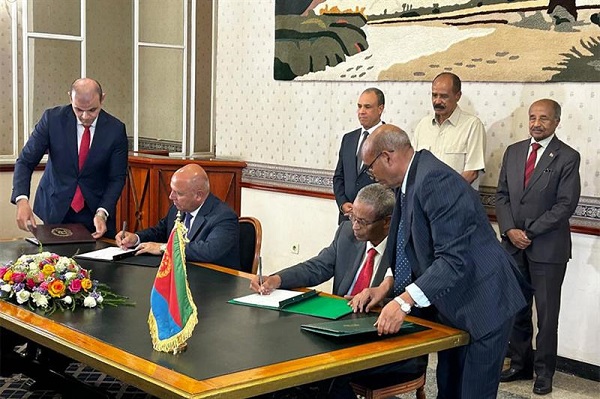
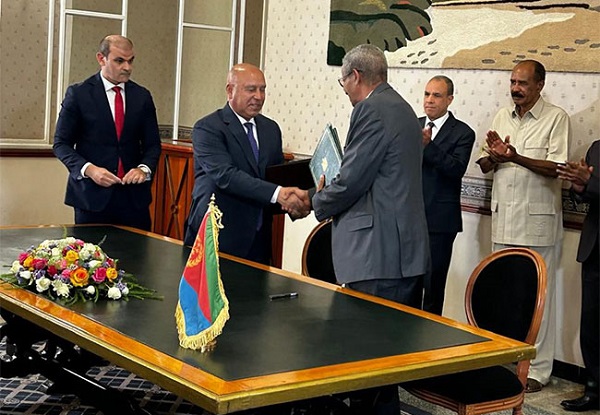
Egypt and Eritrea signed a landmark maritime transport cooperation agreement on Saturday during high-level talks in Asmara, reinforcing a growing strategic partnership centered on Red Sea security, regional stability, and economic integration across the Horn of Africa.
The agreement, signed during a visit by Egyptian Foreign Minister Badr Abdelatty under directives from President Abdel Fattah el-Sisi, marked one of the most significant steps in years toward institutionalizing cooperation between Cairo and Asmara.
Egyptian Transport Minister Kamel Al-Wazir signed the deal with Eritrean officials to expand maritime connectivity, facilitate trade, and increase investment flows between the two Red Sea nations.
The agreement comes amid intensifying geopolitical competition over the Red Sea and Horn of Africa, with both countries reiterating a shared position that governance and security of the strategic waterway must remain exclusively in the hands of its littoral states.
Speaking during the visit, Abdelatty firmly rejected what he described as attempts by outside powers to impose security arrangements or political understandings related to the Red Sea, underlining Cairo’s long-standing position that regional sovereignty must not be compromised.
The Egyptian foreign minister met Eritrean President Isaias Afwerki for extensive talks covering bilateral relations, Red Sea security, Sudan, Somalia, and the broader Horn of Africa crisis landscape. Egypt also reaffirmed full support for Eritrea’s sovereignty, territorial integrity, and national unity, a message President El-Sisi had personally delivered during Afwerki’s visit to Cairo in October 2025.
Officials said the new maritime cooperation framework aims to strengthen logistical integration between Egyptian and Eritrean ports while opening new opportunities for commercial shipping and private sector investment.
Al-Wazir pointed to the already-operational cargo shipping route connecting Egyptian and Eritrean ports through the Red Sea as evidence that cooperation between the two governments has already moved beyond political declarations into practical implementation.
He added that Egypt stands ready to transfer expertise in railways, port management, and maritime transport infrastructure to support Eritrea’s development plans. The discussions in Asmara also reflected Cairo’s growing focus on the Horn of Africa as a direct national security priority.
Abdelatty stressed that preserving state institutions and preventing fragmentation across the region remain essential pillars of Egyptian policy, particularly amid ongoing instability in Sudan and persistent tensions in Somalia.
Egyptian officials described the talks as reflecting an unusual degree of political alignment between Cairo and Asmara on both regional and international issues. Afwerki praised Egypt’s expanding diplomatic and regional role, while emphasizing the “historical depth” of ties between the two countries.
He said Saturday’s agreements represented “the continuation of a long and substantive partnership” rather than a new phase in relations. The Eritrean president also reaffirmed Asmara’s commitment to strengthening coordination with Egypt across political, economic, and security sectors.
In separate meetings, Abdelatty also held talks with Eritrean Foreign Minister Osman Saleh, focusing on trade expansion, joint investments, and increasing Egyptian private sector participation in the Eritrean market.
Egypt has increasingly sought to deepen its influence across the Red Sea corridor and the Horn of Africa amid shifting regional alliances, competition over maritime routes, and mounting concerns over security instability stretching from Sudan to the Gulf of Aden.
Saturday’s agreements in Asmara are expected to further cement the emerging Cairo-Asmara axis at a time when Red Sea geopolitics are rapidly becoming one of the Middle East and Africa’s most strategically contested arenas.
