

Ahmed Kamel – Egypt Daily News
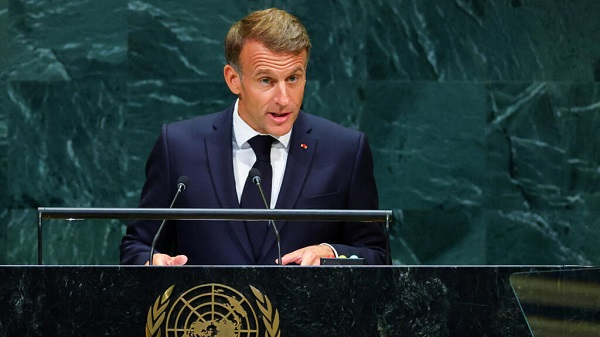
French President Emmanuel Macron warned world leaders on Tuesday that international affairs were drifting toward disorder and urged countries to defend the United Nations as the central institution for addressing global crises.
Speaking during the opening day of the 81st session of the United Nations General Assembly in New York, Macron framed the current international climate as a choice between a rules-based global order and a world governed by force. He asked whether nations wanted to accept “the return of the law of the jungle” or preserve what he described as a civilized international community.
“Our duty, now more than ever, is to stand firmly by the United Nations,” Macron said, calling on governments to work together to determine what serves their shared interests.
The French president’s appeal came as the General Assembly opened against a backdrop of protracted wars, humanitarian emergencies and growing doubts about the ability of international institutions to prevent or end conflicts. Secretary-General António Guterres also addressed the opening of the session and renewed his call for reform of the UN Security Council, an issue that has gained urgency as divisions among its permanent members have repeatedly blocked collective action.
Macron’s speech placed the United Nations at the center of the international response to several of the world’s most serious crises. Rather than presenting the organization as free of weaknesses, he argued that its shortcomings made reform and political support more necessary, not less.
Gaza and the credibility of the international system
A significant part of Macron’s address focused on the war in Gaza and the deteriorating situation in the occupied West Bank. He defended the two-state solution and said the international community could no longer remain passive while civilians suffered.
“What is our credibility if we continue to stand by and watch what is happening in Gaza?” Macron asked.
He described the situation in Gaza as a scene that should shame the entire international community, while also criticizing the escalation of settler violence in the West Bank. In his view, such violence undermines the Palestinian people’s legitimate right to exist and makes the creation of two states living side by side in peace and security increasingly difficult.
Macron argued that a negotiated settlement remains essential not only for Palestinians but also for Israel. The two-state solution, he said, is necessary for Israel’s long-term security and for the future of its people. His position reflects France’s wider effort to preserve a diplomatic framework in which Palestinian statehood and Israeli security are treated as interconnected rather than competing objectives.
The French government has increasingly presented the issue as one requiring international guarantees, humanitarian access, an end to settlement expansion and a credible political process. French officials have also supported international efforts to revive negotiations and to bring Israeli and Palestinian civil society representatives into contact at a time when direct communication has become increasingly difficult.
Macron’s remarks suggested that the humanitarian crisis in Gaza has become a test of the international system itself. If governments continue to endorse international law while failing to respond to civilian suffering, he warned, the legitimacy of the institutions responsible for upholding that law will continue to erode.
Ukraine and the search for limited de-escalation
Alongside his comments on the Middle East, Macron has also pursued a diplomatic initiative related to the war in Ukraine. Before the General Assembly debate, he discussed with US President Donald Trump the possibility of a reciprocal halt to attacks on energy infrastructure in Russia and Ukraine.
The proposed arrangement would focus on energy facilities and other civilian infrastructure. Macron said France and the United States would work together to secure a moratorium, arguing that civilian populations must be protected and that serious negotiations on the conditions for peace should begin as soon as possible.
The initiative remains diplomatic rather than operational. Ukrainian officials have indicated that any agreement would need to be reciprocal, verifiable and supported by guarantees that Russia would comply. Kyiv has also sought stronger air-defense assistance to protect its power grid and other critical infrastructure from missile and drone attacks.
The energy proposal reflects the increasingly international consequences of the war. Damage to electricity networks, fuel facilities and industrial sites affects not only military operations but also civilian life, winter heating, food production and energy markets. A limited agreement on infrastructure could therefore provide humanitarian relief even if it did not immediately resolve the broader political and territorial disputes.
However, the initiative faces major obstacles. Moscow and Kyiv remain divided over the terms of any settlement, while each side has accused the other of using attacks on infrastructure to weaken its opponent’s economy and military capacity. A moratorium would also require monitoring mechanisms capable of determining responsibility for violations.
A broader warning about global disorder
Macron’s message linked the crises in Gaza and Ukraine to a broader concern about the weakening of international rules. In both conflicts, he presented diplomacy, civilian protection and multilateral institutions as alternatives to unchecked military power.
His call to support the United Nations was also an implicit response to growing frustration with the organization’s limits. The Security Council’s veto system has often prevented decisive action, while humanitarian agencies face funding shortages and restricted access to conflict zones. Yet Macron argued that abandoning the UN would leave the world with fewer tools for negotiation, accountability and collective security.
The challenge, therefore, is not simply to defend the organization in its existing form. It is to restore confidence in its ability to act. That would require reforms to the Security Council, stronger compliance with international law and greater political willingness from powerful states to accept common rules.
For Macron, the choice facing governments is stark: accept a fragmented world in which force determines outcomes, or invest in institutions capable of managing disputes before they become wider catastrophes. His speech offered no immediate solution to Gaza, Ukraine or the wider crises confronting the international community. But it placed the defense of multilateralism at the heart of France’s diplomatic message, arguing that the alternative could be a world in which the strongest states act without restraint and civilians bear the consequences.
