

Ahmed Kamel – Egypt Daily News
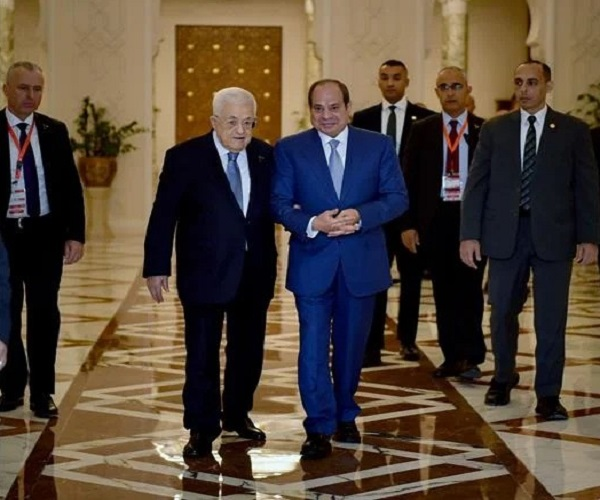
President Abdel-Fattah El-Sisi has renewed Cairo’s opposition to any attempt to remove Palestinians from the Gaza Strip or undermine the Palestinian national cause during talks with Palestinian President Mahmoud Abbas.
The meeting in Cairo took place after Israeli Defence Minister Israel Katz said that the Israeli military was prepared to resume a large-scale campaign in Gaza, target Hamas and carry out what he called a “migration plan” for Palestinians in the territory.
Egyptian officials said President El-Sisi made clear that Cairo rejected any proposal aimed at forcing Palestinians to leave Gaza or permanently altering the demographic and political character of the territory. The president also reaffirmed Egypt’s support for Palestinian rights and its commitment to preventing the displacement of Gaza’s population.
The meeting between President El-Sisi and President Abbas focused on the future of Gaza, efforts to preserve a ceasefire and the political arrangements needed to prevent the separation of the coastal enclave from the occupied West Bank.
According to the Egyptian presidency, Cairo is continuing its contacts with the parties involved in the ceasefire agreement in an effort to ensure that its provisions are respected. Those efforts include maintaining the halt in hostilities, increasing the flow of humanitarian assistance into Gaza and preparing the conditions for recovery and reconstruction.
Egypt has played a central role in regional mediation efforts since the war began. Its geographic position, border with Gaza and relationship with both Palestinian and regional actors have made Cairo an important channel for negotiations over ceasefire arrangements, aid deliveries and the release of detainees.
President Abbas warned during his discussions with President El-Sisi against any plan that would separate Gaza from the West Bank. He also rejected arrangements that could divide the West Bank into disconnected areas, stressing the importance of preserving the territorial unity of the Palestinian territories.
The Palestinian president’s remarks reflected concerns over proposals for Gaza’s postwar administration that could leave the enclave politically isolated from the West Bank. Palestinian officials have repeatedly insisted that Gaza, the West Bank and East Jerusalem must remain part of a single national and political framework.
Katz’s comments have added to those concerns. The Israeli defence minister said that a renewed military operation was ready to begin if Israel’s political leadership ordered it. He linked a possible offensive against Hamas to the implementation of a plan under which large numbers of Palestinians could leave Gaza.
Israeli officials have used different language when describing the proposal. Katz has previously referred to possible arrangements involving departures by land and sea, while presenting the idea as voluntary. Other Israeli officials have said that Israel does not intend to forcibly remove Palestinians but would not prevent people from leaving if another country agreed to receive them.
For Egypt and the Palestinian leadership, however, the distinction between “voluntary” departure and forced displacement remains highly contentious. Egyptian officials have argued that continued military pressure, destruction of homes and restrictions on essential supplies could make any mass departure effectively coercive, even if people were not formally ordered to leave.
The Gaza war has created conditions of widespread destruction and repeated displacement. Since the conflict began in October 2023, most residents have been forced to move within the territory at least once, according to humanitarian assessments. Large sections of Gaza’s housing, medical, water and transport infrastructure have also been damaged or destroyed.
Health authorities in Gaza have reported more than 73,700 Palestinian deaths since the start of the war. The figures do not consistently distinguish between civilians and combatants, but United Nations officials have said the ministry’s overall casualty data is considered credible.
The humanitarian situation has remained unstable despite a ceasefire announced in October 2025. Reports of continued Israeli strikes and further civilian deaths have raised fears that the truce could collapse and that Gaza may face another period of intense fighting.
A recent building collapse in Gaza City, involving a structure damaged during the war, reportedly killed at least 20 Palestinians, including children. The incident illustrated the continuing dangers faced by residents even in areas where active combat has decreased.
During their Cairo meeting, President El-Sisi and President Abbas also emphasized the need to expand humanitarian access. Egypt has called for sufficient quantities of food, medicine, fuel and other essential supplies to enter Gaza, while warning that aid deliveries cannot substitute for a durable political settlement.
The Egyptian president’s position reflects Cairo’s broader regional policy. Egypt views the displacement of Palestinians from Gaza as a threat to its national security, a potential source of prolonged instability and a direct challenge to the possibility of establishing an independent Palestinian state.
By receiving President Abbas and reiterating its opposition to displacement, Cairo sought to reinforce the principle that Gaza’s future must be determined within a broader political solution. Egypt maintains that any lasting settlement must preserve Palestinian territorial unity, support reconstruction and lead to a fair resolution based on international legitimacy and Palestinian statehood.
