

Ahmed Kamel – Egypt Daily News
Ukraine has carried out its most extensive drone assault yet on Russia’s capital, striking Moscow in a coordinated overnight attack that damaged energy infrastructure and disrupted civilian aviation. The масштаб of the operation signals a new phase in the war, with Kyiv increasingly capable of sustaining deep strikes far inside Russian territory.
Russian authorities reported that air defenses intercepted at least 194 drones headed toward Moscow, according to city officials, while nearly 1,000 drones were reportedly engaged across Russia. The intensity of the barrage far exceeded previous waves, highlighting how rapidly Ukraine’s long-range drone program has evolved.
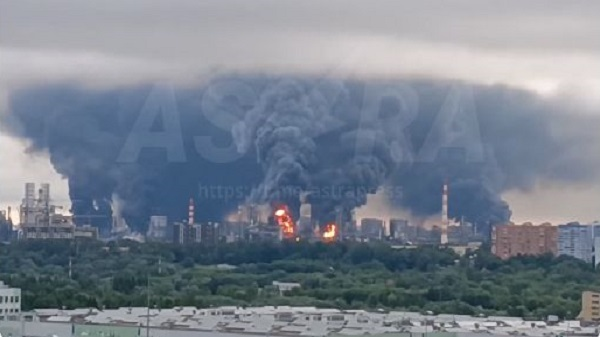
One of the most significant impacts came from a strike on the Moscow Oil Refinery in the Kapotnya district, located close to the Russian capital’s administrative core. Explosions and fires were reported at the facility, with footage circulating showing thick smoke rising from industrial infrastructure.
The attack also forced temporary shutdowns at multiple Moscow airports, disrupting flights and triggering emergency response measures across the region. Russian officials confirmed injuries, with at least 17 people reported wounded during the overnight operation.
Residents in southeastern Moscow described a night of repeated explosions, shaking buildings, and heavy smoke drifting through residential districts. Many accounts pointed to widespread fear and confusion as air defenses operated continuously over the capital.
Volodymyr Zelenskyy framed the strikes as a response to continued Russian attacks on Ukrainian cities and infrastructure, emphasizing that Kyiv’s actions were retaliatory in nature. He argued that pressure on Russian territory is necessary to push Moscow toward ending the war.
The operation formed part of a wider Ukrainian campaign targeting Russian energy assets, which have become a central focus of Kyiv’s military strategy. Refineries, fuel depots, and logistics hubs have increasingly been struck in an effort to weaken Russia’s war-sustaining economic base.
In response, Russia launched its own large-scale missile and drone attacks across Ukraine, targeting energy and industrial infrastructure in multiple regions. Russian officials described these strikes as retaliation aimed at degrading Ukraine’s military capacity.
Sergei Lavrov stated that Moscow would continue conducting regular strikes on Ukrainian facilities tied to military operations, reinforcing Russia’s escalation posture. The exchange reflects a growing cycle of infrastructure-based warfare between the two sides.
Ukraine’s expanding drone capability has become one of the defining features of the conflict in recent months, allowing deeper penetration into Russian territory than at any previous stage. Analysts say this shift reflects both technological adaptation and increased domestic production capacity.
Energy infrastructure has become a strategic battlefield, with Russia’s oil sector playing a central role in funding state revenues and war expenditures. Strikes on refineries therefore carry both military and economic pressure points for Moscow.
The latest escalation also comes amid heightened international diplomacy, with NATO allies discussing expanded air defense support for Ukraine. Western governments continue to balance military assistance with concerns about escalation risks.
The Moscow attack underscores how the war has shifted into a long-range technological conflict, where drones are increasingly shaping outcomes far from traditional front lines. It also signals that neither side is currently willing to reduce pressure, despite growing international calls for de-escalation.
