

Ahmed Kamel – Egypt Daily News
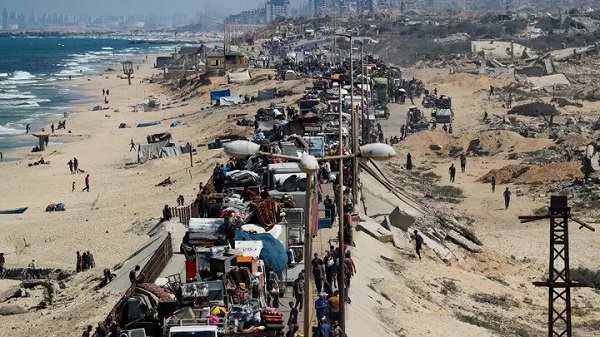
As Israeli ground forces press deeper into Gaza City, the Israeli military has announced the opening of a temporary evacuation corridor for Palestinian civilians. The corridor, accessible via Salah al-Din Street, will remain open for 48 hours, from noon on Wednesday until noon on Friday, allowing residents of the besieged city a limited window to flee southward. The move comes amid an escalating military campaign aimed at rooting out Hamas fighters and evacuating civilians from Gaza’s densely populated urban center.
The Israeli military said the new route was intended to facilitate safer movement for civilians, who have largely resisted previous evacuation orders. In leaflets dropped over the city, the army instructed residents to follow designated yellow-marked routes on accompanying maps and warned them to obey security forces and traffic signals during the evacuation.
However, the evacuation remains fraught with danger. Civilians attempting to flee on foot, by donkey carts, or in overcrowded vehicles have faced airstrikes, poor road conditions, and a lack of basic necessities in southern Gaza, where displacement camps are overwhelmed and food shortages are severe.
“I’d rather die here in my neighborhood than be forced into the unknown,” said Ahmad, a schoolteacher from Gaza City’s Sabra district, in a phone interview. “If we leave, who can guarantee we’ll ever return? Will this war even end?”
Heavy Bombardment and Civilian Casualties
The humanitarian situation continues to deteriorate rapidly. According to Gaza’s health authorities, at least 40 people were killed across the Strip on Wednesday, with 30 of those fatalities occurring in Gaza City. Among the latest incidents was an Israeli drone strike that targeted a children’s hospital Al-Rantisi Pediatric Hospital. While no injuries were reported, the strike forced the evacuation of dozens of sick children and their families.
“This hospital is the only specialized facility for children suffering from cancer, kidney failure, and other life-threatening conditions,” said Fikr Shalltoot, Gaza Director of Medical Aid for Palestinians, a UK-based NGO. “Even these children are no longer safe.”
The Israeli military has not commented on the incident, which has drawn widespread condemnation from aid agencies and international observers.
Tanks Move In, Fighting Expected to Last Months
A day after Israel formally launched its ground assault on central Gaza City, tanks have pushed forward from three directions, advancing into western and central areas. While no major territorial gains were reported, Israeli officials say the primary focus at this stage is to pressure remaining civilians to evacuate southward before intensifying urban combat.
An Israeli official told local media that the military anticipates several months of fighting and expects around 100,000 civilians to remain in Gaza City. The source added that operations could pause if ceasefire negotiations with Hamas make progress, a prospect that currently seems remote.
Hopes for a ceasefire were further diminished after a recent Israeli strike targeting Hamas political leaders in Doha infuriated Qatari mediators. Prime Minister Benjamin Netanyahu has shrugged off mounting international criticism including from the United States and vowed to pursue Hamas leaders wherever they may be. “We will strike Hamas leadership anywhere in the world,” Netanyahu said, rejecting calls for restraint.
U.S. Secretary of State Marco Rubio, who visited Doha on Tuesday, said a ceasefire could be reached in a “very short time,” although his comments seemed disconnected from Israel’s publicly stated military goals of dismantling Hamas’s infrastructure in Gaza.
International Criticism Mounts
The Israeli operation has sparked growing outrage worldwide. The United Nations, several governments, and humanitarian agencies have condemned the military campaign for triggering mass displacement and destroying civilian infrastructure.
A recent UN Commission of Inquiry concluded that Israel has committed acts of genocide in Gaza—a claim dismissed by Israeli officials as “outrageous” and “baseless.”
Since the beginning of Israel’s renewed military campaign in August, Gaza’s Hamas-run Government Media Office reports that over 1,600 residential buildings have been destroyed or severely damaged. Additionally, more than 13,000 tents sheltering displaced people in Gaza City have been wiped out by airstrikes.
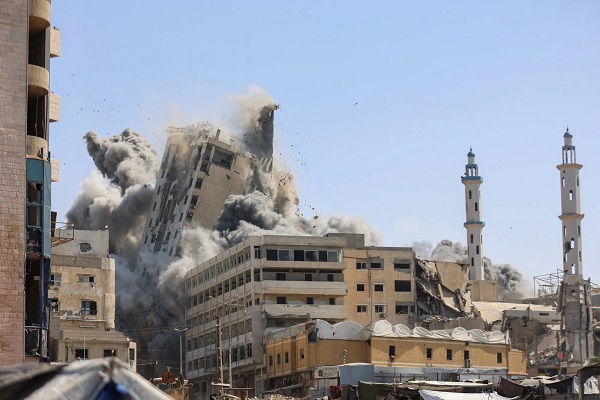
In the central refugee camp of Nuseirat, an Israeli airstrike on a multi-story building on Wednesday forced residents of surrounding buildings to flee in panic. In the south, even the so-called “safe zones” designated by Israel have proven vulnerable. On Tuesday, five people were killed in a strike on a vehicle fleeing Gaza City toward the south.
United Nations officials and Palestinian residents alike have stressed that there is no truly safe location within the enclave. “Gaza is being erased,” said Ahmad. “This ancient city is disappearing before the eyes of a world too afraid to act.”
Death Toll Rises Amid Prolonged Conflict
The Gaza Health Ministry reports that more than 64,000 people have been killed in the Strip since the start of Israel’s military campaign, which began following Hamas’s October 2023 attack that left 1,200 Israelis dead and saw 251 taken hostage. While many hostages remain unaccounted for, the humanitarian catastrophe in Gaza continues to expand at a devastating pace.
The forced displacement of hundreds of thousands from Gaza City to southern areas has created a sprawling crisis. Nearly a million residents had returned to Gaza City after its initial destruction in 2023, many living amid the rubble. Now, once again, they are being pushed into overcrowded camps with little food, water, or shelter facing the harsh reality of a war with no end in sight.
