

Ahmed Kamel – Egypt Daily News
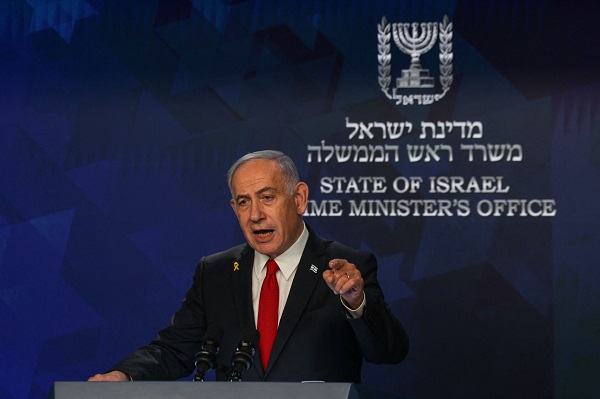
Israeli Prime Minister Benjamin Netanyahu announced a significant escalation in military operations against Iran, stating that Israeli forces have intensified strikes on infrastructure used by the Islamic Revolutionary Guard Corps.
Speaking in remarks carried by Israeli media on Tuesday evening, Netanyahu said the Israeli Air Force had targeted railway lines and bridges across multiple areas in Iran. He claimed these networks were being used by the Revolutionary Guard to transport raw materials for weapons production, as well as to move arms and personnel involved in operations against Israel, the United States, and regional allies.
Netanyahu emphasized that the strikes were not directed at the Iranian population but rather at weakening the ruling system. He described the campaign as part of a broader effort to shift the balance of power in the region, asserting that both Iran and Israel had entered a new phase of confrontation.
Israeli officials indicated that approximately ten railway bridges were struck in coordinated air raids, with the stated objective of restricting the mobility of the Revolutionary Guard. The strikes appear to form part of a wider strategy aimed at degrading Iran’s logistical and economic infrastructure.
Reports from Iranian state media suggested that some of the attacks were carried out jointly by Israeli and American forces, including a strike on a bridge near the city of Qom, located north of Isfahan. Local officials cited by Iranian television confirmed damage in the area, though details remain limited.
Additional unverified reports pointed to airstrikes on bridges along the Tabriz–Zanjan highway in northwestern Iran, as well as the Yahya Abad bridge in central regions of the country. In Kashan, a railway bridge was reportedly hit, resulting in at least two fatalities, according to preliminary accounts.
Israel has warned that further strikes on Iranian infrastructure may follow, framing the campaign as an effort to impose economic costs on the Iranian leadership. Analysts note that targeting transport networks represents a shift toward broader strategic pressure, beyond purely military installations.
The developments come amid an increasingly volatile regional environment, with multiple actors engaged in overlapping military actions and competing narratives. Independent verification of specific strike details remains limited, and the full extent of damage and casualties is still emerging.
