

Ahmed Kamel – Egypt Daily News
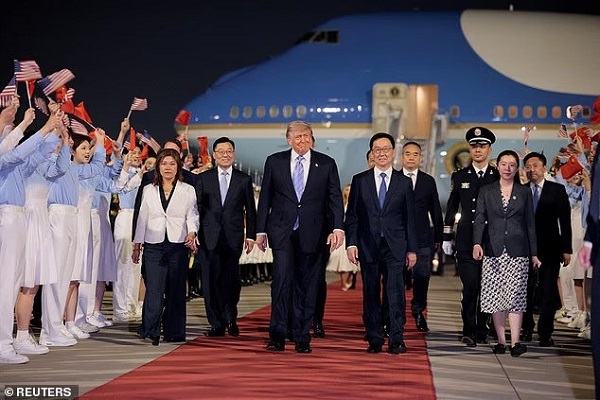
United States President Donald Trump arrived in Beijing on Wednesday in a dramatic display of ceremony and political symbolism, greeted by hundreds of chanting Chinese schoolchildren waving American and Chinese flags as he began one of the most consequential diplomatic visits of his presidency.
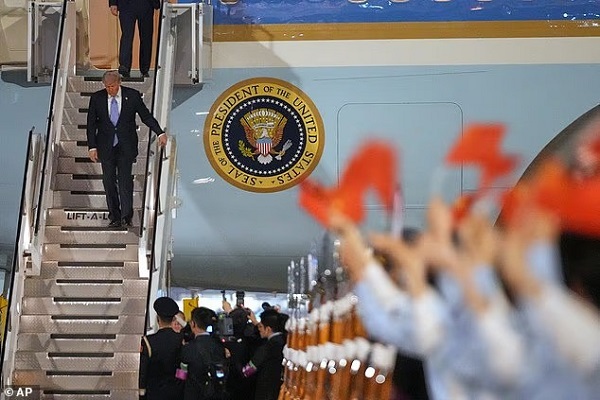
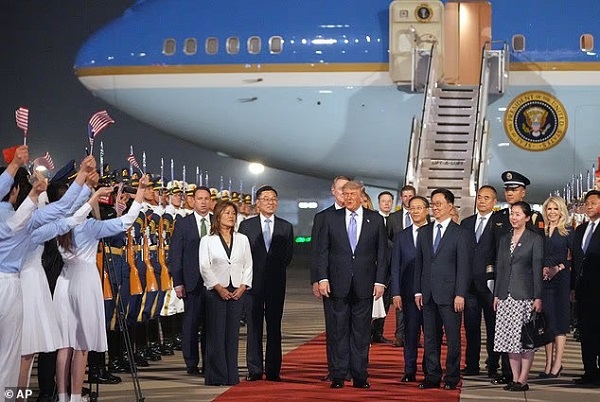
Stepping off Air Force One to a full military honor guard and a red-carpet reception, Trump smiled broadly and delivered his trademark fist pump while crowds shouted “welcome” in Mandarin. Chinese Vice President Han Zheng personally received the American leader at Beijing airport alongside senior Chinese and U.S. officials, signaling the importance Beijing is placing on the summit.
The visit marks the first trip by a sitting American president to China in nearly a decade and comes at a moment of mounting global instability, with Washington and Beijing balancing fierce economic rivalry against urgent diplomatic cooperation on trade, artificial intelligence, Taiwan, and the ongoing Iran conflict.
Trump arrived accompanied by a powerful delegation that blurred the line between diplomacy and corporate strategy. The presidential entourage included tech billionaire Elon Musk, Secretary of State Marco Rubio, Defense Secretary Pete Hegseth, and NVIDIA chief executive Jensen Huang, alongside some of America’s most influential business leaders from the finance, aerospace and technology sectors.
The optics were unmistakable: Trump did not arrive in Beijing merely as a politician, but as the leader of what aides described as an “economic strike force” aimed at resetting U.S.-China commercial relations while securing major agreements for American industries.
The summit with Chinese President Xi Jinping is scheduled for Thursday morning at the Great Hall of the People, where the two leaders are expected to hold nearly two hours of closed-door talks before attending an official state banquet.
Behind the ceremonial warmth lies a deeply tense geopolitical backdrop.
Trump postponed the China trip earlier this year as the U.S.-Israel military campaign against Iran intensified. Although a fragile ceasefire has temporarily slowed the conflict, Washington remains heavily involved in regional negotiations, and Trump is now reportedly seeking Xi’s assistance in pressuring Tehran toward a long-term settlement.
China remains Iran’s largest energy customer, giving Beijing considerable leverage over the Iranian economy and making Xi a potentially critical player in any future diplomatic framework.
At the same time, trade tensions between Washington and Beijing remain unresolved despite progress following last year’s tariff negotiations. Trump is expected to push China to increase purchases of American agricultural goods, beef and Boeing aircraft, while Chinese officials are seeking relief from U.S. tariffs that continue to weigh heavily on China’s export-driven economy.
Taiwan is also expected to dominate discussions.
The Trump administration recently approved an $11 billion arms package for Taiwan, triggering anger in Beijing, which considers the island part of Chinese territory. Senior House Democrats urged Trump this week not to weaken American commitments to Taiwan during negotiations with Xi, warning against allowing Beijing to dictate U.S. policy toward the self-governed island.
The issue carries enormous economic implications beyond military tensions. Taiwan’s dominance in advanced semiconductor manufacturing has made the island central to the global artificial intelligence race, an area where both Washington and Beijing are competing aggressively for technological supremacy.
Trump has increasingly framed the Beijing summit as a business-first mission focused on economic stabilization rather than ideological confrontation.
“I will be asking President Xi, a leader of extraordinary distinction, to open up China,” Trump wrote on social media during the flight to Beijing. “These brilliant people can work their magic.”
That message reflects a broader shift in Trump’s foreign policy approach, relying heavily on private industry leaders as extensions of American strategic influence abroad.
The inclusion of corporate executives from firms such as Boeing, Goldman Sachs and GE Aerospace underscores the administration’s attempt to turn geopolitical competition into a series of transactional economic deals capable of easing inflationary pressures at home while restoring investor confidence amid continued uncertainty over the Iran war.
For Beijing, the visit offers an opportunity to stabilize relations with Washington after months of economic turbulence and escalating rhetoric. Chinese officials are expected to advocate for new bilateral mechanisms that could reduce trade volatility and improve investment flows between the world’s two largest economies.
Despite the carefully choreographed welcome ceremony, analysts caution that the summit remains highly unpredictable.
Trump and Xi enter the talks with competing visions for global influence, growing military tensions in the Indo-Pacific, and vastly different economic priorities. Yet both leaders also face mounting domestic pressures that make diplomatic breakthroughs increasingly valuable.
As Trump begins two days of meetings and state events in Beijing, the world will be watching closely to see whether the summit produces meaningful agreements, or merely a temporary pause in the widening rivalry between Washington and Beijing.
