

Ahmed Kamel – Egypt Daily News
The government of Israel officially agreed to withdraw its military forces from two separate strategic areas in southern Lebanon following intensive diplomatic negotiations in Washington. Prime Minister Benjamin Netanyahu announced that control of these specific evacuated positions will be transferred directly to the Lebanese national armed forces.
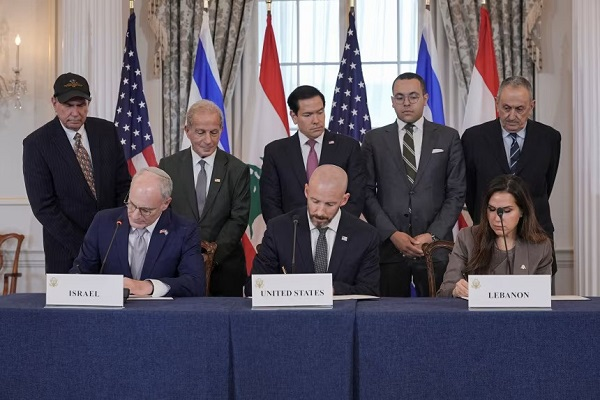
The trilateral agreement involves direct mediation from the United States to establish a foundational framework for potential comprehensive regional stability. Diplomatic officials from all three participating nations gathered at the state department to finalize the signatures after four days of intensive meetings.
Dual Extraction Strategy Dictates Tactical Troop Realignment
The planned military pullback will occur across two distinct geographic zones located both north and south of the Litani River. Netanyahu described the localized movements as a calculated departure from structural positions that his military defense establishment no longer strictly requires.
United States Secretary of State Marco Rubio celebrated the finalized treaty as a vital initial step toward restoring long-term security across the contested frontiers. The regional troop adjustments are being executed as a specialized pilot program integrated into the broader active ceasefire framework.
Defensive Posturing Retains Long Term Territorial Control
The political leadership in Tel Aviv maintains that the targeted repositioning represents a major strategic victory rather than a forced concession. Netanyahu clarified that his forces will continue to occupy the vast majority of the southern border zone until the complete disarmament of hostile regional militias is successfully achieved.
The prime minister explicitly noted that the diplomatic development delivers a significant geopolitical blow to adversarial networks in Tehran. Regional security partners view the joint statement as a direct declaration that external actors have no authority over the sovereign border arrangements.
Armed Factions Reject Bilateral Diplomatic Compromise
Lebanese Ambassador to the United States Nada Hamadeh Moawad expressed deep optimism that the treaty will actively restore territorial integrity to her home nation. However, several opposing political factions within the national parliament have already fiercely denounced the direct engagement with foreign authorities.
Prominent opposition leaders publicly condemned the administrative compromise and demanded an immediate retraction of all collaborative decisions. This internal political friction highlights the immense complexity facing local coordinators as they attempt to deploy national troops into the newly vacated territories.
