

Ahmed Kamel – Egypt Daily News
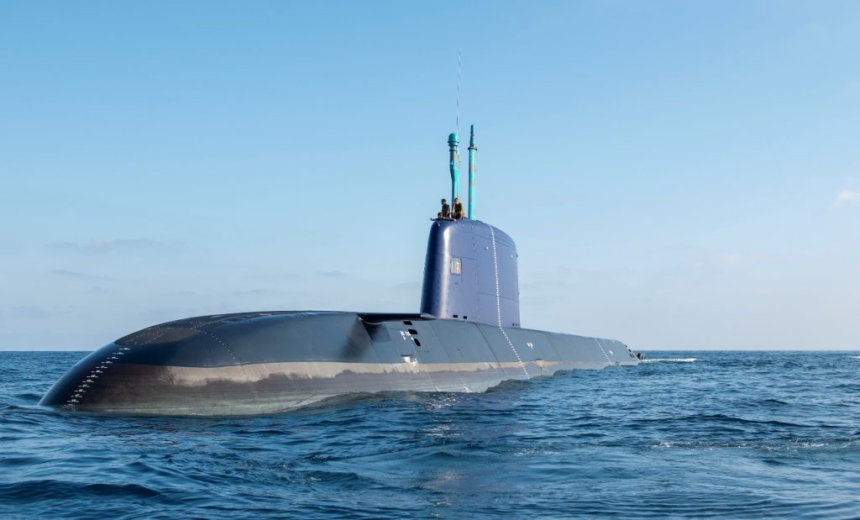
ThyssenKrupp Marine Systems has officially launched the INS Drakon submarine at its corporate shipyard in Kiel, Germany. The highly specialized vessel represents the sixth and final installment of the Dolphin-II class fleet.
The submarine quietly commenced its initial open-water sea trials within Kiel Bay without any public ceremony or media presence. This secretive handoff reflects the sensitive nature of the underlying bilateral defense agreement between Berlin and Tel Aviv.
Unique Elongated Hull Architecture Integrates Advanced Undersea Propulsion Systems
Naval architecture experts note that the INS Drakon is significantly larger and longer than its immediate structural predecessors. The vessel utilizes an elongated hull design specifically engineered to accommodate complex Air-Independent Propulsion frameworks.
This advanced engineering allows the submarine to remain submerged for extended durations without exposing its position to surface tracking systems. The structural modification heavily enhances the vessel’s acoustic stealth capabilities and overall underwater survivability.
Enlarged Sail Configuration Sparks Global Speculation Regarding Hidden Payloads
The most defining visual feature of the newly launched submarine is its uniquely enlarged sail configuration. The massive superstructure represents a historic design variation never before utilized in modern German submarine manufacturing.
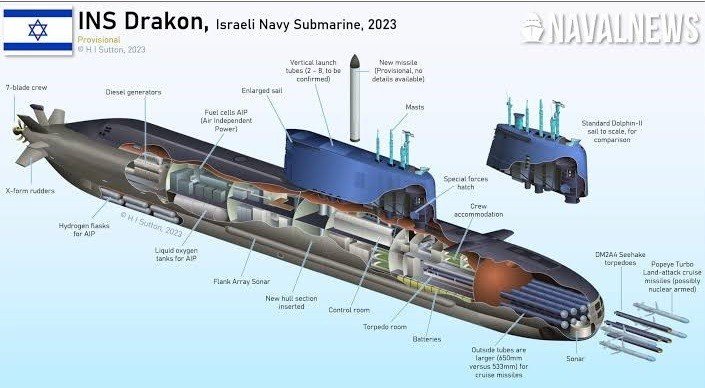
Military analysts suggest this expanded internal space is explicitly designed to house a highly advanced vertical launch system. This specialized vertical compartment adds several meters of vertical clearance, allowing the vessel to carry larger payloads.
Dual Tactical Weapon Arrays Combine Vertical Launch Tubes with Specialized Bow Torpedoes
The implementation of vertical launch tubes within the sail allows the vessel to deploy long-range ballistic projectiles. These modern assets are believed to feature guided final stages to execute precise land-attack operations.
Concurrently, the INS Drakon retains four oversized bow torpedo tubes alongside its standard tactical weapon arrays. These larger apertures are specifically configured to launch domestically developed cruise missiles capable of carrying strategic deterrent payloads.
Retaining Legacy Systems Provides Operational Redundancy During Active Transition Phases
The unexpected integration of both vertical launch systems and bow cruise missile tubes has surprised international intelligence agencies. This dual configuration suggests that the newly engineered vertical missiles are not an immediate replacement for existing cruise arrays.
Defense researchers believe the layout allows the submarine to function as a test bed for new weapons while maintaining operational readiness. This setup ensures continuous mission capability while crews complete technical validation trials over the coming years.
Bakar Class Future Fleet Bridge Established via Custom German Undersea Prototypes
The physical dimensions of the INS Drakon serve as an immediate architectural bridge to Israel’s future Dakar-class submarine program. Upcoming fleet iterations are projected to replicate this elongated hull and magnified sail structure to maximize tactical payload volumes.
The German government has historically restricted these specific Dolphin customizations exclusively to the Israeli Navy, refusing alternative global export requests. Berlin heavily subsidizes the construction costs of these vessels to actively enforce regional Qualitative Military Edge policies.
Regional Defensive Doctrines Drive Surging Procurement Programs Across Neighboring States
The unilateral introduction of such advanced maritime hardware continues to influence broader procurement strategies across the Eastern Mediterranean basin. Diplomatic representatives from adjacent Arab states, including Egypt, frequently emphasize that long-term regional stability requires technological balance rather than asymmetrical military advantages.
As a result, regional maritime powers are expanding their own naval modernization programs to defend sovereign littoral borders. These domestic security investments focus on acquiring competitive surface combatants and specialized anti-submarine warfare technologies to protect vital economic zones.
