

Ahmed Kamel – Egypt Daily News
Egypt and China have agreed to further deepen their comprehensive strategic partnership, expand economic and technological cooperation, and strengthen coordination on regional and international issues.
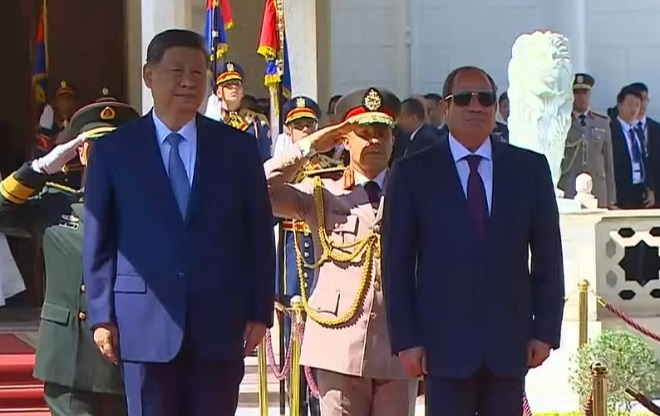
The agreement was announced in a joint statement issued following Chinese President Xi Jinping’s state visit to Egypt on September 1 and 2, 2026, at the invitation of President Abdel Fattah El-Sisi. The visit coincided with the 70th anniversary of the establishment of diplomatic relations between the two countries.
The statement said the talks between President El-Sisi and President Xi covered the full range of bilateral relations, which have witnessed significant development since the launch of the comprehensive strategic partnership in 2014. The two leaders also exchanged views on regional and international issues of common concern and reached broad areas of agreement.
Bilateral relations
- The two presidents agreed to deepen the comprehensive strategic partnership by maintaining high-level exchanges, making effective use of the strategic dialogue between the two foreign ministers and other mechanisms, strengthening strategic coordination, consolidating mutually beneficial cooperation in all fields, and expanding coordination on global governance issues. They also agreed to defend the interests of developing countries and the Global South.
- Both sides expressed their desire to build on the progress achieved in bilateral relations in recent years and work toward advancing the construction of an Egypt-China community with a shared future. The Chinese side praised the principle of strategic balance established by Egypt, saying that it supports international multilateralism.
- The two sides reaffirmed their firm mutual support on issues related to the core interests and major concerns of either country.
The Chinese side acknowledged the vital importance of the Nile River to Egypt as its main lifeline, as well as Egypt’s legitimate right to protect its water and food security and development interests. Both sides called on all Nile Basin countries to comply with international law, including the obligation not to cause harm to other states.
The Egyptian side reaffirmed its opposition to interference in China’s internal affairs and its continued commitment to the one-China principle. Egypt confirmed that Taiwan is an inseparable part of the territory of the People’s Republic of China, supported China’s position on issues concerning its sovereignty and territorial integrity, and backed efforts to achieve China’s reunification.
- Egypt praised the historic development achievements made by China under President Xi Jinping’s leadership and expressed its support for China’s efforts to build a strong country and achieve the comprehensive rejuvenation of the Chinese nation.
The Chinese side, in turn, expressed its appreciation for Egypt’s achievements in state-building and development under President Abdel Fattah El-Sisi within the framework of the “New Republic.”
- The two presidents praised the continuation of successful cooperation on major projects in infrastructure, transportation, energy, manufacturing, space and technology. This includes the continued implementation of joint cooperation under the Belt and Road Initiative, support for the development of the Suez Canal Economic Zone, and encouragement for companies from both countries to cooperate on renewable energy, artificial intelligence, digital transformation and local manufacturing projects.
- The two sides agreed to work toward deeper alignment between Egypt’s Vision 2030 and the Belt and Road cooperation initiative. The goal is to help transform Egypt into a regional hub for industry, logistics, clean energy and the digital economy, linking Asia, Africa and Europe.
This will involve strengthening Egyptian-Chinese partnerships, encouraging Chinese companies to benefit from Egypt’s competitive advantages and actively exploring cooperation in localizing industries. Priority areas include electric vehicle manufacturing, shipbuilding, renewable energy such as solar panels and wind towers, and seawater desalination.
The two sides also agreed to expand cooperation in advanced technologies, including cloud computing, data centers, the data economy, semiconductors, cybersecurity, space applications, remote sensing, critical mineral supply chains, agriculture and automobile manufacturing. They also emphasized the importance of developing human capabilities and exchanging expertise and technology to support Egypt’s digital transformation and sustainable development.
- The presidents expressed their appreciation for existing financial cooperation, including the issuance of Chinese panda bonds and the expansion of local -currency swap arrangements. They encouraged financial institutions in both countries to support industrial and development investments, infrastructure projects, and green and digital transformation initiatives.
In this regard, the two leaders welcomed the renewal of the currency-swap agreement between Egypt and China and the increase of its value.
- The two sides agreed to expand and strengthen tourism cooperation. China welcomed the increase in the number of Chinese tourists visiting Egypt, while both countries supported cooperation in hotel construction and resort management.
They also agreed to enhance cooperation in media, culture, higher education, scientific research and youth exchanges.
- The presidents welcomed implementation of the Executive Program for the Comprehensive Strategic Partnership for 2024–2028. They agreed to increase the use of local currencies in trade and investment and encourage more commercial and investment transactions to be settled in local currencies.
Egypt welcomed China’s measures to exempt African countries from customs duties. The two presidents also agreed to work toward achieving greater balance in bilateral trade and encouraging more Egyptian products to enter the Chinese market in accordance with Chinese standards. They further agreed to continue consultations on the “early harvest” agreement.
- The two presidents instructed the relevant authorities in both countries to strengthen communication and implement the agreements reached during the visit, including convening the joint governmental committee at the earliest possible opportunity.
- On the occasion of the 70th anniversary of diplomatic relations, the presidents praised the deep historical friendship between the ancient Egyptian and Chinese civilizations. They welcomed the organization of a series of joint events and celebrations, including activities marking the “China-Africa Year of Cultural and People-to-People Exchanges 2026.”
- Egypt and China agreed to continue strengthening cooperation in law enforcement and security, work jointly to combat transnational crime, and accelerate consultations on signing an extradition agreement. They also agreed to enhance communication and cooperation in combating terrorism and provide firm support for each other’s counterterrorism efforts.
Both sides strongly rejected terrorism in all its forms and rejected linking terrorism to any particular state, race or religion. They also rejected double standards in counterterrorism and opposed harboring or supporting terrorist forces under any pretext. The two countries affirmed their commitment to jointly combat all terrorist organizations.
- The Chinese side praised Egypt’s development efforts, particularly the “Decent Life” initiative, describing it as a development model aimed at improving citizens’ living standards and achieving comprehensive development.
Egypt, in turn, praised the Global Development Initiative launched by President Xi Jinping, describing it as one of the international initiatives contributing to accelerating the achievement of the United Nations Sustainable Development Goals under the 2030 Agenda. Egypt said it would continue actively participating in cooperation across all areas under the initiative.
Egypt also expressed its appreciation for China’s Global Civilization Initiative, particularly because both countries share principles based on respect for cultures and civilizations on the basis of equality. The two sides noted that Egypt and China are ancient civilizations with deep historical roots and major contributions to human history.
Egypt further praised China’s Global Security Initiative and Global Governance Initiative, saying that they contribute to addressing global challenges and promoting peace, development and shared prosperity.
Regional and international issues
- The two presidents affirmed their commitment to strengthening political and security coordination on regional and international issues of common concern. They agreed to maintain close coordination in support of peace, stability and development at the regional and international levels.
Both sides reaffirmed their commitment to the principles and purposes of the United Nations Charter and international law. They rejected double standards and unilateral actions and stressed the need to reform the international system and international financial institutions so that they become fairer, more representative of developing countries and more effective in responding to global challenges.
Egypt and China also agreed to strengthen coordination and cooperation in international forums, including the United Nations, BRICS, the Shanghai Cooperation Organization and the Group of 20. Their cooperation will include climate change, food security, energy and the digital economy.
Egypt expressed support for China’s presidency of BRICS in 2027 and its plans to host the 19th BRICS Summit. Egypt also welcomed China’s initiatives to establish the International Organization for Mediation and the World Organization for Cooperation on Artificial Intelligence.
- The presidents reaffirmed that the Palestinian issue is the central issue in the Middle East and stressed the importance of reaching a just and lasting settlement based on the two-state solution. Such a settlement, they said, should establish an independent and sovereign Palestinian state on the borders of June 4, 1967, with East Jerusalem as its capital.
They categorically rejected any plans to displace the Palestinian people from their land under any pretext or name. They called for consolidating the ceasefire in the Gaza Strip, facilitating the unrestricted flow of humanitarian aid and enabling the Palestinian Authority to return to Gaza as soon as possible.
The two sides also expressed concern over the dangerous Israeli escalation in the West Bank and East Jerusalem, including the rising level of settler violence, land confiscation and settlement construction. They stressed the importance of preserving the unity of the Palestinian territories, supporting the role of the United Nations Relief and Works Agency for Palestine Refugees in the Near East and protecting its mandate.
- The presidents said that strengthening stability in the Horn of Africa requires respect for the sovereignty, unity and territorial integrity of its states. They also stressed that responsibility for the governance and security of the Red Sea rests primarily with its coastal states and that their will must be fully respected.
They called for stronger regional cooperation among the Red Sea states to confront shared challenges and guarantee freedom of navigation and international trade.
- The two sides stressed the need to respect Sudan’s unity, sovereignty and territorial integrity, preserve its national institutions and refrain from interfering in its internal affairs. They affirmed their determination to work together to end the war in Sudan and launch a comprehensive political process owned by the Sudanese people.
- China praised Egypt’s central role in supporting regional security and stability and its continuing efforts to achieve comprehensive political settlements to geopolitical crises in the Middle East. China also commended Egypt’s support for good-neighborly relations, respect for state sovereignty and non-interference in internal affairs.
Egypt expressed its appreciation for President Xi Jinping’s vision on preserving and strengthening peace and stability in the Middle East.
The two sides welcomed regional and international efforts to reduce tensions, promote dialogue and reach political understandings that take the concerns of all parties into account and contribute to strengthening security and stability in the Gulf and the Middle East.
- The presidents praised the productive cooperation carried out through the China-Arab States Cooperation Forum and the Forum on China-Africa Cooperation. They affirmed their determination to continue implementing the outcomes of both forums and strengthening practical cooperation within their frameworks.
- The two presidents emphasized the importance of strengthening the voice of the Global South and supporting the right of developing countries to participate fairly and proportionately in international economic and political decision-making.
They also called for a greater role for emerging markets and developing countries in the international system.
The presidents agreed that the comprehensive strategic partnership between the Arab Republic of Egypt and the People’s Republic of China represents a model of cooperation between major developing countries. The partnership is based on mutual respect, non-interference in internal affairs, mutual benefit, joint development and solidarity among the countries of the Global South. They said it contributes to guiding the international system toward a fairer and more equitable direction.
- The two sides praised the productive results achieved during President Xi Jinping’s visit, describing it as an important milestone in the development of Egyptian-Chinese relations.
President Xi expressed his deep appreciation to President Abdel Fattah El-Sisi for the warm welcome and generous hospitality extended to him and his delegation. He invited President El-Sisi to visit China, and the Egyptian president accepted the invitation, promising to make the visit at a mutually convenient time.
