

Ahmed Kamel – Egypt Daily News
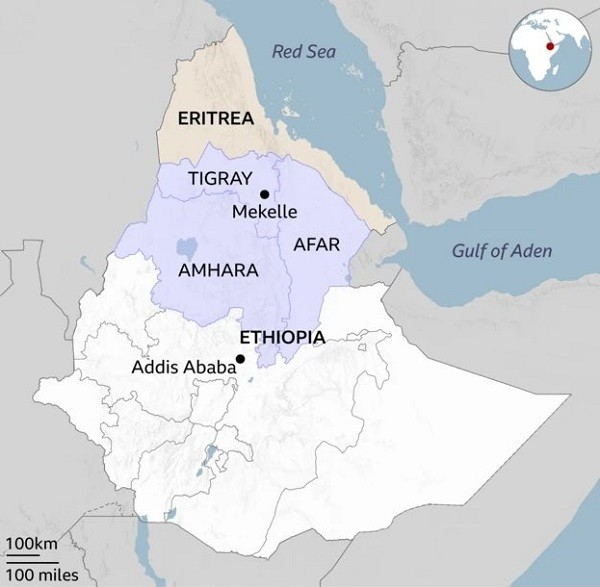
Ethiopia has called on the United Nations to respond to what it describes as Eritrean military aggression, deepening a confrontation between the neighbouring countries as fighting in Tigray renews fears of a wider conflict in the Horn of Africa.
Foreign Minister Gedion Timothewos raised the allegations during a meeting with visiting UN Deputy Secretary-General Amina Mohammed. Ethiopia’s government said he urged Eritrea to withdraw its forces from Ethiopian territory and called for the United Nations to take a clear position. Timothewos also said Ethiopia had the right to protect its sovereignty and territorial integrity.
State Minister of Foreign Affairs Berhanu Tsegaye separately accused Eritrea of military involvement on several fronts along the countries’ shared border. Ethiopian officials say the alleged activity threatens regional stability and could undermine attempts to contain the renewed conflict in Tigray.
Eritrea rejects Ethiopia’s accusations and has made counterclaims of its own. Asmara has accused Addis Ababa of pursuing a hostile agenda and supporting Eritrean armed opposition groups. Ethiopia’s allegations and Eritrea’s denials have not been independently verified in full, leaving the two governments’ competing accounts at the centre of a rapidly worsening diplomatic crisis.
The dispute has already produced a sharp break in official relations. Ethiopia closed its embassy in Asmara and expelled 10 Eritrean diplomats, accusing them of activities that posed a threat to national security. Eritrea responded by cutting diplomatic ties. With embassies closed and relations severed, direct communication between the governments has become more difficult at a moment when military developments are fuelling suspicion on both sides.
The deterioration comes amid renewed fighting in Tigray, Ethiopia’s northern region. Ethiopian federal forces and allied groups have clashed with forces aligned with the Tigray People’s Liberation Front. Federal troops have retaken Mekelle, the regional capital, following the withdrawal of TPLF-aligned forces. The conflict has raised concern that instability could spread towards the Eritrean border, particularly as both governments accuse the other of supporting armed groups.
The current crisis follows the devastating war in Tigray that lasted from November 2020 until the Pretoria peace agreement in November 2022. Eritrean troops fought alongside Ethiopian federal forces during much of that conflict, but Eritrea was not a party to the agreement that formally ended the fighting. The accord reduced large-scale hostilities but did not settle every dispute over regional power, territory or security.
That unresolved history adds to the risks of renewed confrontation. Ethiopia and Eritrea were once bitter enemies, then became partners during the Tigray war. Relations have since deteriorated again, with mutual accusations replacing cooperation. The latest dispute is unfolding in a region where armed groups, political rivalries and cross-border alliances can quickly complicate a local clash.
The countries also disagree over Ethiopia’s desire for access to the Red Sea. Ethiopia lost its coastline when Eritrea became independent in 1993 and has repeatedly described maritime access as a strategic national interest. Eritrean officials have treated Ethiopian statements on the issue with concern, particularly when they appear to question the status of ports or territory under Eritrean sovereignty. Addis Ababa says its objective can be pursued peacefully, while Asmara fears that the issue could become a source of pressure.
Ethiopia’s request for UN intervention now puts the international organization in a difficult position. Addis Ababa wants a forceful response to its allegations, while Eritrea contests the account and presents Ethiopia as the aggressor. The UN has emphasized the importance of respecting Ethiopia’s sovereignty, but that does not amount to an independent determination of what has happened along the border or a formal finding against Eritrea.
The immediate concern is that military incidents could escalate before diplomatic channels are restored. Ethiopia has alleged that Eritrean forces are operating inside its territory; Eritrea denies wrongdoing and accuses Ethiopia of supporting its opponents. With relations severed and fighting continuing in Tigray, each side may interpret the other’s actions as preparation for a broader confrontation.
For civilians in northern Ethiopia, another escalation could bring fresh displacement and deepen the humanitarian consequences of years of conflict. The Pretoria agreement ended one phase of the war, but it did not resolve the political and security tensions that now threaten to draw Eritrea and Ethiopia into direct confrontation. Preventing that outcome will require restraint on the ground and a credible means for the two governments to address their allegations before the crisis expands.
