

Ahmed Kamel – Egypt Daily News
Egypt has condemned attacks on civilians and civilian infrastructure in Sudan and criticized the United Nations Security Council for what it called an inadequate response to evidence that a neighboring country (Ethiopia) was enabling attacks by armed groups and foreign fighters.
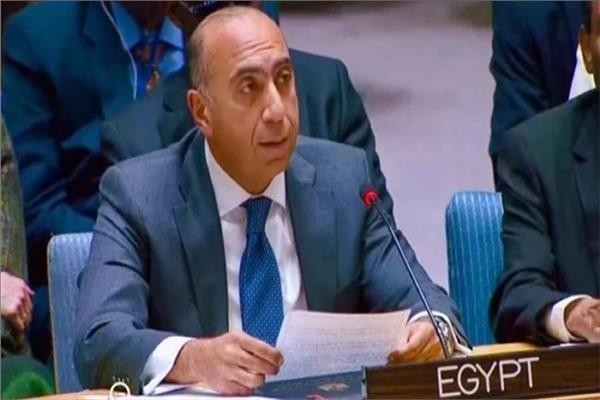
Speaking before the Council, Egypt’s representative, Ambassador Ehab Mostafa Awad, said Cairo was deeply concerned by the escalation of fighting and its widening geographic reach. He singled out Blue Nile state, warning that further violence there could drive new waves of displacement and deepen an already severe humanitarian crisis.
Awad said Egypt strongly condemned abuses against civilians attributed to the militia forces fighting in Sudan. Those responsible, he argued, must not be allowed to evade accountability. He also called for an end to the abuses and for action against entities he said were contributing to the conflict’s escalation.
The sharpest part of his statement focused on allegations of external involvement. Awad said Egypt was surprised that the Security Council had not responded more firmly to what he described as evidence that a neighboring state was helping enable attacks by militia forces and mercenaries, including drone strikes in Blue Nile. He urged the Council to issue a direct warning to the country concerned, calling on it to stop actions that could intensify the conflict and expose civilians to further destruction and fear.
The Egyptian statement did not identify the neighboring country in the account provided. Separately, recent reporting on the conflict has described allegations that Ethiopian territory was being used to support operations by Sudan’s Rapid Support Forces. Those claims have emerged amid an increasingly regionalized conflict and remain allegations, rather than independently established findings in the Egyptian statement.
Drone warfare has become a growing concern for diplomats and humanitarian organizations. Security Council discussions scheduled for mid-October were expected to address the use of drones by the warring parties and the risk that cross-border dynamics could draw neighboring states more deeply into the fighting. A Security Council monitoring report also described escalating clashes in Blue Nile and concerns about alleged support networks operating across the border. The reports underscore the difficulty of distinguishing verified facts from claims made by parties to a conflict in which responsibility for attacks is often contested.
Egypt’s intervention comes as the war continues to disrupt civilian life across Sudan. Fighting between the Sudanese Armed Forces and the Rapid Support Forces has devastated communities, damaged essential infrastructure and driven large numbers of people from their homes. In Blue Nile, the prospect of intensified clashes raises particular concern because further displacement would add to the pressure on people already seeking safety and on the services available to them.
Awad also highlighted the consequences of the war for Egypt. He said Cairo was bearing substantial humanitarian and economic costs and continuing to support about 1.5 million Sudanese people. Egypt’s assistance, he said, reflected the historic and humanitarian ties between the two populations.
The remarks connect Egypt’s diplomatic position to the practical demands of hosting and assisting people fleeing the conflict. Continued fighting can increase pressure on public services and aid systems, while also making it harder for humanitarian organizations to reach communities inside Sudan. Cairo’s appeal for accountability and restraint therefore accompanied a warning about the conflict’s effects beyond Sudan’s borders.
The Council faces a difficult task in responding to allegations of outside support while trying to preserve space for diplomacy and humanitarian access. Its members have differed over whether sanctions and arms-embargo measures should be expanded beyond Darfur to cover the wider country and all parties. Those disagreements have complicated efforts to respond to the changing nature of the conflict, including the growing use of drones.
Egypt’s appeal was for the Council to address alleged external involvement more directly and to press the neighboring state to avoid actions that could worsen the violence. At the same time, Awad’s statement called attention to the immediate protection of civilians, accountability for abuses, and the humanitarian burden carried by countries receiving people displaced by the war. The challenge for the Council, as the fighting spreads and accusations multiply, is to respond to those concerns without treating unverified claims as established fact.
