

Ahmed Kamel – Egypt Daily News
Israel has drawn renewed international criticism after Defence Minister Israel Katz said the country was prepared to remove Palestinians from the Gaza Strip if the United States approves a plan and helps identify countries willing to receive them.
Katz made the remarks during a political conference in Israel, presenting the proposed transfer of Gaza’s population as a long-term answer to the territory’s future. He said Israeli authorities had already considered how such an operation could be carried out, including through maritime and aviation routes.
The minister’s comments have raised immediate legal and diplomatic concerns. International humanitarian law prohibits the forcible transfer of civilians from occupied territory, except under narrowly defined and temporary circumstances linked to the safety of the population or military necessity. A permanent or coercive removal of Gaza’s residents could therefore amount to forced displacement, which is recognized as a war crime.
Katz argued that Gaza could not be stabilized without what he called “migration.” He said Israel was ready to act but needed Washington’s backing before proceeding. The United States has not publicly endorsed the latest version of the proposal. Officials at the US embassy directed questions to the State Department.
The plan echoes a controversial proposal previously raised by US President Donald Trump, who suggested that Gaza’s approximately two million residents should leave the territory. Trump said the area, heavily damaged during the war between Israel and Hamas, could then be rebuilt as a major coastal development.
The proposal encountered firm opposition from Arab governments, Palestinian political groups and much of the international community. Egypt was among the most vocal opponents. Cairo warned that removing Palestinians from Gaza would threaten regional stability and could permanently undermine the Palestinian right to self-determination.
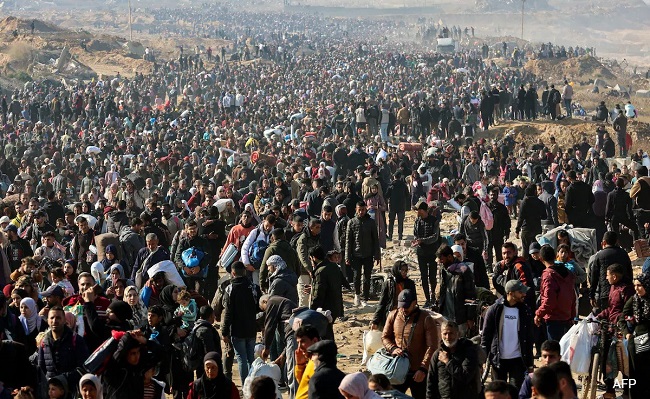
For Palestinians, the prospect of another mass displacement carries particular historical significance. The proposed transfer has been compared with the Nakba, the term Palestinians use for the mass expulsion and flight of their people during the 1948 war. Any attempt to force Gaza’s population across international borders is therefore viewed by Palestinian leaders as part of a broader effort to erase their national claims.
Trump later appeared to retreat from the idea following pressure from Arab states and other governments. A 20-point framework associated with a Gaza ceasefire included a commitment against compulsory displacement. Katz nevertheless said the concept had not been discarded, describing it as paused while the United States considered possible destinations outside Egypt.
Egypt again rejected the proposal in a joint statement issued with China after President Abdel-Fattah El-Sisi held talks with Chinese President Xi Jinping in Cairo. The two governments called for the continuation of the Gaza ceasefire and urged the immediate, unrestricted delivery of humanitarian aid.
Cairo and Beijing also reaffirmed their support for a negotiated settlement based on the establishment of a Palestinian state. Their statement backed a state within the borders that existed before the 1967 war, with East Jerusalem as its capital. Both countries rejected any Israeli plan to move Palestinians out of Gaza, regardless of whether it was described as resettlement, migration or humanitarian relocation.
The statement further supported restoring the Palestinian Authority’s role in governing Gaza. That position contrasts with Israel’s stated opposition to allowing Hamas to retain control and with uncertainty over who would administer the territory after the war.
Katz’s remarks also came as Israeli political parties compete over security policy and the future of Gaza. Prime Minister Benjamin Netanyahu has resisted calls for a full Israeli withdrawal and has insisted that Hamas must be disarmed before Israeli troops leave. Right-wing politicians have increasingly used demands for tougher military action and permanent Israeli security control to appeal to voters.
Netanyahu visited Israeli troops in Gaza on Wednesday and said Israel would maintain its positions inside the territory. Near the Yellow Line, a boundary marking areas controlled by Israeli forces and Hamas, he claimed that Israel held roughly 60% of the strip and would not withdraw from those positions.
The comments came despite international efforts to advance the next phase of a US-supported ceasefire arrangement. Negotiations have focused on the withdrawal of Israeli forces, the release of hostages and prisoners, the delivery of aid, the disarmament of Hamas and the political administration of Gaza.
The International Criminal Court issued arrest warrants in 2024 for Netanyahu and former Israeli Defence Minister Yoav Gallant over alleged crimes connected to the war. Israeli officials have rejected the court’s jurisdiction and denied the allegations.
After months of bombardment and ground operations, most of Gaza’s population has been displaced internally, while the death toll has reached tens of thousands, according to figures cited in the report. Aid organizations have warned that a formal effort to remove civilians from the territory would worsen the humanitarian emergency and make any future political settlement significantly more difficult.
