

Ahmed Kamel – Egypt Daily News
President Abdel Fattah El-Sisi has reaffirmed Cairo’s opposition to any attempt to forcibly displace Palestinians, saying lasting peace in the Middle East depends on the establishment of an independent Palestinian state.
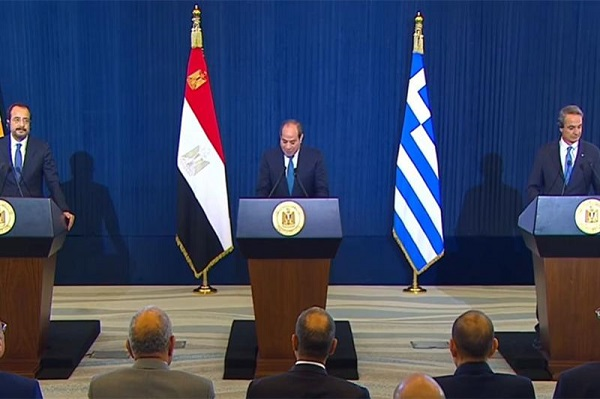
President El-Sisi made the remarks during a joint press conference with Greek Prime Minister Kyriakos Mitsotakis and Cypriot President Nikos Christodoulides, who traveled to Egypt for a summit under the Egypt-Greece-Cyprus Trilateral Cooperation Mechanism.
The leaders met in Alamein as the regional agenda was dominated by the conflict in Gaza, humanitarian access, energy security, maritime safety and political instability in Libya, Syria and Lebanon. Their discussions also covered migration, trade, investment and cooperation with the European Union.
“President El-Sisi renewed Egypt’s absolute rejection of any attempts aimed at displacing the Palestinian people, changing the demographic composition of the Palestinian territories or fragmenting them,” according to the Egyptian president’s remarks. He also stressed the importance of protecting Palestinians’ right to remain on their land.
Egypt’s position is that a just and comprehensive peace can only be achieved through the creation of an independent Palestinian state on the borders that existed before the June 1967 war, with East Jerusalem as its capital. El-Sisi said the Palestinian people have the right to live in peace on their land and establish their own state, describing that outcome as essential to regional security and stability.
He called for the implementation of all provisions of the Sharm El-Sheikh ceasefire agreement and the broader peace plan backed by U.S. President Donald Trump. He also urged the international community to ensure sustained and unrestricted humanitarian assistance reaches Gaza.
The Egyptian president said regional governments should prioritize de-escalation and political solutions rather than allowing existing conflicts to expand. He also reiterated Egypt’s rejection of attacks against Arab states, linking that position to what he described as a shared Arab security interest.
The three leaders’ meeting took place on the same day that President El-Sisi opened the second El Alamein International Airshow with President Christodoulides in attendance. The summit therefore combined political discussions with a highly visible display of military and civil aviation cooperation.
Cyprus supports two-state solution
President Christodoulides said Cyprus shared Egypt’s opposition to the forced displacement of Palestinians and reaffirmed his country’s support for a two-state solution.
He praised Egypt’s role in supporting regional stability and facilitating humanitarian assistance to Gaza. Because of Cyprus’s geographical position in the eastern Mediterranean, the country has been involved in efforts to deliver aid through maritime arrangements, including the Amalthea initiative.
The Cypriot president said the three countries had discussed developments across the Middle East and the need to contain escalation through diplomacy. He also expressed support for Lebanon’s unity and territorial integrity and reaffirmed Cyprus’ commitment to relations with Syria based on international law.
President Christodoulides highlighted the expanding scope of trilateral cooperation. He said the sixth meeting of the three countries’ defense ministers was expected to take place in Cairo within weeks, while a meeting of the foreign ministers was planned in New York in September. Cyprus is also scheduled to host the next trilateral summit.
Energy cooperation was another central issue. President Christodoulides described progress surrounding Cyprus’ Aphrodite offshore gas field as an important step toward allowing Cyprus to export natural gas through Egyptian infrastructure. Egypt has liquefaction facilities and export routes that could help deliver eastern Mediterranean gas to European markets.
The arrangement would strengthen Egypt’s role as an energy hub while giving Cyprus a potential route to commercialize offshore reserves. It would also support broader European efforts to diversify energy supplies.
Greece emphasizes stability and maritime security
PM Mitsotakis said regional stability must not mean accepting political stagnation or the continuation of unresolved conflicts. He called for a just peace in the Middle East and said the immediate priorities in Gaza included advancing the next stage of the ceasefire process, facilitating reconstruction and ensuring uninterrupted humanitarian aid.
The Greek prime minister praised Egypt’s diplomatic and humanitarian role and emphasized the importance of Cairo’s continued engagement in efforts to stabilize the region.
Regarding Libya, PM Mitsotakis backed the country’s unity and territorial integrity and called for a Libyan-led political process supported by the United Nations. He said that process should lead to credible, inclusive elections and prevent further foreign interference.
Greece also reiterated its support for a settlement of the Cyprus issue within the United Nations framework and in line with relevant Security Council resolutions.
Maritime security was another major concern. PM Mitsotakis said the safety of shipping routes stretching from the Strait of Hormuz through the Red Sea and Bab el-Mandeb has consequences far beyond the region. Egypt, Greece and Cyprus all depend heavily on maritime trade and therefore have a shared interest in protecting commercial routes, energy infrastructure and freedom of navigation.
The Greek leader also promoted the GREGY electricity interconnection project, which is intended to transmit renewable electricity from Egypt to Greece and eventually connect North African energy production with European markets. He described the project as a potential energy bridge between the two regions.
The leaders also discussed prospects for natural-gas cooperation involving Cyprus’ offshore resources, Egypt’s processing infrastructure and Greece’s liquefied-natural-gas facilities and distribution networks.
Broader regional agenda
The summit addressed the situations in Libya, Syria, Lebanon, Sudan, the Horn of Africa and the Red Sea. El-Sisi said Egypt, Greece and Cyprus shared an interest in preserving the unity and sovereignty of states and rejecting foreign military intervention, political fragmentation and unilateral actions.
The Egyptian president also raised the Nile water issue, which Cairo considers an existential national-security matter. He welcomed Greek and Cypriot support for Egypt’s position and called for compliance with international principles governing transboundary rivers, including the obligation to avoid harm, provide prior notification and refrain from unilateral measures.
The three countries also discussed migration and the movement of Egyptian workers to Greece and Cyprus through organized and legal channels. Security cooperation is expected to continue in areas including irregular migration, terrorism and organized crime.
The summit concluded with renewed support for the trilateral mechanism, which was established in 2014 as a framework for cooperation in the eastern Mediterranean. The leaders presented the partnership as a model for regional coordination at a time when conflicts, energy competition and maritime-security concerns are reshaping relations between Europe, North Africa and the Middle East.
