

Ahmed Kamel – Egypt Daily News
At least seven people were killed and 34 wounded when gunmen opened fire during a funeral at a Greek Orthodox church in southern Jordan on Friday, October 23, authorities said. King Abdullah II vowed a forceful response as security services launched a manhunt and investigators worked to establish who carried out the attack and why.
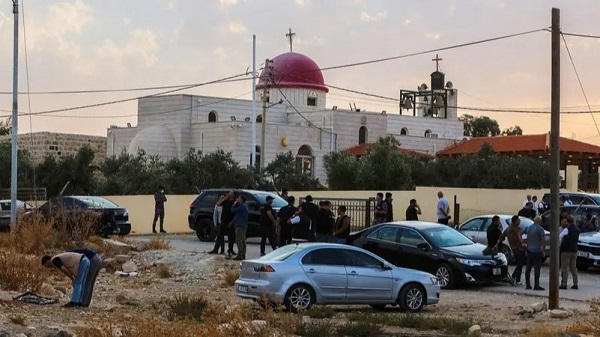
The shooting took place at a church in Hammoud, in the Karak governorate, about 180 kilometres south of Amman. The Public Security Directorate said the attackers arrived by vehicle, got out and fired during the funeral procession before fleeing. An eyewitness told local television that the gunfire continued for about five minutes.
Between 150 and 200 people were reportedly in or near the church when the shooting began. Many of those killed and injured were older adults, according to the witness, who said most were between 50 and 70 years old. Of the 34 wounded, 27 were still receiving medical treatment, Public Security Director Major General Abdullah Al-Maaytah said. Officials had not publicly identified the victims.
King Abdullah described the shooting as a terrorist attack and promised the “harshest retaliation.” In a statement posted on social media, he said Jordan would act against those who threatened the country. The king travelled to Karak later on Friday, state television reported.
Interior Minister Mazen al-Faraya said a group of extremists was responsible, but authorities had not publicly identified suspects or announced a motive. Investigators were working to determine whether the church or Christian community had been specifically targeted. No group had claimed responsibility in the immediate aftermath.
State television aired footage showing three gunmen approaching the church. Two appeared to carry pistols, while a third had a long gun. The men fired from near an entrance and moved toward the compound. The footage and eyewitness accounts offered a first glimpse of the attack, but did not establish what happened before or after the gunmen fled.
Government Communications Minister Mohammed Al-Momani said security forces were investigating and working to identify those responsible. The Interior Ministry described the incident as a terrorist attack, while authorities said further information would be released as the inquiry progressed.
The attack is rare in Jordan, a predominantly Sunni Muslim country where Christians make up a small minority. The Karak region has a longstanding Christian community, and the Greek Orthodox Church is among the country’s established Christian institutions. The archdiocese condemned the violence and rejected any attempt to use it to drive Christians from the region. If that was the assailants’ aim, the church said, the attack would instead strengthen the community’s determination to remain.
The archdiocese also stressed that the violence was alien to Jordan’s tradition of coexistence and moderate Islam. Its message echoed a broader concern among officials and religious leaders: that an attack on a place of worship could inflame sectarian divisions even in the absence of evidence that the perpetrators’ motive was sectarian.
Jordan’s government has repeatedly presented social and religious stability as central to the kingdom’s security. The country hosts communities of different faiths and has generally avoided the scale of militant violence seen in parts of the region. But the Karak area has experienced a deadly security incident before. In 2016, an attack in the governorate killed 10 people, including seven security personnel and a female tourist. Four militants were later killed after barricading themselves in Karak’s historic castle.
The 2016 violence prompted a major security response and remains a reference point in public memory. Friday’s shooting, however, unfolded in a markedly different setting: a funeral at a church, with mourners gathered in a place of worship. Its impact may extend beyond the immediate toll, particularly if investigators establish that the site or community was deliberately chosen.
The government’s rhetoric has been emphatic, with the king and senior ministers pledging a determined response. Yet officials have offered few details about the investigation, and key questions remain unanswered: the identities of the attackers, their possible affiliations, how they obtained their weapons, and whether others helped plan or facilitate the assault.
For now, security forces are searching for the gunmen while the wounded receive treatment and families await confirmation about those killed. Religious leaders have called for unity, and officials have promised to pursue those responsible. The investigation’s findings will determine whether the attack was part of a wider extremist plot or a targeted act—and whether the king’s vow of retaliation will be followed by arrests, prosecutions and additional security measures across the country.
