
Ahmed Kamel – Egypt Daily News
France and the United Kingdom have conducted their first joint airborne exercise simulating a nuclear strike, marking a new step in military coordination between the two European nuclear powers while leaving their national control over nuclear weapons unchanged.
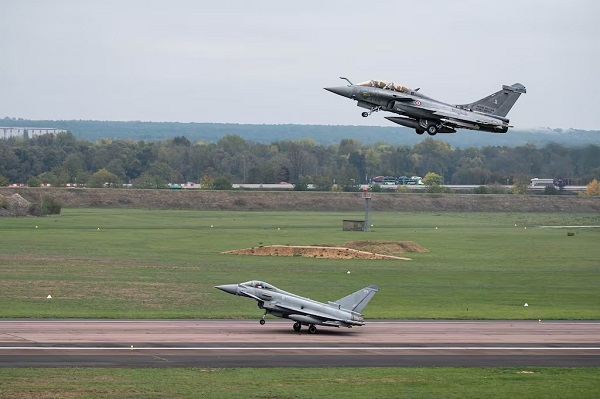
During Exercise Rummy, held over the Mediterranean on October 20 and 21, Royal Air Force Eurofighter Typhoons escorted French Rafale fighters on a simulated strike mission. The French aircraft took off from Saint-Dizier air base in northeastern France. French officials said the exercise involved no actual nuclear weapons.
The drill also included A330 MRTT tanker aircraft, which provide aerial refuelling. French Armed Forces Chief of Staff General Fabien Mandon said the joint crews demonstrated a high level of interoperability and an ability to coordinate. The French Armed Forces Ministry described the exercise as an important step in putting into practice the closer cooperation agreed by Paris and London last year.
The Northwood Declaration, signed in 2025, established a framework for deeper nuclear cooperation and coordination. It states that the countries’ nuclear forces remain independent while allowing them to work together in support of European security. The declaration also says that the two governments see no extreme threat to Europe that would not prompt a response from both countries.
The exercise gave that agreement a practical dimension. French strategic air forces have traditionally carried out their nuclear missions independently, and Rummy marked the first time British aircraft took part in a French airborne nuclear-strike exercise. A French defence analyst described the shift as a major change for forces that have operated autonomously since their creation in the 1960s.
The roles in the exercise reflected the different structure of the countries’ nuclear deterrents. France has both submarine-based nuclear forces and an airborne nuclear component: Rafale aircraft can carry nuclear-tipped cruise missiles. The United Kingdom’s independent nuclear deterrent is based on ballistic-missile submarines and does not include a comparable national airborne nuclear strike force.
In Rummy, the British Typhoons served as escorts for the French Rafales; they did not carry nuclear weapons. The exercise therefore demonstrated how British conventional aircraft could support a French nuclear mission without transferring control of French weapons or changing either country’s authority over their use.
French Armed Forces Minister Catherine Vautrin said that maintaining independent nuclear forces does not rule out coordination. She argued that cooperation could strengthen the contribution both countries make to the security of the alliance and stability across the Euro-Atlantic region.
The distinction between coordination and shared control is central to the arrangement. France and the UK retain separate arsenals, command structures and decision-making authority. The French ministry said either country would consider using nuclear weapons only in extreme circumstances of legitimate self-defence. Rummy did not establish a joint decision-making process, nor did it signal that the two governments had merged their nuclear doctrines.
The exercise comes as France seeks to broaden European involvement in its deterrence discussions amid concern over the continent’s security environment and the durability of US commitments to European defence. French President Emmanuel Macron has promoted the idea of “forward deterrence,” which envisages a wider discussion with European partners about how French nuclear forces could contribute to the security of the continent. The concept does not amount to placing France’s weapons under another country’s control.
For Britain, the exercise demonstrated a form of military cooperation that does not depend on the country possessing its own airborne nuclear force. Fighter escort and other conventional support can help an aircraft package operate together, while the nuclear mission itself remains under French command. The inclusion of aerial refuelling also highlighted the logistical coordination required for long-distance operations.
France regularly conducts simulated nuclear strike exercises known as Poker. Rummy’s significance lies not in the use of nuclear weapons, which were absent, but in the participation of British aircraft alongside French strategic forces. It showed that the two governments are moving beyond political statements toward practical cooperation between their armed forces.
The exercise also sends a deterrence message: France and the UK intend to coordinate more closely in responding to threats to Europe. But the limits are equally clear. Their nuclear forces remain sovereign and independent, and the decision to use them remains a national one.
