

Ahmed Kamel – Egypt Daily News
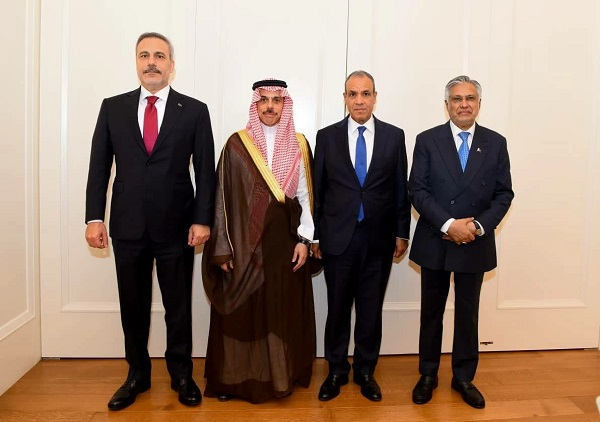
The foreign ministers of Egypt, Saudi Arabia, Türkiye and Pakistan used a meeting in New York to emphasize diplomatic coordination, defend Saudi Arabia against attacks and reaffirm support for Palestinian statehood.
The discussions took place on the sidelines of the 81st session of the United Nations General Assembly, as regional tensions continued to spread across the Middle East. The four ministers reviewed developments in the region and beyond, agreeing that sustained consultation between their governments was necessary to strengthen security, protect trade routes and support long-term stability.
The meeting brought together four countries with different political systems and strategic priorities but a shared interest in preventing a wider regional war. Egypt remains a central diplomatic actor in the Arab world, Saudi Arabia is a leading Gulf power, Türkiye has sought a greater role in regional mediation and Pakistan has increasingly positioned itself as an intermediary in disputes involving Iran and the United States.
In their joint message, the ministers said dialogue and diplomacy offered the only realistic route toward lasting solutions. They warned that military escalation was increasing pressure on civilians, threatening energy markets and placing international shipping at risk.
A central point of the meeting was the Islamabad Memorandum of Understanding, an agreement viewed by the four governments as an important instrument for reducing tensions between Washington and Tehran. The ministers called for all parties to respect their commitments and continue working toward a lasting and verifiable settlement.
The memorandum has particular importance for the Gulf states, which would face the immediate consequences of renewed fighting between Iran and the United States. Any escalation could affect oil exports, commercial shipping and the security of several countries that host foreign military forces. The ministers therefore emphasized that regional governments should be consulted in future negotiations and that their security concerns must be taken into account.
The officials also condemned attacks against Saudi Arabia, including recent strikes attributed to the Houthi movement in Yemen. They reaffirmed their support for Saudi sovereignty, territorial integrity and national security, while recognizing what they described as the Kingdom’s right to defend its territory and population under international law and the UN Charter.
Maritime security was another major concern. The ministers called for the protection of freedom of navigation and the safety of commercial vessels. The demand reflects wider anxiety over attacks on shipping in the Red Sea and nearby waterways, where disruptions have forced some vessels to take longer and more expensive routes.
The group’s statement also supported Yemen’s internationally recognized government and the Presidential Leadership Council. Rather than endorsing another military solution, the ministers called for an inclusive political process involving the country’s various factions.
They said Yemen’s conflict could be resolved only through dialogue among Yemenis and urged efforts aimed at restoring security, economic development and functioning state institutions. Their position reflects a broader regional effort to prevent Yemen from becoming a permanent arena for confrontation between Iran-aligned forces and Arab governments supported by the United States.
The Palestinian issue occupied another prominent place in the meeting. The ministers described it as central to peace and security in the Middle East and reaffirmed their support for the Palestinian people’s right to self-determination.
They called for the creation of an independent, sovereign, viable and geographically connected Palestinian state along the borders that existed before the June 1967 war. East Jerusalem, they said, should serve as the capital of that state. The ministers linked their position to relevant UN Security Council resolutions and presented the two-state solution as the foundation of a permanent settlement.
Their statement came as Gaza, the West Bank and East Jerusalem remained at the center of international concern. The four countries have consistently rejected attempts to separate the humanitarian crisis in Gaza from the broader political question of Palestinian statehood. They have also opposed displacement, permanent military control and changes to the demographic character of occupied territory.
The ministers additionally addressed the war in Sudan. They reaffirmed support for Sudan’s sovereignty, unity, independence and territorial integrity, while rejecting the formation of parallel governing structures that could divide the country.
Their position reflects concern that the conflict between Sudan’s army and the paramilitary Rapid Support Forces could lead to the fragmentation of the state. The ministers called for an end to the illegal flow of weapons, mercenaries and foreign fighters into Sudan, arguing that outside intervention was prolonging the conflict and worsening the humanitarian situation.
The meeting concluded with an agreement to maintain close coordination on regional and international developments. Although the ministers did not announce a new initiative or formal treaty, their joint position demonstrated an effort to create a common diplomatic front.
By speaking collectively, Egypt, Saudi Arabia, Türkiye and Pakistan sought to reinforce several messages: regional disputes must be addressed through negotiations, attacks on sovereign states must be condemned, maritime routes must remain open and the Palestinian question cannot be separated from wider Middle Eastern stability. Their continued cooperation could give the four governments greater influence in future discussions over Iran, Yemen, Gaza and Sudan.
