

Ahmed Kamel – Egypt Daily News
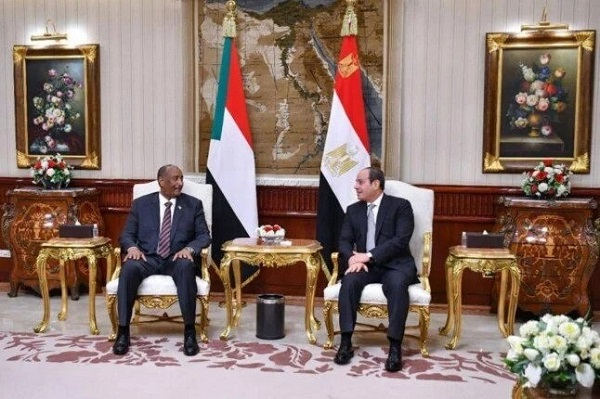
President Abdel Fattah El-Sisi has reaffirmed Cairo’s support for Sudan’s unity, sovereignty and territorial integrity during talks with Sudanese leader Abdel Fattah Al-Burhan in New Alamein.
The meeting took place on the sidelines of the African Union’s eighth Mid-Year Coordination Meeting, which brought together African leaders and representatives to discuss continental security, political cooperation and regional integration.
The discussions focused primarily on the war in Sudan and the worsening humanitarian crisis caused by the prolonged confrontation between the Sudanese Armed Forces and the Rapid Support Forces. Since the conflict began in April 2023, millions of Sudanese have been displaced, cities and essential infrastructure have been destroyed, and access to food, healthcare and other basic services has been severely disrupted.
According to the Egyptian presidency, President El-Sisi told Al-Burhan that Egypt’s position toward Sudan remained based on several principles: protecting the country’s unity, preserving its sovereignty, maintaining its territorial integrity and supporting the continuity of its national institutions.
Cairo has consistently rejected any political or military arrangement that could lead to Sudan’s fragmentation or create competing authorities across the country. Egyptian officials have also stressed that Sudan’s future should be determined by its people and through a political process that preserves the state and prevents further institutional collapse.
President El-Sisi said Egypt would continue working at both the regional and international levels to support a political settlement. The Egyptian president also called for efforts aimed at ending the fighting and reducing the suffering of civilians, with the longer-term objective of allowing Sudan to restore stability and begin reconstruction.
The meeting came as international attempts to secure a durable ceasefire in Sudan continued to face serious obstacles. Several mediation initiatives have been launched since the beginning of the war, but repeated truces have collapsed and the rival military camps have remained unwilling to accept a comprehensive political agreement.
The Sudanese conflict has created one of the world’s largest displacement crises. Millions of people have fled to neighboring countries, including Egypt, Chad, South Sudan and Ethiopia, while many others have been displaced within Sudan. The destruction of hospitals, schools, markets, roads and water systems has made civilian life increasingly difficult in areas affected by the fighting.
Al-Burhan expressed appreciation for Egypt’s political and humanitarian support. He praised Cairo’s position toward the Sudanese crisis and described the relationship between the two countries as rooted in historic and social ties between their peoples.
The Sudanese leader also thanked Egypt for hosting large numbers of Sudanese citizens who left their country because of the war. Egypt has received substantial numbers of Sudanese refugees and has provided access to essential services, although the continuing arrivals have placed pressure on housing, healthcare, education and local infrastructure.
A major point raised during the talks was the status of Sudan’s state institutions. Al-Burhan emphasized that internationally recognized government bodies should not be treated as equivalent to armed groups or parallel political entities.
The Sudanese military-led authorities have repeatedly argued that the Rapid Support Forces should not be considered a legitimate political counterpart while they continue to hold territory and operate outside the formal structure of the state. The RSF, however, has established its own administrative arrangements in areas under its control and has sought recognition as a political force capable of participating in negotiations over Sudan’s future.
Egypt has supported the principle that Sudan’s national institutions must be preserved. Cairo’s position reflects concerns that the creation of parallel administrations could institutionalize the country’s division, complicate humanitarian operations and make a future peace agreement more difficult to implement.
The issue is also significant for the wider region. Sudan borders seven countries and occupies a strategic position linking North Africa, the Horn of Africa and the Red Sea. Continued instability could increase cross-border arms trafficking, refugee movements and militant activity, while threatening trade routes and regional development projects.
For Egypt, the Sudanese conflict also has direct national-security implications. The two countries share a long border, historical ties and important economic interests. Stability in Sudan is therefore closely connected to Egypt’s concerns over border security, irregular migration, food supplies and developments along the Nile Basin.
Despite its close relations with the Sudanese army, Egypt has repeatedly said that it is seeking a political solution rather than an expansion of the conflict. Cairo has called for an end to hostilities, greater protection for civilians and a national dialogue that includes Sudanese political and social forces.
During the New Alamein meeting, President El-Sisi also expressed Egypt’s readiness to continue supporting Sudan in multiple fields. Cooperation could include humanitarian assistance, medical care, education, border coordination and efforts to restore basic services when security conditions permit.
The talks also addressed the broader bilateral relationship. Egypt and Sudan have traditionally maintained close links in trade, transport, agriculture, education and cultural exchange. The war has disrupted many of those connections, but both governments have expressed interest in preserving cooperation and preparing for reconstruction.
President El-Sisi said Egypt wanted to strengthen the frameworks governing relations between the two countries in a way that serves their shared interests and meets the aspirations of both populations. Such cooperation, however, will depend heavily on the establishment of security and the restoration of functioning state institutions in Sudan.
The meeting delivered a clear political message from Cairo: Egypt supports the Sudanese state, opposes the country’s division and wants negotiations to lead to an end to the war rather than a temporary pause in fighting.
For Sudan, Egypt remains one of its most important diplomatic and humanitarian partners. For Egypt, the conflict represents both a regional crisis and a matter of direct national security. The Sisi-Burhan discussions therefore underscored the importance Cairo places on preventing Sudan’s war from producing a permanent political split or triggering wider instability across the region.
