

Ahmed Kamel – Egypt Daily News
Masked Israeli settlers attacked vehicles carrying European diplomats in the occupied West Bank on Saturday and beat Bernard Baudoux, a 78-year-old French mayor visiting the village of Taybeh, witnesses and officials said. The assault took place during a particularly tense olive-harvest season, as Palestinians have faced repeated efforts to disrupt access to their groves.
The delegation included diplomats from France, Belgium and Poland, as well as Belgian consul general representatives. They had travelled to Taybeh, a predominantly Christian Palestinian village near Ramallah, to observe conditions during the harvest. Baudoux, mayor of Aulnoye-Aymeries in northern France, was accompanying the group.
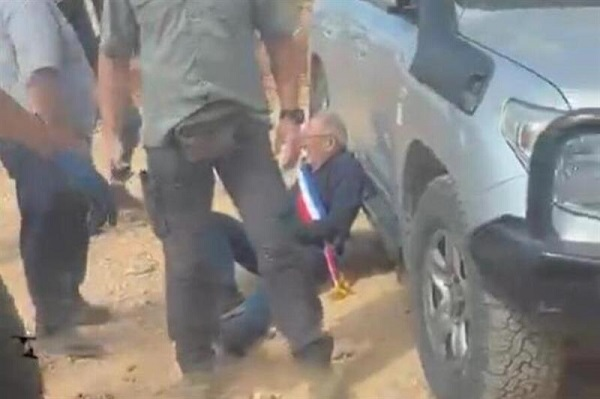
Witnesses said settlers arrived as Palestinians were gathering olives and tried to stop the work. Masked men confronted the visitors, made hostile remarks and damaged at least one diplomatic vehicle. Belgian officials said a window of a Belgian consular car was smashed. Video from the scene showed Baudoux, wearing a sash in the French tricolour, sitting on the ground beside a car after the attack.
Baudoux later said he had been kicked and struck with iron bars before being knocked down. He sustained minor injuries and did not require hospital treatment. The mayor said he had travelled to Taybeh with the French consul general and a priest from his home parish to sign a goodwill cooperation agreement with the town. He described the violence as gratuitous and said the residents who remain in the area are the ones most exposed to its consequences.
The attack drew condemnation from European officials. Belgium’s foreign minister, Maxime Prévot, said the assault had targeted Palestinians, Catholic representatives, diplomats and other officials. He called on Israel to protect people in the occupied territory and bring those responsible to justice, warning that violence against Palestinians, journalists and diplomatic visitors could not be allowed to go unanswered.
Israel’s Foreign Minister Gideon Sa’ar also condemned what he called severe violence by Israeli “rioters” in the Taybeh area. He said his ministry was in contact with the ambassadors of the countries involved. At the same time, he criticised the delegation for failing to coordinate the visit with the Israeli military, arguing that prior coordination might have helped protect the visitors.
The Israel Defense Forces said that no soldiers were present when the attack occurred and condemned the violence. Israeli police opened an investigation. Prime Minister Benjamin Netanyahu’s office urged caution, saying that images circulating online did not establish the complete sequence of events or the responsibility of particular individuals. It also alleged that reports of settler violence were part of a coordinated effort to discredit Israel and Jewish residents of the West Bank, which Israel refers to by the biblical name Judea and Samaria.
The assault came amid a wave of violence during the annual Palestinian olive harvest. The harvest is a major source of income for many Palestinian families and carries deep cultural significance. Farmers and local residents have reported attacks, threats and interference that prevent them from reaching their land or collecting their crops.
A day before the attack in Taybeh, settlers assaulted Heidi Levine, an American photographer working for The Washington Post, as she documented Palestinian farmers harvesting olives in another West Bank village. She was reported to have suffered broken vertebrae and was in moderate condition. Earlier in the month, AFP photographer Jaafar Ashtiyeh was also beaten while covering harvest tensions, sustaining fractured ribs.
The incidents have intensified criticism of Israeli authorities over the safety of Palestinians and journalists in the territory. Belgium called for an end to impunity for violent settlers, while Israeli opposition figures criticised the government’s response. Netanyahu’s office, by contrast, said the circumstances of the attacks remained under investigation and cautioned against drawing conclusions before investigators established what happened.
The violence is unfolding in a politically charged period, with Israel approaching an October 27 election. Netanyahu has sought support among right-wing voters, including constituencies sympathetic to settlements. His office’s comments about a supposed campaign against settlers came as critics argued that the government’s public response to the recent attacks risked diminishing the seriousness of the incidents.
Israel captured the West Bank in 1967. The territory is home to around three million Palestinians and approximately 500,000 Israeli settlers, according to estimates reported in recent coverage. Most countries consider Israeli settlements in occupied territory illegal under international law, a position Israel disputes.
For residents of Taybeh and surrounding villages, the immediate concern is whether they will be able to complete the harvest safely. For the diplomats, the attack has raised questions about the protection afforded to official visitors as well as the risks faced by Palestinians whose livelihoods depend on access to their land. The police investigation may identify those responsible for Saturday’s assault, but the broader question of accountability for recurring settler violence remains unresolved.
